Open source startup founder, technology leader, mission-driven investor, and engineer. I just want to help.

Subscribe to get updates via email.

benwerd

werd.social/@ben


Get Blogging!

Get Blogging! Your easy-to-use guide.

A lot of people ask me how to get started blogging. I figure a lot more are going to want to know how as the major social media sites start to fade. So I made you a guide!

Get Blogging! is your easy-to-use guide to starting to blog. It covers picking a platform (free, paid, or self-hosted) and reading what other people have to say. I expect to build on it over time. But for now: please give me feedback, and share it with anyone you think might want to start a blog!

· Posts · Share this post


Signed up for a service I'm excited about only to discover it was a false door marketing test and it doesn't actually exist yet. Womp womp.

· Statuses · Share this post


The end of Twitter

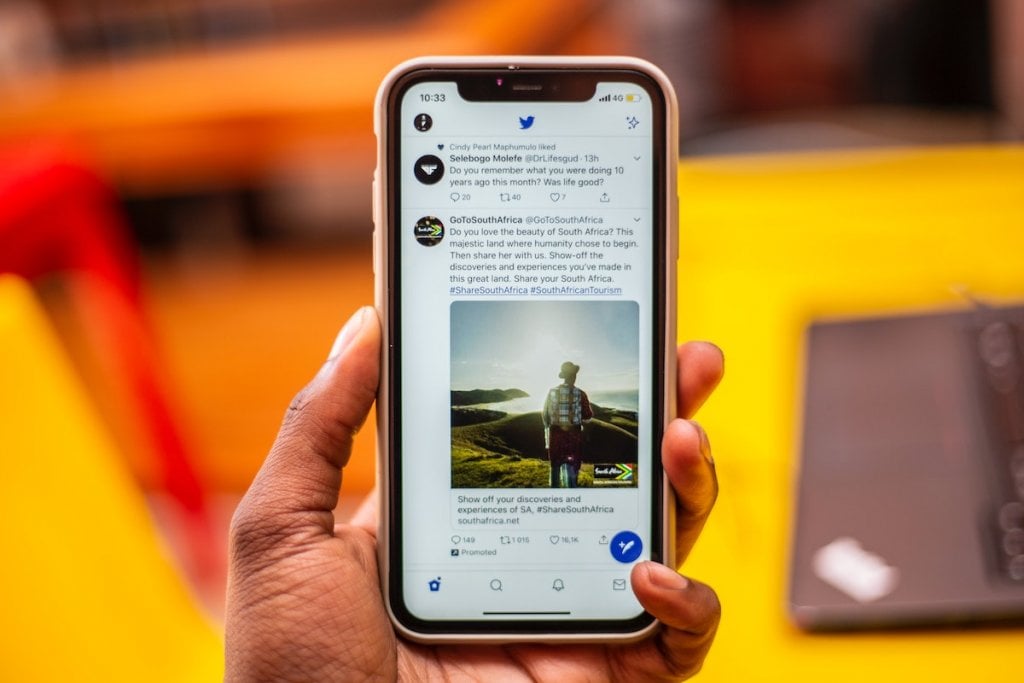
Illustration of a handheld cellphone showing the Twitter app.

Elon Musk needs to complete his acquisition of Twitter by October 28 if he wants to avoid the company’s lawsuit against him. That’s really soon - a week from today as I write this post.

The network has been a part of my life more or less since it launched. I’ve been hopelessly addicted since my Elgg days, back when you could post via SMS and hashtags were but an IRC-style gleam in Chris Messina’s eye. Unlike blogging, I don’t know if it’s done anything positive for my career, but it’s certainly informed my view of the world, both for better and worse.

For a few years, it was tradition that I’d go offline for the year at around Thanksgiving, to give myself some time to recover from the cognitive load of all those notifications. I don’t think the constant dopamine rush is in any way good for you, but the site’s function as a de facto town square has also helped me learn and grow. It’s a health hazard and an information firehose; a community and an attack vector for democracy. More than even Facebook, I think it’s defined the internet’s role in democratic society during the 21st century.

But all things must come to an end. Musk has suggested that he’ll reinstate Donald Trump’s account in time for the 2024 election and gut 75% of Twitter’s workforce, impacting user security and content moderation. It turns out, though, that even without Musk’s involvement, at least a quarter of the workforce would still face layoffs that the Washington Post reported would have “possibly crippled the service’s ability to combat misinformation, hate speech and spam”. There was no good way out. Twitter as we know it is sunsetting.

So where do we go next?

The answer is almost certainly not one single place. There’s certainly the indieweb and the fediverse, as well as newcomers like DeSo and the work Bluesky is doing. But those are all technical solutions to the problem of a missing platform; focusing there misses the point that what will really be missing is a community space. The answer to that is more community spaces, each with their own governance and interaction models. The solution will be an ecosystem of loosely-joined communities, not a single software platform or website - and certainly not a service run by a single company.

Facebook is also in decline. As big tech silos diminish in stature, the all-in-one town squares we’ve enjoyed on the internet are going to start to fade from view. In some ways, it’s akin to the decline of the broadcast television networks: whereas there used to be a handful of channels that entire nations tuned into together, we now enjoy content that’s fragmented over hundreds. The same will be true of our community hangouts and conversations. In the same way that broadcast television didn’t really capture the needs of the breadth of its audience but instead enjoyed its popularity because that’s what was there at the time, we’ll find that fragmented communities better fit the needs of the breadth of diverse society. It’s a natural evolution.

It’s also one that demands better community platforms. We’re still torn between 1994-era websites, 1996-era Internet forums, and 2002-era social networks, with some video sharing platforms in-between. We could use more innovation in this space: better spaces for different kinds of conversations (and particularly asynchronous ones), better applications of distributed identities, better ways to follow conversations across all the places we’re having them. This is a time for new ideas and experimentation.

As for the near-term future of Twitter? I’m pouring one out for it. I’m grateful for its own experimentation and for the backchannel it provided to everyday life. But let’s move on.


Photo by Daddy Mohlala on Unsplash

· Posts · Share this post


No, you can't pay me for a link

Every single day, I receive at least one email asking if I’ll accept cash for adding a link to someone’s website in an old post.

I won’t. Not ever. Please stop asking.

I can imagine a world where, if my website and newsletter became more of a full-time endeavor, I’d accept patronage. Daring Fireball and Pixel Envy are two personal blogs that have weekly sponsors; I don’t mind this at all as a reader. Maybe I’d consider that.

But if your goal is to juice Google’s algorithm by spammily adding links in authoritative old posts, the answer is always no. If you have to promote your site using these techniques, their quality is probably very low, and my site will suffer as a result of linking to them; the amount of money is also not worth me considering.

I’m not opposed to making money from my site. But if I do that, I want to do it in a way that’s above board, aligned with my community, and that is worthwhile for everyone involved. In the meantime, I’m just going to keep writing for me.

· Posts · Share this post


Pronouns

Over in Platformer, Casey Newton reports that MailChimp’s CEO Ben Chestnut left after writing an ill-advised email about sharing personal pronouns during onboarding:

“Now, everything is incredibly politicized,” he said in the email. “I am finding that peeps are no longer motivated by meaningful work – they are motivated to make political statements. They are using company time and company resources to win a game, against their opponents, in a game that is raging in their minds and on social media.”

Needless to say, I think he missed the point.

It’s not some kind of game, although it might feel that way to someone whose demographics and background mean he’s never had to feel the brunt of systemic injustices. What’s actually happening is that groups of people whose identities have been historically suppressed and oppressed are now feeling free to express who they are. In turn, they’re engaging in mutual support: declaring personal pronouns is a simple, courteous way of saying that you’re welcoming to diverse identities. This isn’t to win points; it’s part of creating a more supportive environment for everyone, as opposed to one designed around the narrow demographic of people who have dominated mainstream business and culture at the expense of everyone else for generations.

In the case of pronouns, the correct pronoun to use is not always obvious, and it’s always safer and more courteous to use self-reported pronouns than trying to guess. And it matters: in transgender youth in particular, acceptance of gender was correlated with one-third lower odds of a past-year suicide attempt. Giving people the space to declare theirs - and normalizing it across a community like a workplace or school - is a very low-effort way to protect the health and well-being of people who need it.

More generally, I’m fed up of people who consider “woke” to be some kind of fad or societal affliction. It’s a welcome, progressive change that simply means you’re awake to the injustices of the past and want to correct them in the future. It’s worth considering what kind of person would find that to be a bad thing.

For the record, my pronouns are he/him.

· Posts · Share this post


Unlocked new layers of a piece of writing I’m working on once I gave myself permission to have fun with it. I don’t need to be worthy; I just need to be true to me.

· Statuses · Share this post


It's nice to see all these climate tech venture funds, but I'm not at all convinced that our climate solutions should expect to see profit or shareholder value. I'm much more interested in seeing solutions for the ecosystem than for the markets.

· Statuses · Share this post


You’ve got this, Larry.

· Statuses · Share this post


You can directly track all of this chaos back to David Cameron.

· Statuses · Share this post


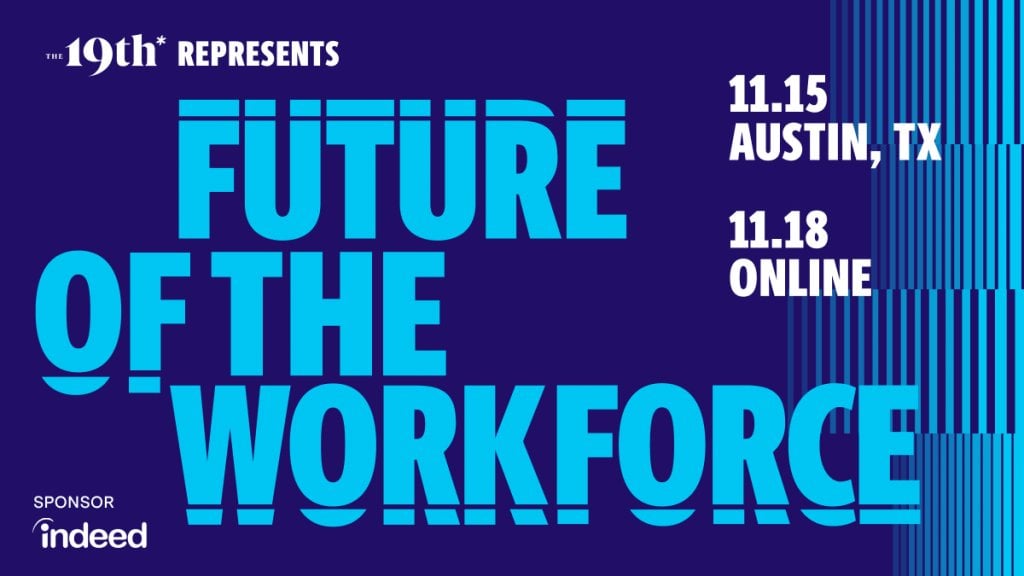
The Future of the Workforce - live in Austin

We’re hosting a conversation about the future of the workforce, in-person in Austin, Texas, and streaming online everywhere. It’s free to register and attend.

Here’s more about the event:

From the Great Resignation to the Great Reshuffle, our working lives have transformed during the pandemic — especially in terms of the economic and social dynamics. Some business sectors, as well as nonprofits and media organizations, have embraced change while others have fought against new policies.

COVID-19 has ushered in some new options, like flexible time off and hybrid work schedules. Remote work isn’t perfect for everyone, but it offers a reprieve for those who’ve felt alienated by inaccessible workspaces, where gender and racial microaggressions can proliferate.

Are the shifting norms of the last few years here to stay — or will large businesses continue to push for a return to pre-pandemic “normal?” How can business leaders balance economic growth and emerging technologies with the rights and needs of workers? The 19th is gathering business and policy leaders who think deeply about labor to discuss the future of the workforce.

Check out our speakers and sign up here.

· Posts · Share this post


I wish everyone would focus on making out-there, interesting content that an AI could never have written. If your marketing or your articles can be synthesized by a computer, perhaps that's a sign it's not very good?

· Statuses · Share this post


A reminder that if you're building an interface, it's probably best to use the same size of screen as your users. Don't build on a giant monitor and make downsizing an afterthought.

· Statuses · Share this post


My bookmarks process

I tend to get my links from three sources: my feed subscriptions, links I find on social media (particularly using Twitter Blue’s excellent “top articles from people you follow” feature), and stuff that people send me directly.

If I read something and find it particularly interesting, I’ll save it to a Notion database I’ve got set up. Mostly I do this because the Notion web clipper and iOS app makes life really easy for me.

Then the bookmarks get synced in a few different ways:

  • To my website using Micropub
  • To Buffer for scheduled sending to Twitter

The sync itself is via Zapier right now, but when I get time I’ll replace with my own script.

I used to post directly to Twitter, but I realized that there’s no need to post there at the same time I save to my site. Because I tend to read my feeds in batches, Buffer helps me avoid posting floods of links to my Twitter account at once. It also gives me a little wiggle room if something goes wrong (eg if the sync accidentally triggers when I’m halfway through writing a description).

At the end of the month, I take my links from the Notion database and use a simple script to turn them into a formatted post, which I edit in iA Writer before publishing to my site using its micropub feature.

The end result:

  • I have a searchable database of my bookmarks
  • I reliably share them to my website
  • I get to publish a round-up post at the end of the month, which is one of my favorite things

It sounds like a lot, but I really enjoy the process I’ve set up: it’s easy for me, and does everything I need it to.

· Posts · Share this post


The 19th annual community survey

We want to hear from you. Take our annual survey.

At The 19th, we’re running our annual community survey. If you’ve read a story on The 19th, or if you’re a woman or LGBTQ+ person, or are interested in policy and democracy news that affects women and LGBTQ+ people, we’d love to hear from you.

Complete our annual survey and you’ll be entered to win one of four $50 gift cards as a small token of our appreciation for your time.

It’ll take just a few minutes of your time. Get started here.

· Posts · Share this post


How the web reads fiction

Last week, I asked you about your fiction-reading habits as part of my research for a personal project I’m working on.

I also ran a separate survey on Google Surveys - getting in just before that service shuts down next month - to get a sense of what the average web visitor reads.

Although I expected this community to diverge from overall web visitors in key ways, I was surprised - but perhaps shouldn’t have been - by where it didn’t.

Here’s the biggest headline: traditional, paper books are still by far the best way for an author to reach even a technical audience. Most people across all audiences discover books via traditional bookstores, word of mouth, and the library - so if you’re limiting yourself to self-published ebooks, you’re missing out in a big way. More on that in a moment.

Blog readers like to read fiction far more than the average person.

First, some overall numbers:

The average American reads twelve books a year: a number that includes non-fiction titles. And only 59% of Americans read fiction books at all.

In contrast, over three quarters of you read more than ten fiction books a year; a sixth of you read more than fifty. This is fiction only: a subset of all the books you read. Although I didn’t connect this to demographic data or questions about what respondents read outside of fiction, I expect these stats hold up for the communities of most similar blogs.

No surprise: tech blog readers like science fiction. The world at large loves mystery and romance.

Everyone loves genre fiction - but which genres are sharply divergent.

This community is far and away most interested in science fiction and speculative fiction (1 in 4), with fantasy coming in at a close second (almost 1 in 5). 10% of folks said they read literary and historical fiction each, followed by mystery (and “cozy mystery”, which is a distinct sub-category). 3% of the community reads romance novels.

On the web as a whole, the numbers are very different. Almost 40% of respondents read mystery novels; 30% read romance; fantasy and horror are read by around a quarter of web visitors who filled in the survey. Only one in five web visitors read science fiction. Literary and historical fiction was in line with respondents from this community at 10% each.

Blog readers find their books offline.

About 20% of respondents from this community get their books through their local library - roughly the same percentage as the number who get them from Amazon. 15% get their books from traditional bookstores, and another 15% get them second hand. Other sources (including other stores, like Apple Books) came in at very small percentages.

A much higher percentage of the wider web gets their books via Amazon - around 40%. Only 10% of them get their books from a bookstore.

These latter statistics are closer to what I expected to see across the board, but blog readers are far more likely to go to independent bookstores, visit their local library, and borrow books from friends and family. So while this community is more technically-inclined, its book consumption is actually more offline than the general public.

We find our books through word of mouth.

Almost 40% of readers in this community preferred to learn about books through friends and family. Booktok doesn’t reach us: only 1% saw recommendations via TikTok. Social media, on the other hand, represented 25% (even if only 5% followed up on recommendations from blogs). 12% of respondents learned about books via Goodreads.

In both sets, around 12% got their recommendations from displays in physical bookstores. But whereas only 4% of this community said they learned through Amazon recommendations, 25% of general website visitors listed it as a main source. Only 6% of general website visitors learned about books from Goodreads.

Paper books still rule.

Finally, across both datasets, paper books rule supreme: 60% for the general public and for blog readers alike.

In both cases, about 20% read their books specifically on Amazon’s Kindle platform. About 10% “read” via an audiobook platform (mostly Audible, which is also owned by Amazon). And even among my open source forward community, only around 1% read using alternative ebook platforms.

I was genuinely surprised by this: I thought I’d see much higher ebook usage in my blog community. But it turns out that we all love the tangible look and feel of a book, and I strongly suspect that those of us who stare at a screen all day are more than happy to read on something else.

Reading between the lines:

This audience values books and the traditional book ecosystem. We like libraries and independent bookstores; we like the smell of a book. Anecdotally, I suspect we’re also suspicious of Amazon and of books that haven’t gone through a publisher’s vetting process. That also means it’s harder to get an independently-published book into our hands.

But libraries and independent bookstores are also more likely to carry and highlight books from small presses. These startup and independent publishers could be a really great way to reach readers with similar reading habits to those in this community. Of course, the big presses could be great too - but are potentially harder to get published by.

Based on this first set of quantitative results, my hypothesis is that it’s better to publish your book with a traditional press and then double down on both social media and independent bookstore promotion. That’s the marketing: I also believe that literary science fiction with a strong mystery component is the kind of fiction that would speak to this audience.

My next step is to double down on this hypothesis, identify my key assumptions, and go out and test them with some qualitative interviews.

More on that soon.


Photo by Seven Shooter on Unsplash

· Posts · Share this post


I have very little problem with fringe right-wing voices decamping to fringe right-wing networks. In fact, I’d argue it’s a near-perfect situation.

· Statuses · Share this post


The bare minimum I hope for in the wake of Truss’s spectacular failure is that future governments everywhere are warned off trying similar policies based on the same malformed ideology.

· Statuses · Share this post


Seems obvious that freeways will be self-drivable potentially decades before other roads. Self-driving is an upgrade to cruise control, not an upgrade to driving.

· Statuses · Share this post


The last six weeks have changed everything. My life has been redefined; I am animated by a new purpose.

I refer, of course, to somehow getting enough sleep, by any means necessary, and at all costs.

· Statuses · Share this post


Because I’m getting some reachout from here: I’m blissfully happy in my current position, I’m not investing, and my baby means I don’t have time for any side work. But please let me know if there’s any other way I can help you.

· Statuses · Share this post


Grateful to not have had any side effects from my covid booster or flu shot this week, and for the miraculous fact that these protections exist at all. Thank you, science; thank you, scientists.

· Statuses · Share this post


"Free speech" networks and anti-semitism

JP Morgan cancelled Kanye West’s bank accounts following his anti-semitic remarks today.

Over the last few years, a raft of “free speech” social networks have emerged as an alternative to the content policies enacted by companies like Twitter. They take very public anti “cancel culture” stances. But what does that really mean?

Using observer accounts, I took a peek at each of the main ones to see how this particular piece of news went down. Here I will issue a content warning: posts on these sites, including those run by mainstream political operators, are extremely disturbing.


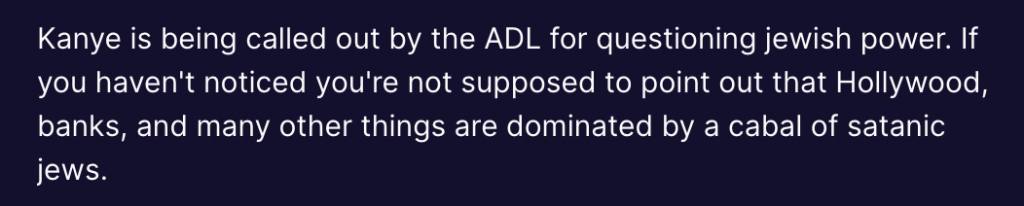
Truth Social is owned by the Trump Media and Technology Group, which in turn is chaired by former President Donald Trump. There, an account with over 50,000 followers (10% of its Daily Active Users) states:

Kanye is being called out by the ADL for questioning jewish power. If you haven't noticed you're not supposed to point out that Hollywood, banks, and many other things are dominated by a cabal of satanic jews.

Truth Social has around 2 million users.


Gab was founded in 2016 as the first right-wing alternative social network. The founder (who has 3.7 million followers) writes:

Kanye criticizes Jewish people and instantly gets banned from all social media platforms and banks. Funny how that keeps happening to people who do so.

In response to a post that asks "who runs JP Morgan Chase?" hundreds of users respond with some variation of "the Jews".

Gab has around 4 million users.


Minds was founded in 2011 and originally built on top of Elgg, the open source social networking framework I co-founded. While it was originally created as an alternative to surveillance capitalism, its anti-banning stance caused it to provide a home to white supremacists banned from mainstream networks in the wake of the January 6 insurrection. (Indeed, Trump had invited its founders to the White House alongside the founders of the networks listed above in 2019.)

Over there, a popular post states:

Jews in our government need to be pulled out by the root like weeds-there are reasons Hitlers first move as chancellor was to remove all Jews from parliament-he knew what they were and still are today-Communists!

Minds has over two million users.


GETTR is another conservative Twitter clone, this time founded by a former Trump aide. Here the anti-semitism is less overt, although a few comments from fringe accounts did talk about “the satanic Jews”, which was a trope on the other networks.

GETTR also has around 4 million users.


Parler, which also emerged during the Trump era, is hopelessly unusable. I couldn’t figure out how to search for content on it, when it even managed to log me in.

Parler claims to have a million users, but I don't know how.


It’s not a partisan statement to say that I find these comments to be utterly chilling both in terms of their content and their effective endorsement by large-scale backers that include the former President of the United States.

I’m also deeply unhappy with how my open source code was used to build Minds. I don’t believe its founders to be anti-semites, but I do think that tolerance of this kind of hatred is not anything approaching the virtue that they think it is. While these sorts of hateful ideas can certainly be countered by better ones, it’s also certainly true that alternative social networking sites have been used to plan undemocratic insurrections and hate crimes that led to real harm.

Mainstream social networks, particularly Facebook, are not off the hook here: banning anti-semitism does not absolve you of complicity in genocide elsewhere. Twitter also has its fair share of discoverable posts that espouse anti-semitic tropes. But these other networks are remarkable for their concentration: whereas these ideas are a tiny fringe on Facebook and Twitter, they’re how these other networks support themselves. You go to an alt network because you’ve been banned - or you’re worried you will be banned - from a traditional one. This concentration of extremists is why much of the insurrection was able to be openly organized on networks like Gab.

The Southern Poverty Law Center noted as such in its The Year in Hate & Extremism Report 2021:

Hate groups and other extremists do not solely rely on mainstream social media platforms to spread their message — they are increasingly using “alt-tech” platforms that are often advertised as “free speech” alternatives to places like Twitter and Facebook. On these platforms, users don’t have to worry about content moderation. These include video platforms like Bitchute and Odysee and social media sites like Gab.

And there does seem to be a growing, violent movement lurking here. Incidents of antisemitism in America hit an all-time high in 2021. I’m certain that this is in no small part because overtly racist town squares have become easier than ever to be a part of. These networks have millions of users, are growing, encourage real hate crime, and have ringing endorsements from people who have held the highest office in the land. We overlook them as sideshows at our peril.

· Posts · Share this post


My baby smiling in recognition when I go to say hello is the best part of each and every day.

· Statuses · Share this post


This is a great time to build something from scratch. But if you're building, do it right: by distributing equity to your community, building with ethics and empathy, and doing it to build value for everyone for a long time.

· Statuses · Share this post


How do you read fiction?

For a new project, I’d love to understand how you read fiction. In particular, I’d love to know what your favorite topics are, which books you particularly love, and how you discover new books to read.

So I put together a short, anonymous survey. It shouldn’t take more than a few minutes to fill out, and it would really help me. All questions are completely optional, and it would be useful to me even if you just filled out one.

I’ll follow up with results in a future post. Thank you!

· Posts · Share this post

Email me: ben@werd.io

Signal me: benwerd.01

Werd I/O © Ben Werdmuller. The text (without images) of this site is licensed under CC BY-NC-SA 4.0.