 

Community is the most important part of open source (and most people get it wrong)

This post by Bill Mills about power and communication in open source is great:

Being belittled and threatened and told to shut up as a matter of course when growing up is the experience of many; and it does not correlate to programming ability at all. It is not enough to simply not be overtly rude to contributors; the tone was set by someone else long before your first commit. What are we losing by hearing only the brash?

Bottom line: if you, either as a maintainer or as a community, are telling people to shut up then you're not open at all.

If you make opaque demands of people to test their legitimacy before participating then you're not open at all.

If you require that only certain kinds of people participate then you're not open at all.

The potential of open source is, much like the web, that anyone can participate. On Known, we're really keen to embrace not just developers, but designers, writers, QA testers - anyone who wants to chip in and create great software with us. That's not going to happen if we're unfriendly or project the vibe that only certain kinds of people can play. Donating time and resources on an open project is a very generous act, that not everyone can participate in. Frankly, as a community we should be grateful that anyone wants to take part.

As a project founder, a lot of that is about leading by example. That means being talkative and open. I get a lot of direct messages and emails from people, and I try and direct people to participate in the IRC channel and the mailing list - not just because it allows our conversations to be findable if people in the future have similar questions, but because every single message adds to the positive feedback loop. If there's public conversation going on, and it's friendly, then hopefully more people will feel comfortable taking part in it.

Like any positive communication, a lot of this is related to empathy. I'm pretty shy: what would make me feel welcome to participate in a community? Probably not abrupt messages, terse technical corrections or (as we see in many communities) name-calling. Further to that, explicitly marking the community as a safe space is important. We're one of the few communities to have an anti-harassment policy; I'm pleased to say that we've never had to invoke it. More communities should do this.

Which isn't to say that there isn't more that we can do. There is: we need better documentation, better user discussion spaces, a better showcase for people to show off what they've built on top of Known. We're working on it, but let us know what you think.

And please! Whether you're a writer, designer, illustrator, eager user, or a developer, we'd love for you to get involved.

· Posts · Share this post


10 things to consider about the future of web applications

  1. Twitter - by far the social network that I use the most - is struggling to break 300 million monthly active users and is not hitting revenue targets. (Contrast with Facebook's 1.44 billion monthly actives.) Even investor Chris Sacca has warned that he's going to start making "suggestions".
  2. Instagram - still a newcomer in many peoples' eyes - is beginning to send re-engagement emails in response to flagging user growth.
  3. The 2016 US election is apparently going to be huge on Snapchat. Translation: Snapchat is over. The next generation of young users are already looking for something else. Snapchat was released in September 2011.
  4. The Document Object Model - core to how web pages are manipulated inside the browser - is slow, and may never catch up to native apps. We've known that responsiveness matters for engagement for over a decade.
  5. It's possible to build more responsive web apps by going around the DOM. But these JavaScript-based web apps are harder to parse and often can't be seen by search engines (unless you provide a fallback, which requires a lot of extra programming time).
  6. Push notifications - which are core to apps like Snapchat, and possibly the future of Internet applications - are not available on the open web. Browsers like Chrome are implementing them on a browser-by-browser basis.
  7. Facebook has no HTML fallbacks, renders almost entirely in JavaScript and lives off push notifications. Twitter has HTML fallbacks, is very standards-based, uses push notifications but also SMS and email, and is generally a good player (with respect to the web, at least, although it's less good at important features like abuse management). Facebook is kicking Twitter's ass.
  8. The thing that may save Twitter? Periscope, a native live video app, which is highly responsive and live-video-heavy.
  9. Users have stopped paying for apps, and instead opt for free apps that have in-app purchases, so they can try before they buy. We're a long way off having a payments standard for the web.
  10. There's no way to transcode video in a web browser, which means uploading video via the web is effectively impossible on most mobile connections. (Who wants to sit and wait for a 1GB file to upload, even on an LTE connection?) Meanwhile, the web audio API saves WAV files, rather than some other, more highly-compressed formats you may have heard of. Similarly, resampling images is difficult. In other words, while the web has been optimized for consumption (albeit in a slower way than native apps, as we've seen), it has a long way to go when it comes to letting people produce content, particularly from mobile devices.

What does all of this mean?

I don't mean to be pessimistic, but I think it's important to understand where users are at. The people making the web aren't always the people using it, and there's a serious danger that we find ourselves trying to remake the platform we all enjoyed when we first discovered it.

Instead, we need to make something new, and understand that if we're building applications to serve people, the experience is more important to our users than our principles.

All of these things can be solved. But while we're solving them at length, native app developers are going off and building experiences that may become the future of the Internet.

· Posts · Share this post


Remembrance on Memorial Day

Memorial Day is an American holiday that commemerates people who have lost their lives in service to the United States. It's similar to Remembrance Day in the commonwealth countries, except that it's also a long weekend that marks the start of the summer.

My dad spent the first few years of his life in a Japanese-run internment camp, while my grandfather was captured by the Nazis and had to deny his Jewishness to stay alive. My great grandfather's family fled pogroms in Ukraine. I'm a pacifist, and war is evil, but I also believe it is sometimes necessary as a last resort.

But in remembering the brave people who fought and died, it's also important to remember who sent them, and why. Many people died in Iraq for shameful political reasons. Many people died in Afghanistan. Vietnam. Patriotism can't just be about remembering their sacrifice: it has to also be about trying to make sure it never happens again, whether we consider war to be just or not. One life lost is too many. There are still war criminals involved in some of those wars who need to see justice. There are still politicians who make joining the armed services and dying for their country the only viable career choice for many people.

I also want to remember, as Marc has in his own post, the people who are fighting for freedom domenstically. People have lost their lives for civil rights, for equality, for better working conditions for immigrants, for the right to form a union, for the right to vote. In contrast to resource skirmishes for policial purposes, their sacrifices have changed our societies for the better in tangible ways. They should never be forgotten.

· Posts · Share this post


A walk in the park

"Daddy," Wendy said, looking up at the sky, the cloudless blue stretching opaquely in all directions. "Can people fly?"

I smiled at her. "They say that some people can," I said.

"Can I fly?"

I shook my head, smiling. "No, honey," I said, gently. "Mommy and daddy can't fly either."

"Why not?"

"Well, for one thing, being on the ground's just fine," I said, patting the grass in the park. "It's nice down here."

And for another, I thought, I can't afford that upgrade.

I can't be completely certain on which day I died, but I'm pretty sure it was the Wednesday before Thanksgiving: the first real cold day in months, when the wind picked up and remembered it was fall, and the auburn of the leaves finally overwhelmed the green. Wendy was with her grandparents, and I just thought, well, why the hell not?

I was the last on my block to die. None of us knew it yet, of course. If anything, we were excited for it and what it meant: the Mayor had been the first to go all the way, and he came back from the store telling us about all the new colors he was seeing. A more vivid spectrum, he said; he could see the life-force in everything around him, from the squirrels in the trees to the trees themselves. He said it was magical. He used that word: magical.

Pretty soon, everyone was doing it. The police all did it as a group, before the police disbanded, and then the local businesspeople in town started to die one by one, and then the rich part of town, and then our neighbors. Finally, when it seemed like everyone else had gone and done it and I was overwhelmed with fear that I was missing out on something vital, I went and did it, too.

Wendy was the last living girl I knew.

When Samantha died, she was gone, and it felt like there was a hole in my heart that was torn fresh each morning and could never heal. I clawed at the walls wishing time would peel back with the wallpaper, and found ways to smile for our daughter even as I wanted to rip myself apart. When she slept, mercifully in her own room because she was a big girl now, I retired to our bed and wept. Were it not for the life that was entrusted to me, my precious girl, I would have simply found my way to the bridge and stepped into nothingness.

Death isn't what it used to be. When I died, I saw new colors in the trees, my metabolism was automatically managed for me by an intelligent software agent, and I gained the ability to manage my emotions from an elegant control panel on my wrist. My memories were organized. For the first time in my existence, I felt fully in control. It was magical.

When I first stepped out of the store, having paid the staff to configure me, I was struck by the silence in my head. The pain of Samantha's legacy death was gone, along with the background ebb and flow of dread that had been my soundtrack. Samantha's face was not staring at me from my mind's eye, as it had done every day for the past four years. I had no desire to whisper her name and call out to her. I had no desire at all.

Instead, I saw information. My mind had become a dashboard, and everything in the world was a point of data. I felt free, and suddenly the world seemed full of possibilities. They had worked hard on designing that first emotion: it was spectacular. The app told me I was empowered.

Wendy and I held hands as we walked through the park. The glow of the energy in the trees rivaled the sunshine. She sang to herself, softly, and my controller app told me it was an old Sandie Shaw tune. It suggested I sing a few bars along with her to build empathy, and I complied.

"Wow, that's a real old song," I said. "Where did you learn that?"

"It's from a commercial," Wendy said, matter-of-factly.

The controller told me which one and played a few seconds for me, and I smiled.

"Do you want to go get a burger?" I asked, sensing that she was hungry.

"How did you know it was from that commercial?" Wendy said, smiling. She nodded.

The burger joint was on the edge of the park; we crossed a tall bridge to get there, and paused briefly to play pooh sticks. We stood at the top of the bridge and each dropped a stick into the water. The winner would be the stick that the current passed through first; like always, I engineered my throw so that it would be Wendy's, and like always, she was delighted. One day she would tire of this game and I would have to find new ways to entertain her. Luckily, I had access to a vast database of games.

It was a traditional sort of place, not unlike the kind my dad had taken me to when I was Wendy's age. Everything was primary-colored, and the tables were wipe-clean. Booths lined with glittered cushioning sat against the walls, while the floor was dotted with circular tables. Once, almost every table would have been occupied with families like ours. These days, almost nobody needed food, so the loop of soft, upbeat music played to an empty room. I already knew what Wendy wanted, and my app communicated this to the kitchen wordlessly; we simply took a booth, and a drone waiter flew out the food once it was ready.

"How's your hamburger?" I asked, knowing the answer was written on her smiling face. The hamburger meat was made with insect meal, but that was all that Wendy had ever known, and anyway, they found plenty of ways to make it just as juicy and delicious as the beef I had enjoyed as a child. I felt her emotions as if they were my emotions and knew that it was good.

"Don't you want to eat anything?" she asked between mouthfuls.

"I'll eat later," I said.

I sighed happily, although my oxygen is processed for me and I no longer use my lungs. "What next, pumpkin?"

"I haven't finished my fries yet," Wendy pointed out, and although I knew she didn't really need them nutritionally, I saw that they would have an emotional benefit. "Once I've finished my french fries, let's go home," she said.

"Sounds like a plan," I said, smiling. The app suggested I look out the window, and I took in the amber light of the dimming sun.

The app strongly suggested I step outside. "I'll be right back, okay, honey?"

"Okay, daddy."

I slid myself out from the booth seat and walked through the swing doors to the street outside. The controller app gave me directions and I turned to follow them exactly, suddenly aware that my energy levels were running low. My pace increasing, I walked around to the rear of the restaurant and scanned the backlot.

There was an old Ford Fusion parked against the dumpsters, and I could see a man rummaging around inside them, his torso fully submerged in trash.

"Excuse me," I said, understanding why I was here.

With the advent of the controller apps, there was no need for a police force: everyone became the eyes and arms of the law. When it was introduced halfway through a lavish keynote presentation, crowdsourced enforcement was hailed by the press as the future of policing. They took great pains to point out that it was not the same as vigilante justice: the apps were highly-regulated, and everything app users saw and heard was recorded for later algorithmic judicial compliance. Anyway, using the app to begin with enforced compliance with social norms; virtually everyone had it installed, so it was rare that policing was even required. Staying on the straight and narrow felt good. The app made sure of it.

The man kept rummaging.

"Excuse me," I said again.

The man pulled himself out of the dumpster and turned to look at me. He was wearing a flannel shirt, and had an unsanitary beard. He'd managed to pull out some discarded food: leaves of lettuce, a few packages of insect meal.

"That food is the property of this restaurant," I said. "You really can't take it."

"They're just throwing it out, dude," the man said.

"It's theft," I said. "If you're hungry, there are ways to get credit so you can buy your own food."

"It's wasteful," the man said.

"It's their property," I said.

He sighed. "Fucking users," he said, under his breath.

"Pardon me?"

"Fucking users," he said again, loudly and deliberately.

He turned to run, but naturally, my reaction time was faster. I caught up to him before he managed to get up to speed without needing to increase my heart rate, and forced his arm behind his back.

He yelled in pain. "I've got kids, man."

"You need to respect the rules of your community," I said. "Your children don't outweigh the rights of this restaurant to their property."

My body sent me a notification. I was critically low on energy; I needed to recharge quickly, or I would shut down.

"Put the property down," I said. "Now."

"Fuck you," the man said, spitting. "I need to feed my family."

Another notification. I would be down soon. "You should put down the food," I said, holding the arm lock. Behind the scenes, the app sent a request to the cloud controller.

Request approved. Unthinkingly, I let go of the man's arm, and put both hands around his head. For a moment, he screamed out in fear, but the app downloaded quickly, and he fell limp. For thirty seconds, we stood in the backlot together, me cradling his head, distant birdsong the only sound. Silently, a spot of light on my wrist pulsed to the rhythm of my long-discarded heartbeat.

Fully charged; needs met. With a single movement, I picked up the carcass and threw it in the dumpster.

Wendy had finished her burger and fries, and was patiently watching for me through the window. She waved at me through the glass as I approached, and flashed me a toothy grin as I sat back down opposite her. "That was delicious," she said, smiling. "Are we ready to go home?"

I smiled at my daughter, the only living child in town. "Absolutely."

We lived in a small, suburban house with a driveway in front and a small yard in the back, similar to around 60% of our town's population. It was a little too big for just two of us, but moving would have been one stressful experience too many for Wendy, so we stayed. The remnants of Samantha's presence no longer bothered me, and Wendy had been too young. For her, they were a curiosity.

Much of the bandwidth for the National Internet had been dedicated to controller apps; almost nobody strolled the web or talked to each other over immersive video, because they didn't need to. We were all a mesh now, united by our controllers and tethered to the cloud. But I had Wendy, so I continued to purchase Internet service so she could tap into the movies. We would often sit on the couch together until she fell asleep, a blanket covering us both, like we had always done. I could sense that it was comforting to her, and it was a pattern that I found pleasant, too. I don't know if what I felt was real closeness, or a well-designed authentic emotional experience. They are materially the same, so I don't believe it matters.

There we lie, father and daughter, as the movie runs to its credits. She dreams of adventures and new experiences, and I watch the electrons dance inside her brain. And then I carry her up to her bed, ready for another day, my hands cradling her head just a little. She is beneficial.

· Posts · Share this post


Publish on your Own Site, Reflect Inwardly

Known gives you the ability to share the content you create across social media platforms at the point of publishing, with just one click. I'm deliberately not doing that with this post.

If you're reading it, it's because you came to my site, or you picked up the content in a feed reader.

One reason to publish on the web is to make a name for yourself, and create an audience for your content or services. But that's not the only reason, or even the best one. I think structured self-reflection is more valuable - with or without feedback.

We've been trained to worry about audience and analytics for our posts. How many people read a piece about X vs a piece about Y? Is it better to post at 2pm on a Thursday or 10pm on a Sunday? Which demographic segments are most interested?

That's fine and dandy if you're a brand, but not all of us need to be brands. Not every piece of content needs to be a performance. If we unduly worry about audience, we run the risk of diluting our work in order to appeal to a perceived segment. Sometimes the audience is you, and that's enough.

The dopamine hit that comes from a retweet or a favorite creates a kind of awkward emotional dependence. A need for audience. There's a lot to be said for slow reflection for its own sake. That's what we encourage when we give blogs to students, and that's probably what we should be practicing more of ourselves.

And of course, I'm speaking for myself. I've decided I need to ease back on social media interactions, and start using my own space as just that: my own space. My own space to reflect, to think out loud, and to publish because I want to. That's how we used to do it on the web. As I've said before: I think the world would be better if we revealed more of ourselves.

· Posts · Share this post


Elgg and Known: how deep insight can help you build a better community platform

Ten years ago last November, we released the first version of Elgg. An open source social networking platform originally designed for higher education, where it was used by Harvard and Stanford, it spread to organizations like Oxfam, Orange, Hill & Knowlton and the World Bank, as well as national governments in countries like Australia, Canada and the Netherlands.

Not bad for a couple of industry outsiders based in Scotland.

Elgg is still in wide use today. I credit that to a technical emphasis on extensibility and ease of use, as well as our focus on being responsive to the needs of the community - but not too responsive. We never veered from the vision we had of an open social networking infrastructure for organizations.

The web has changed unrecognizably since 2004, and Known takes those changes into account: mobile-first, with an emphasis on streams and shorter bursts of content. You can still run it in an organization, but you can run it as a personal platform, too. Higher education institutions are using it to give self-reflective websites to all their students, and more and more private companies are using it to create social feeds internally, too. Design thinking is core to our process, which helps us stay responsive and build tools that truly solve a deep user need.

Known, Inc goes beyond Known the platform: we're exploring new applications that use design thinking, and our deep community platform knowledge, to solve problems in different verticals.

Most importantly, we offer that experience and toolset to other organizations. If you need platform strategy advice, or even to build a new social website or app for your organization, we can help. We have over a decade of experience in building organizational social platforms, and you can put it to work. To get started, get in touch via our website.

· Posts · Share this post


The full-stack employer

Just over four years since I permanently moved to California, I'm beginning to understand the differences in work style between the US and Europe. America still has a largely time-based view of productivity, even in Silicon Valley. But with tech industries in other nations catching up fast, and remote working becoming a more viable option, you need to compete for talent with companies all over the world. You have to be a full-stack employer.

What is a full-stack employer?

Over the past year in particular, there's been a lot of discussion about "full-stack employees", "full-stack developers" and "full-stack startups". The trend is that employees are expected to have a broader range of skills, and be able to switch between them seamlessly. Employees apply their skills in a more holistic manner, moving away from a dedicated position on an assembly line.

This is arguably related to startup culture, and the growing trend for even larger companies to innovate by creating much smaller, more autonomous internal product teams. It has worked for a number of corporations. But the full-stack expectation places greater demands on employees, which must be met by the employer. Simply put, to innovate, you need support.

I'm shamelessly repurposing the term "full-stack" to mean not just the technology you use to build your products and services, not just the skills you are expected to use in the course of doing business, but also the support mechanisms that humans need in the course of doing their job. A full-stack employer is one that sees their employees as a community of people, and that provides structures, support networks and services for them based on that understanding.

The good news is, treating the people who work for you as human beings has a real effect on productivity, sales and the health of a company.

What it's like to have a full-stack employer

The new reality is that you are expected to use a variety of skills in the course of doing your job. But those skills didn't just come to you, fully-formed. Nobody puts on a headset, Matrix-style, and emerges minutes later knowing kung fu: mastering a new skill requires time, effort and investment. Full-stack employers recognize that providing dedicated training and professional development for their employees creates a measurable return on investment. You're expected to join the company with intelligence, an enthusiasm for learning, and skills that relate to your core role - but the reality is that even those will develop as you continue at your company. Importantly, it's needs-led: as an employee, you can tailor your professional development based on your needs. Training isn't dropped on you from above.

You are not expected to be always-on. Phone calls at 3am, Slack messages late at night, urgent emails that need to be responded to out of hours are not on the table. It comes down to respect: the employer understands that you have your own life, and that your choice to work for a company is a relationship that goes both ways.

The ethics of this are clear, but it turns out that workers are more productive when they are rested and take more breaks. The same is true during working hours. Employees are trusted to do their work, and aren't measured in terms of the amount of time they spend at their desks. In fact, research suggests that they should build some break-time into every hour, and they may be encouraged to do this. Similarly, they may be encouraged to take a full hour for lunch, perhaps with a walk. And they're encouraged to go home after eight hours. It all results in happier, healthier employees, and more productivity.

Employees have some choice over their benefits, but they always have full medical coverage in countries where this isn't a given. Childcare is paid for (because the employer saves money by making it available).

Generous parental leave is provided, for both mothers and fathers, engineered in such a way that both parents take it more or less equally. Studies have shown that equal paternity leave helps to prevent against pay discrimination, and provides happiness (and therefore productivity) boosts across both parents. The company becomes a better place for women to work, allowing it to remain competitive.

Finally, the aspect that may make American managers shake their heads with disbelief. Every employee gets a minimum of six weeks of vacation time a year, and they are strongly incentivized to use it. In order to combat a culture of working all the time, full-stack employers may create a financial bonus for employees that go on holiday, knowing that vacations dramatically increase productivity. Happier workers are more productive.

Why it's great to be a full-stack employer

While it sounds expensive, full-stack employers actually save money. Happier employees are measurably more productive, and arguably more creative, leading to more innovative solutions. These measure also reduce churn, which is important when the cost of employee turnover can be as much as twice their salary.

Providing a better place to work can be a differentiator, which can help companies compete for employees in a cost-effective way. By way of example, I was once offered a position at a very well-known Silicon Valley web company; one whose services people use every day. The salary was great, and it would have looked good on my resumé. At the end of our meeting, the interviewer remarked to me, "you do end up spending a lot of time at work, but it's okay, because your colleagues become like your family." I refused the job, and started noticing when employees posted Instagram photos of their office on Saturdays and after midnight.

Optimizing the workplace for people who have lives outside of work allows for more experienced employees (who are more likely to have families), and people who have outside hobbies and interests. All of these things provide more bang for your salary buck as an employer - as well as creating a far more enjoyable place to work.

What does this mean for employees and managers?

Although some of the benefits sound costly, most of them actually save the company money over time. The biggest adjustment it requires is an attitude shift.

I would argue that the American reliance on time-at-desk as a productivity metric is an ideological, rather than fact-based, approach. German workers, for example, are at least as productive as their US counterparts, while enjoying six week vacations, more regular working hours, and so on.

Therefore, the biggest required change is for managers to respect the time of the people on their teams, and to create conditions where employees don't feel guilty for stepping away from their desks, putting their phones down, and spending regular, quality time away from work. In fact, they should feel empowered to do so, because they will be better workers as a result. The same goes for asking for professional development resources, and expecting fair compensation in both monetary and benefit terms.

It's a seismic shift for a country so deeply involved in the Protestant work ethic.

What of the future of work?

Ubiquitous mobile Internet was supposed to give us more freedom and allow us to live more fulfilling lives. It has not necessarily lived up to this potential.

Just because an employer can contact an employee at midnight on a Thursday night, does not mean that we should do so. We have gained all kinds of new, amazing tools to help us be productive and create more innovative companies. Now it's time to learn to do so responsibly.

After the industrial revolution, Henry Ford and others learned that five-day weeks and eight-hour days allow us to be more productive. After the information revolution, it seems we now have to relearn these lessons.

· Posts · Share this post


Convoy is a new kind of progressive enhancement for self-hosted web applications.

We just released Convoy, an add-on service for Known that lets you use our servers to more easily share content with social media.

Previously, self-hosted site owners needed to create individual developer accounts on Twitter, Facebook, LinkedIn, etc, and manage API integrations with each one. It was a pain, and lots of people told us that they'd prefer to avoid it.

You still can mess around with API integrations if you really want to. But Convoy gives you another option: connect your site, and then log into each service as easily as you would with any centralized cloud application. You still own all your data on your own server, but we handle the fiddly technical bits.

Service integrations aren't the only things that add value to a self-hosted site. Typically, shared hosts aren't good at search: there's no great dynamic search engine in the LAMP stack, and we get lots of complaints about MySQL's build-in full-text search. So we're looking at how we can add this to Convoy, too. The same goes for notifications and a host of other services that can help your self-hosted site use all the great new web technologies that the centralized services do.

I think of this as progressive enhancement: your site will still work without them, and you still store all your data. These services serve to add to the user experience without taking away any of your agency.

We're not removing functionality from the open source codebase: you can self-host everything if you have the technical ability. But if you'd prefer not to, Convoy is here for you.

And of course, it needn't be limited to Known at all ...

You can learn more about self-hosted Known on our open source site, or get started with our free hosted service.

· Posts · Share this post


Forget the mass market: the untribe is the new normal.

There was one conversation I used to hate more than any other. I used to brace myself for it; grit my teeth in anticipation.

Here's how it would happen.

"Where are you from?" someone would ask, detecting that my accent wasn't quite British; something else was lurking just underneath.

"That's a long story," I would start to say, hoping to leave it at that and turn to some other, more interesting topic. But once someone has the scent that you're not a part of the tribe, that perhaps you don't belong, they never let it go. So I would explain. "My mother's Ukrainian / American, my dad's Dutch / Swiss / Indonesian, I grew up here, and -"

"Oh," they would say, stopping me. "You could become a British citizen, you know."

Then I would have to nod and smile, and perhaps bumble something along the lines of, "oh, well, yes, I suppose I could, now that you mention it, that's a rather good idea ..." Hugh Grant style, a polite stream of bashfulness that stood in for the lies, "nobody has ever suggested this before" and "clearly that's exactly what I need to do".

The implication was: "you could do this one thing and then you would belong!" It was as if being a part of the tribe would elevate me, somehow. The implication was that having the right sort of passport would make me the right sort of person, and I despised it.

There was exactly one time, every five years or so, when I ever wished I had been a British citizen. Although I could vote in local elections, I wasn't able to take part in the general elections that would help pick who would run the country. I couldn't help select a Prime Minister, but I cared deeply. I would pay close attention to the campaign pledges, flinch into my real ale when a politician mentioned immigration reform, and, once the polls were closed and results were announced, suck it up until next time.

Perhaps I could have become British, but that would have required - literally, in this case - giving up a part of who I was.

I grew up in Oxford, a few miles east of the university's picturesque dreaming spires, in a pebbledash duplex between a pub and a gas station. My high school's catchment area covered both my side of town - arguably the bad side, with its tiny houses and tower blocks - and the fancy North Oxford Victorians where the professors raised their children. High school is notorious for nurturing cliques, and England is notorious for class awareness. One friend's professor parent was very open about looking down on me because I came from the wrong side of town, and in a perverse way I'm thankful to him for his honesty; I'm not sure how many others did so behind my back. Meanwhile, many of the kinds from my end of town openly despised me for being visibly interested in learning. My parents are both highly academic, and I was overtly a computer geek who loved writing.  As is the high school way, everyone picked on everyone else for the ways in which they didn't fit their ideal archetype.

By the end of high school, I was a nervous wreck, but I had also found the people I identified most strongly with: the people who were not easily described. I guess you could call us the people who weren't part of the other cliques. In some ways, that was a tribe, too, and we found strength in our friendships. These are people I love dearly and I still talk to some of them every day.

But I had also discovered the Internet, which felt like a magical, invisible layer on top of the world. Hidden in invisible corners there, where no-one else could find us, on newsgroups and IRC, not limited by geography, space or time, we reached out to each other. I believe we were the first generation of teenagers to make friends in this way. I think we were also probably the last to be allowed to travel and meet each other without supervision. We traveled across Britain to show up at "meets", where we acted like British teenagers do, loitering outside pubs, hanging out in parks, and cementing friendships that could not have been created any other way.

Our untribe grew with the Internet. It turns out that everybody is a niche. Everyone has their own complicated mix of interests, background, skills and personality, which is unique to us like a fingerprint. The fact that I have an individual background is not, in itself, unique to me. We all do. With the accessibility of international travel, as well as the ubiquity of international communication, more and more people have backgrounds and contexts that cross traditional borders.

Chris Anderson called this endless parade of uniqueness "the long tail". I don't know if it's a tail: over time, mainstream demographics have revealed themselves to be a ruse, a kind of statistical slight of hand that allows us to dehumanize collections of people, remove the characteristics that make them real, and average them out into buckets so they can be marketed to efficiently. Desires and demographic groups have been manufactured in order to sell; their glue is a kind of peer pressure, the desire to belong bringing with it manufactured social norms. But it's not a tail. In reality, there is no mass market. We are all part of an untribe.

As the Internet has matured, marketers are discovering new ways to sell and to target their messages. Commerce has adapted to the untribe. But a further cultural shift is still to come.

"I don't think you want to belong," someone once said to me, in reference to my outside-ness with respect to nationality. I think it was meant as a criticism, but it was completely true. I had always felt that by bending myself into the social norms of a particular group, I would lose - at least to an extent - the part of myself that didn't fit into those norms, unless it was nurtured in some other way. Most importantly, in a world where we can all make connections based on our individuality, why should an artificial group membership based on where we are born matter at all? To make the point bluntly, if we get along, why should I give a shit where you're from?

Nationality is an artificial demographic. There are more differences within nationalities than between them. Because of the Internet, the friendships we make, the business we negotiate, the media we consume and even the people we fall in love with are not bound by these borders. In this context, being proud of being from a particular place is ridiculous. One might as well be proud of rolling a double 6 in a game of Backgammon, and there are uncomfortable implications. By being born in the United States, say, are you inherently a better person than someone who was born in India? Would you give preference to someone from your home country over someone who wasn't? This is no longer a hypothetical question.

Nationalities no longer make sense as a tribe. In contrast, the Internet has allowed people to define themselves by their passionate interest groups. Consider fandoms, which always existed but previously had been relegated to photocopied fanzines and minor conventions. Those conventions are booming; fanzines are now major publications. Rather than define ourselves by things entirely out of our control, we can use the things we really care about; the tribes we have chosen for ourselves. Nobody will reject you from a convention. There is no entrance requirement.

Really what we're defining ourselves by are our values, of which our interests are a subset. It could be argued that this is one reason why politics have become more divided on the web: increasingly, we are either liberal or conservative. But I think this is an artifact of our moment in time, between the Internet's demographic fracturing and a necessary split from a two-party system. Representative democracy is a good idea, but our parties no longer represent us. If we are all part of an untribe, we need a more granular way of thinking about our values. Our governments are likely to fracture, too, to coalitions of smaller representative groups, but the result will be political structures that more closely resembles who we are as populations. I have to wonder if the same could be true of religions.

In a world where I can have a conversation with someone in Iran as easily as someone in Palo Alto, clinging to traditional borders is an anachronism. Traditional flag-waving patriotism feels like a relic from the past, because it is. We don't need to let go of these traditions and backgrounds entirely - history is a crucial part of who we are, and there's nothing wrong with advocating for a place you love - but we do need to accept our new reality. I am not arguing that ethnicities or sexualities are not a part of who we are, or that they should not be acknowledged, but I do think the aspects of ourselves that we choose are more important than the ones we do not. There is no need to pledge allegiance to a demographic, or discriminate against people who are not of ours. We are all people, connected to each other by our interests, our skills and our personalities.

There is so much to be gained by embracing this, and so little value - as always - in clinging meaninglessly to the past, and robbing people of their individuality. We are all different. The world is so much richer when we think of it in those terms.

· Posts · Share this post


Introducing the Indie Dash Button! #indieweb #vrm

I wish I knew how to quit youWe've all been there: you're standing by the washing machine, about to start a load, and you realize you're out of laundry detergent. Or you're getting ready for bed and you realize you've forgotten to buy more mouthwash. Less often, you find yourself wondering how to fly to a particular destination cheaply, or needing a good deal on a new car.

You don't want to deal with a single vendor for each of these things, but you also don't want to spend ages doing price comparisons. What would be great is if you had a personal shopper that would find the best version of these things and automatically get them for you.

For regular, low ticket value essentials - laundry soap, mouthwash, diapers - wouldn't it be nice if you could get these products in a vendor-agnostic way by pushing a single button?

Here's how it works.

What you'll need

A website running on your own domain, with the ability to accept webmentions. Hey, Known does this! So do a variety of other projects!

The request

First, you need to publish a request on your own site. To you, it's a simple statement: something like, "I need some more laundry soap". (The button could make this statement for you.)

On the back-end, the statement is marked up using microformats, and a note is made to a PubSubHubbub hub that there's new content.

A product request aggregator is subscribed to your request, and is notified immediately via PubSubHubbbub. Your request is pushed to an aggregated feed of requests from all over the web. Vendors can subscribe to the requests, or filter them by location, or other profile characteristics that you have published on your own website. Again, these profile fields are just published as HTML, using microformats; there's nothing fancy or proprietary here.

Over time, as vendors build relationships with individual consumers, they can subscribe to their feed of requests directly. There's no requirement for a middle-man.

Making an offer

Vendors can then respond with an offer.

Offers are written as HTML statements too: product details, the quantity, and the price. For example, a statement could include a box of Tide at a particular price.

This statement is published as a reply to your original request using webmentions. In other words, your request to buy something - an item on your personal URL - is answered by a corresponding offer, which is an item on the vendor's personal URL.

Accepting an offer

You can peruse all the offers that have been made on your request. But you could also tell the platform that runs your URL to automatically accept offers within a certain range (for example, if you're offered Tide at a reasonable price, or airfare from SFO to LHR under $800).

To accept an offer, another statement is made, again written as HTML marked up with microformats. This just says something to the effect of, "yes please". Using webmentions, it is attached as a response both to the vendor's offer, and to your original request. That means that any vendor can see that you have accepted an offer, and the vendor can see that their offer has been accepted.

All of this happens behind the scenes, and although the formats involved are very simple, the user gets to use their phone, their browser, or another familiar interface. Again, it could all be done with a simple button.

And then the connection is made. If you have no prior arrangement with the vendor, they get in touch with you (via contact methods published on your URL) to arrange payment and delivery. Otherwise, if the arrangement is already set up, you're good to go.

Finally, another webmention is sent when the product has been shipped - or if the order had to be canceled or changed for any reason.

Why does this make the world better?

This model for commerce - commonly referred to as Vendor Relationship Management, or VRM - turns traditional advertising on its head, and removes the need for complicated targeting technology. Customers readily identify themselves, creating more valuable sales channels where guesswork is all but eliminated.

Additionally, the use of indieweb technologies like webmention and microformats here removes the need for complex or proprietary identity technology. The customer can use the platform of their choice, without the risk of a single vendor locking stakeholders into a single service and impeding commerce and innovation over time.

The customer says they need to buy something; vendors respond with their best offer; money is made, products are sold, and everyone walks away happy, with almost no friction.

· Posts · Share this post


Marc Benioff is doing the right thing. Every founder should take note.

Marc Benioff, the CEO at Salesforce, is cancelling all programs in Indiana:

Salesforce CEO Marc Benioff says he doesn’t want his employees subjected to discrimination as part of their work for the San Francisco-based company, and he is cancelling all required travel to the state of Indiana following the signing of a religious freedom law that some say allows business to exclude gay customers.

As CNN reports, the bill is extremely regressive:

On his website, Miller highlighted examples of the law's effect: Christian bakers, florists and photographers won't have to participate in "homosexual marriage," he wrote, while Christian businesses won't be punished for "refusing to allow a man to use the women's restroom."

It's a law for bigots and shouldn't be protected by any claims of freedom of religion (just as racism isn't).

There's always pressure as a company founder to not reveal your political values, but I believe this case is clear, and taking a stand against it is the right thing to do. The technology industry is often too apolitical in cases where it could make a difference. I'm glad that Benioff is taking a stand and bringing Salesforce with him; I hope the industry follows suit. More than that, I hope more founders feel that it is safe for them to publicly declare their values, and follow them up with action.

· Posts · Share this post


Facebook wants to own our news and communications. Here's why it has to fail.

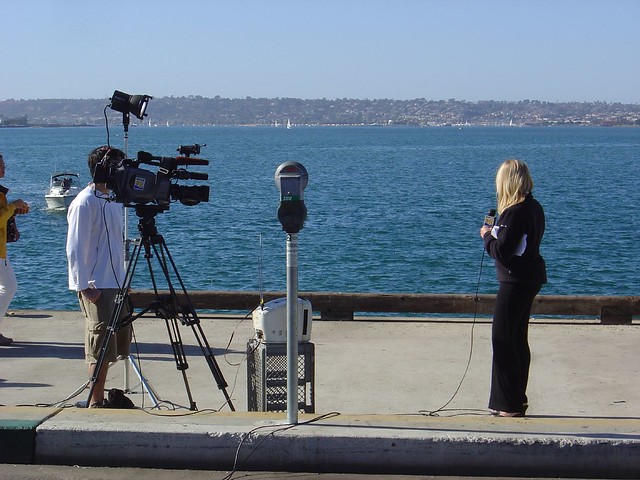
TV News

Earlier this week, it emerged that Facebook was in talks to host the content from publications like the New York Times, Buzzfeed and National Geographic. Today, it "opened up" their Messenger app into a platform that can be incorporated into a host of other apps and services, as well as a raft of other new features around identity and communications.

As a society, we tend to raise a skeptical eyebrow at nations with state-controlled media. But a world where one major entity controls the distribution of news, not just nationally but internationally, is arguably more harmful. I don't believe that Facebook as a company has nefarious intent here, but the precedent is worrying. News and information are important to democracy; informed voters are better voters. The implications of a single algorithm controlling how a population gets its news goes far beyond a web company trying to increase its market share.

Even if you don't buy that argument, Facebook's history with censorship should give any news outlet pause for thought. And that's the real danger: if someone other than you is hosting your content, can you trust them to treat it responsibly?

Brands looking to incorporate Facebook Messenger should have similar worries. It's a seamless-looking platform, but what if Facebook changes the rules, or changes its features, somewhere down the line? What if they choose to monetize the conversations you have with your customers?

Brands and news outlets need more audience. In that light, it makes sense to put your money behind the largest social networking platform on the planet, at least on the face of it. But the web remains the largest content network that is, with no single gatekeeper controlling how you use it. For identity, nothing beats a well-made website. For chat, services like XMPP carry zero business risk, and are easier to integrate than you'd think.

For startups, the opportunity is to provide open solutions that let media companies have all the sharing and integration benefits of the Facebook News Feed, Facebook Profiles and Facebook Messenger, without any of the concerns, and without any of the business uncertainty.

The web stopped being a game some time ago. It's not about whether this web toy or that web toy will win; it's about how we learn about the world, how we talk to each other, and how we represent ourselves to each other.

· Posts · Share this post


Some thoughts on building a high-growth startup with an open source product

Known is my second open source startup. I've spent over a decade working with free and open source software, and have been producing it in a startup context for most of that time. I've had a lot of time to think about the realities of doing this.

I believe that free and open source software is important for both social and technical reasons. In this post, I'd like to explore the implications for running an end-user open source software project from a startup business perspective.

What is free and open source software?

First, let's back up a second and talk about "free software". This was defined by Richard Stallman as giving you the following four freedoms:

  • The freedom to run the program as you wish, for any purpose (freedom 0).
  • The freedom to study how the program works, and change it so it does your computing as you wish (freedom 1). Access to the source code is a precondition for this.
  • The freedom to redistribute copies so you can help your neighbor (freedom 2).
  • The freedom to distribute copies of your modified versions to others (freedom 3). By doing this you can give the whole community a chance to benefit from your changes. Access to the source code is a precondition for this.

Note that "free" refers to "freedom", and doesn't necessarily mean "free of cost". However, this is not immediately obvious to newcomers. "Open source", in contrast, is purely a development methodology rather than a social movement. Because of that, and because the wording is unambiguous, I prefer to use this term. There's a lot of disagreement on this, and my preference shouldn't be construed as me prescribing this for other people.

Why is free and open source software desirable?

Free and open source infrastructure software - things like Linux, the Apache Web Server, OpenSSL and so on - have allowed for highly functional server stacks that aren't limited to a single vendor. Here's a slightly unfair way of looking at it: while Windows Server and similar products are Lunchables, where the whole stack is made by the same group of people, Linux is a picnic, with lots of individual ingredients provided by different organizations that add up to a richer whole. Each ingredient does one thing really well; the jam is really good jam, the cheese is awesome cheese. And because everyone gets the list of ingredients for each item in the picnic, you know that the jam and the cheese don't contain any nasty surprises. With the Lunchables, not so much.

Maybe my analogy needs work. But while free and open source software is particularly suitable for infrastructure software, it has broad implications for end-user software, too.

By end-user software, I mean products that non-technical people will use directly. WordPress is probably the best example: 23% of the web is made up of WordPress sites. Elgg, the social networking platform I founded, is another. Ghost is another, more recent example. And finally, Piwik, the self-hosted web analytics library, is one more.

What if I told you that only one of those projects was a traditional tech startup? And it's probably not the one you're thinking of.

The structure of open source startups

A common misconception is that Automattic, the company founded by WordPress cofounder Matt Mullenweg, is also the company behind WordPress. It's not. WordPress is a non-profit foundation, while Automattic provides the hosted WordPress.com service, as well as anti-spam tools, analytics and other centralized functionality.

Ghost, which was founded by an ex-Automattic employee, is also a not-for-profit organization. John O'Nolan explained his rationale for this in a blog post, where he clearly backs the social movement side of free and open source software:

The point of Open Source is to promote furthering technology for the entire world by not locking down software with patents and charging millions for them. The point of Open Source is that shared technology is better than closed technology because it has so many more people working on it. The point of Open Source is that the software you create benefits not just yourself, but many others - and in return you receive the same.

[...] I wanted to make it completely clear that Ghost is about making great software. I own 0% of the company. Hannah owns 0% of the company. According to our legal documents of incorporation, neither of us can pay ourselves enormous tax-free dividends. Just normal, taxable salaries.

Elgg, the open source social networking platform I cofounded, is also now a non-profit foundation.

Piwik, meanwhile, is a startup, albeit one that was founded significantly later than the project. They're a distributed company, with headquarters in New Zealand and Poland.

Why end-user projects are different to infrastructure projects

Over 80% of Linux kernel patches are written by corporations that use Linux, either as part of the infrastructure that serves their products (e.g. at companies like IBM), or as part of Linux-based end-user projects like embedded devices and Android phones.

By definition, end-user projects are the product, rather than a building block that becomes part of the product. There are far fewer levels of stakeholders downstream from the project to contribute to it, both monetarily and in terms of code patches.

This, however, is not to say that there are far fewer stakeholders overall. For example, there are plenty of people who use WordPress - it powers 23% of the web, remember? There are hosting service providers, web shops, and consumer users who depend on the software. This may represent a less technically-savvy base of people, but it may also be greater in terms of raw numbers.

Creating a self-sustaining project clearly demands a different strategy - particularly if the open source project is going to serve as the core of a startup.

What startups need

Startups need to be more than self-sustaining: their engine is scalable revenue.

In other words, revenue for a startup needs to have several properties:

  • It needs to be recurring
  • It needs to be able to grow non-linearly with the team (in other words, revenue isn't tightly bound to team size)
  • It needs to be subject to experimentation (the startup needs to have freedom to run experiments around pricing, features, angle, and virtually every aspect of their business)

Where is the intersection between this and the four freedoms we discussed at the beginning? That's where an open source startup needs to operate.

Services

One of the first things you learn as a startup founder is that professional services should be avoided, because they're not recurring, and they're not scalable. By professional services in this context I mean customizations, consultancy contracts and so on. They're clearly tightly bound to the size of your team. It can be interesting to offer these services in the beginning in order to learn more about your market, but you need to be careful, because it will stunt your ability to grow quickly.

This isn't to say that it will completely stunt your ability to grow. After all, professional services are the classic open source business model: offer consultancy and support. It's essentially what Red Hat has made its billions on (at the time of writing its market capitalization is $12.77B). But it flies in the face of the startup model where you build something that will rapidly expand.

So let's look at Automattic, which was valued at $1.16B after a round of funding last year. How have they grown?

While Automattic isn't directly responsible for the WordPress open source project, it is directly responsible for the WordPress.com hosted version. The bulk of its revenue comes from premium subscriptions. It does also provide a professional services "VIP" offering for high-value customers. To augment its income, it created an advertising network, and the company was actually founded to provide anti-spam services.

It's a smart mix: a lot of people don't have the expertise or resources to maintain code on their own servers (by way of example, around 10% of Known sites are self-hosted, while the other 90% are on our service). But even if they do, they can certainly use the Akismet anti-spam service, and because Automattic employs many members of the core WordPress team, high-value customers like the New York Times can use their expertise to get the best possible performance out of the platform. Perhaps most importantly, running a service allows platform developers to more quickly learn from its users.

By providing services to self-hosters, Automattic avoids a common pitfall with open source startups, where the most engaged users - the people who really, really care about running the project, and the principles behind it - are the ones who bypass the company entirely. The freedom of the WordPress open source project is not compromised, and all of the services are additive to the overall WordPress ecosystem. Anything that helps WordPress helps the company, and vice versa.

While Ghost is a non-profit, it provides similar services to WordPress.com. Similarly, Piwik Pro is a hosting service for Piwik. And, of course, WithKnown.com is a hosted platform for our open source Known software. (You should try it!)

Free as in free

While the principles of freedom that underly free and open source software are strong and important, it's also fair to say that many people choose it because it's cheaper. Freedom from lock-in also implies a freedom from recurring license costs. WordPress is arguably so popular today because its competitor, Moveable Type, decided to impose a licensing charge a decade ago, prompting a mass exodus.

It's hard to charge for end-user software, whether it's open source or not. Non-free platforms tend to get away with this by running advertising - and in fact, even WordPress.com runs ads on free sites for non-logged-in site visitors. A lot of open source campaigners are also pro-privacy, and don't believe in the invasive tracking that modern targeted advertising typically uses. Yet, at the same time, they often won't pay to use a platform, which obviously leaves the startup in an interesting bind.

Of course, if a platform is free and open source, you have a choice of where to run it. WordPress.com isn't the only place where you can get a hosted WordPress blog, so if you don't like their advertising policies, you don't have to use them. It could be argued that choice gives Automattic an ethical get-out clause: if you don't want advertising, go ahead and host your blog elsewhere or pay a subscription fee. When we ran a customer survey a few weeks ago, a fair proportion wanted us to run ads on the platform. So far, we have chosen not to do this.

Free software is a social movement, which is sometimes seen as being in line with anti-capitalist movements. If you have chosen to run a startup, you are probably a capitalist: you've chosen the route of revenue growth and creating business value. I believe that this is compatible with having strong social values (which I believe I do), but many people disagree. Ultimately, as a founder, you have to accept that you won't be able please everybody, and you have to be able to pay the people who work for you. Luckily, with open source software, everyone who runs the platform has a choice about who to run it with.

There is power in a movement

I do think that making your software open source gives your users more control and power, while allowing you to build a high value, scaleable business. It also more easily allows you to create an ecosystem around your software, allowing other people and companies to make money out of it too (potentially leading to even stronger growth). The trick is being aware of what open source entails, and what the implications are for your business, but you can absolutely build a high-growth, ethical business. We're on our way.

· Posts · Share this post


Venture capital isn't evil.

I enjoyed this episode of This Week in Startups with USV's Fred Wilson. It's a fairly candid conversation from this year's Launch Festival, and Fred comes across as having both integrity and a very practical approach to investing in startups.

The story that jumps out at me is that of Tumblr's acquisition by Yahoo!. There are two important details: the first is that Tumblr's initial investment round was less than a million dollars. The second is Fred's disclosure that the acquisition happened at a time when Tumblr had spent a lot of money on growth, and would have to either raise a huge round to make up the shortfall, significantly diluting the existing shareholders in the process, or raise unrealistic amounts of revenue. So selling to Yahoo! for $1.1 billion made sense for them.

There has been a great deal of backlash against venture capital in data ownership circles over the last year. Certainly, VC money gravitates towards a certain kind of company strategy, where designing for extremely rapid growth is a hallmark, and a profitable exit - either to IPO or acquisition - is desired. Rapid, sustainable growth is very difficult to achieve without a budget. It also overwhelmingly leads to strategies like revenue through advertising, where user growth isn't hampered by having to pay to use a service. Advertising is often criticized for requiring people to give up some personal privacy so that advertisements can be more targeted, and therefore more valuable to the service.

I think it's worth considering that services like Tumblr, Twitter and Facebook have also connected us and become a part of the cultural landscape in ways that wouldn't have been possible if people had needed to pay for them. Assuming that everyone should pay for a service is not realistic if you want to build a global community. Again, a resource-strapped startup is also more likely to see slower growth than one with millions of dollars in the bank: their box of tricks is necessarily more limited.

If you're opposed to this kind of financing, it's worth asking: would you pay for Tumblr, or Twitter, or Facebook? If not, why not? How many services do you actually pay for?

Venture capital isn't the only way. Notably, O'Reilly Alpha Tech Ventures created Indie.vc in order to explore a more revenue-centric funding model (and I hope more will follow). But I do think VC is a legitimate funding tactic for a particular kind of highly-available, free-to-use mass-market tool, and it seems to me that whether it has a detrimental effect on a startup's service has more to do with the individuals at the startup, and the personalities of the VC investors they choose, than the model as a whole.

· Posts · Share this post


Why the secure web isn't ready for primetime (but we need to use it anyway)

Keys.

In today's climate, it's important that we secure communications with our servers. For example, if you're on open wifi (at a coffee shop, for example, or at a conference), it's trivial to steal the unsecured logins of the people around you. Using secured connections also helps protect against people monitoring your communications further up the chain, at an infrastructure level. In the era of the Snowden revelations, protecting your privacy is an obviously good idea - but there is also an immediate practical value in preventing people from stealing your passwords and credit card details, too. Security is so important that Google recently said that they would rank secure sites higher in their index.

But it's so hard to implement that today, most peoples' websites are nowhere near secure - and it's the technology's fault.

First, let's talk about secure websites work.

Here's a summary version.

When you visit a secure website, your browser and the site's web server discuss which secure encryption protocols and algorithms they both support. The server also sends your browser a security certificate, which contains the website address, as well as details about a central certificate signing authority that can verify that the certificate is authentic. The certificate is cryptographically signed by the digital signing authority. Every browser comes with the cryptographic keys of all the major certificate signing authorities, which it uses to verify the certificate's authenticity. Only once the secure protocols have been chosen and the certificate is verified as being both authentic and for this website does the page load.

Even the summary is kind of technical, so if your eyes glazed over, just take away these two things:

  1. Secure websites are only accessible if they have been certified by one of a handful of central organizations, and the certificates contain the address of the website they pertain to.
  2. There are lots of different algorithms that can be used to secure the traffic between your web browser and the website, and some of them are more secure than others.

So how do I secure my website?

Let's back up a little bit. Here's how a lot of people create their websites:

  1. Sign up with WordPress.com or Squarespace (or Known Pro, of course!)
  2. Pay for a custom domain name

If they've chosen to self-host, here's how most individuals create their websites:

  1. Sign up for a shared host like Dreamhost or Fasthosts
  2. Click on their server control panel to install WordPress or Known

I mean, it could be easier, but it's short of being an ordeal, right?

Meanwhile, here's what you have to do if you want to install a secure certificate to make sure your self-hosted website uses encrypted connections:

  1. Log into your server using an SSH terminal
  2. On the command line, create a certificate signing request by following the command-line instructions for your particular web server
  3. Specify a cryptographic key of appropriate length (don't know what that is? too bad)
  4. Enter your address details on the command line
  5. Open the certificate signing request file
  6. Copy and paste the contents
  7. Go to a certificate authority website
  8. Click to buy a certificate for your domain
  9. Paste your certificate signing request
  10. Download the certificate and what are called the certificate chain files, which describe to the browser how to validate the certificate
  11. Install them on your server, probably using command line tools
  12. Make sure your server is set to use strong encryption algorithms in its configuration files
  13. Check your website's security score to see how well you did

To be fair, some hosts, like DreamHost, take care of many of these steps for you. But it's still not easy.

And as far as using SSL on custom domains on managed services like WordPress.com and SquareSpace? Here's the truth: you can't.

Why SSL is hard for custom domains on managed services

Remember when I said that the certificates were issued for a domain? Multi-domain certificates can also be bought, but in all cases, the domains have to be specified at the point when you buy the certificate. If you already know you have 50 domains that you want to secure, then that's great - but if you're providing a service where you know you want to secure domains you will host in the future, you're stuck. You would need to request and buy a new certificate for every new domain, or do it in batches.

Because each certificate needs to be separately requested and installed, this is a hard process to automate. To make matters worse, most virtualized server environments - for example, Amazon Elastic Beanstalk - only support one SSL certificate per instance. That means you've literally got to set up a new clone of an application environment every time you want to support a new SSL domain.

That's unsustainable, and because most services like WordPress.com and SquareSpace use these kinds of virtualized environments so they can add and remove servers to cope with changing demand, they have trouble supporting secure websites for their custom domain users.

We need security, so it needs to be easier to deploy

Security is vital. A clue that it isn't easy enough are those website security scores: a letter grade for your website that describes how secure it is. I've seen engineers ooh and aah at sites that managed an A+ grade.

If we want everyone to use this kind of security, it needs to be totally brainless. Trusted encryption needs to be there by default in every web server and adding new domains programmatically needs to be simple.

The certificates are also difficult because they are trusted by central authorities - which themselves need to be trusted. Not only is the secure web cumbersome to maintain, it's actually potentially insecure. We have certificates to prevent against man in the middle attacks, but maybe there's an alternative? Could the blockchain help, for example?

There's no dispute that you should secure your site, and you should strive to use secure sites. But it's difficult. You'll note that at the time of writing, I haven't secured my own site yet (although the Known service does use secure connections). I don't think the existing technology is cutting it, and to protect all of our security, we need to find something new.

· Posts · Share this post


Homogeneity is for wimps. Let's all be ourselves.

"The thing about alternative people," a coworker once said to me, many jobs ago, "is that they act like the mainstream isn't good enough for them. It's like they're saying they're better than us." He was talking about a receptionist at our office, who was kind of off-kilter, but not at all unprofessional. He didn't like her.

I think about this conversation a lot.

I like "alternative people". With all due respect to everyone else, they're my favorites. For me, the people who are off at an angle to the rest of the world are the most interesting. People who think differently and see things differently are more likely to arrive at solutions and ideas that everyone else can't. They're opinionated. They make more interesting art. They're better engineers. They find new ways to live. They don't give a shit about fashion or traditional success, or whether challenging the status quo is offensive. They are, by definition, more creative, because they're not following the herd.

I look up to them. For one thing, I do kind of think that mainstream culture isn't good enough. It shouldn't be good enough for any of us. Traditional ideas around things like gender roles and sexuality have a potent power to oppress; correspondingly, choosing not to adhere to them, or to give them respect solely for being incumbent, is a kind of empowerment.

As Winnie Lim wrote in a wonderful piece recently:

It takes courage to be ourselves, it takes a lot of hard work and self-awareness. But we are continually building a world that other people live in, that means at every step of the road, we need to continually ask ourselves, what kind of world do we want our kids to live in? Do we want a world where they have to disown their beautiful personalities just to fit in our idea of what it takes to succeed? That it is celebrated that we spend our formative years disowning who we are?

The thing that bugged me most of all about my colleague's comment is that we are all "alternative people". at least to some extent, with individual desires, histories, interests, skills and contexts, which bind together to help us become who we are. Our lives are unique tapestries woven from those threads. For everything we have in common as humans, there is so much variation between us, too, and I don't think there should ever be pressure to present as "normal". None of us are normal; we all reveal our true selves to different degrees. That's awesome.

People are amazing. The only reason to try and homogenize them is so you can dehumanize them: make neat little demographic groups that allow you to sell to them, or count them, or process them, or some combination of all three. It's an abstracted model of the world for marketing purposes, and it shouldn't be how we interact with each other in real life.

Facebook is, in many ways, like my old coworker. By insisting on legal names, they are saying that we all should present ourselves using one set of rules, regarless of our desires and contexts. What's good enough for upper middle class white kids from Palo Alto, the thinking goes, should be good enough for everyone else. The same goes for the kinds of content you can post, or how you want your profile to look.

But look: if you want the page that represents you to the world to spin around and have pink sparkles with a Carly Rae Jepson song that autoplays on load, why shouldn't you have that? It's your profile. Here's a hint: your social profile design is optimized for advertising and site engagement, not your own self-representation. Here's a follow-on question: why can't you post breastfeeding photos on Facebook? Could it be that advertisers object?

The world is much richer than the things that sell ads, but this isn't just a post about why an independent web is a good idea (although it is).

I'm lucky to have friends who very much are themselves, and who believe in diversity and not just tolerance, but proactive kindness. I'm lucky that I was raised by people who shun traditional norms and have spent their lives thinking about better, fairer ways to live. Collectively, they're my role models and my inspirations. And more than anything, I hate the idea that it might be acceptable to judge someone who - like so many of the people that I love - has chosen to present themselves as different to you.

Being different is, in my world, something to be celebrated. Cherished, even. It's what makes us human. Correspondingly, to force someone to deny their identity is to deny them a piece of their humanity. As entrepreneurs, as citizens, engineers, designers, businesspeople, whatever we are - let's maybe try not to do that.

· Posts · Share this post


Why I'm excited about Known Pro (and what's next for us)

We launched Known Pro today. It's the best way to reach your audience, wherever they are on the web, from a single platform. It's also the culmination of a lot of work over the last few months.

We made an important decision, back in November: we were going to test whether a premium version of our service was viable. Traditionally, one of the ways this is done is through crowdfunding, but we decided we would put another twist on it. We would run a pre-sale, and we'd only collect money once the product was ready to roll out.

Earlier this year, we rolled Known Pro out to our pre-sale customers. They've helped us learn, given us great feedback, and enabled the product to be fully released. This morning, we pushed the button.

You can publish to an unlimited number of social profiles and pages from a single platform. You can use your own JavaScript and CSS to customize your site. You can publish from any device. And most importantly of all, you can export your data, self-host the entire platform on your own server, and be - in the Internet sense - the master of your own domain. In particular, I'm not aware of another web service that will give you a full database export of your content in a way that you can use directly on your own server.

So what's next?

There are more people signing up to the free Known service, and creating their own self-hosted sites, than ever before. For an open source project that emerged from the indieweb community not long ago, it's exciting to be in a place with recurring revenue, excitement, and an awesome community of its own. We're strong participants in the indieweb community, but we're also exploring other places where people need to own their own data: in particular, groups who need a truly private place to share resources. More on that soon.

We'll be working on a new design for the Known platform. We'll also be looking at other ways that individuals need to interact with content that they publish elsewhere on the web. And mostly, we'll be working on our mission to make Known the best place to communicate from your own space on the Internet.

Check out Known Pro. Let us know what you think. And stick with us: we're really just getting started.

· Posts · Share this post


Some unpopular opinions about the Bay Area tech industry

Large tech companies like Google and Facebook should be aware of the effect they're having on their cities and neighboring communities and invest in social infrastructure to protect against poverty and create healthier cities.

A single-payer healthcare system would not only be more efficient, but would support startups and other small entrepreneurs.

Equalizing maternity and paternity leave, and making both substantial, would also help equalize working environments.

That there is an enormous homeless problem in San Francisco isn't a good reason to not live there. It is a great reason to try and solve the causes of the problem, so we can all have better lives in our communities.

If you're going to promote standardized, computerized testing in public schools, maybe also think about promoting increased resources to support teachers, who are stretched to breaking point, and modernize facilities.

Smart freeways are a good idea, but smarter, integrated public transport is a better one.

Startups are great, but not everything should be a startup. Some things should be services that government provides, and we should pressure them to do so. Privatizing public services is not a positive thing.

Libraries will never stop being important, and they deserve our tax dollars.

The State of California should work with private industry to make museum entry free, every day (although it would be better if this was fully publicly funded).

We should understand that we are all connected, and enriching our communities enriches us, too.

· Posts · Share this post


I have the best job in the world.

I'm incredibly proud of what we've accomplished at Known so far.

We're one of the few social web apps where you can use our cloud service or host it yourself - or move at any time, in either direction.

We have an active and growing open source community.

More and more university educators are using Known as part of their teaching, and we're seeing more people pick it up for use inside companies, too. It turns out there are lot of organizations that need to own their own data, but want to have the kind of user experience you find on the consumer web.

I use it for my personal website, as a private site for my extended family to share news and photos, and as an official company space.

I post content on my own site, and syndicate to Twitter, Facebook, LinkedIn, Foursquare, Flickr, SoundCloud and Slack. Via brid.gy, all my interactions across all my social profiles are stored on my own site. But more and more, even without those things, it's become an important space for me in its own right. I can search for everything I've ever written on the web; I can talk to my family in a private space that belongs to us; I can promote my company across the web with a push of a button.

I use it dozens of times a day, and lots of other people do, too. That's really neat. I'm grateful for our amazing community, and for the people who have taken interest in what we're building. Many of them have become our friends.

We're going to make some product announcements this week, which we'll do on the Known Stream. Mostly, I wanted to express gratitude for what I get to do every day. But we're still a small company, and there is so much more we plan to do.

Whether you're an individual, a class, an organization or a company, we want Known to be the best way to communicate from your own space on the Internet.

We believe everyone should own their own space on the Internet. The web should be all of ours. We should all own our content and conversations online, and the software that makes it happen should be beautiful and easy to use.

It's a mission I personally believe in, and I'm grateful to work on it. Thanks for being a part of it so far - now wait and see where we'll take it next.

· Posts · Share this post


6 honest reflections on being an early-stage startup founder

I previously co-founded Elgg and served as CTO at latakoo, but Known is the first time I've been a CEO. Candid reflections have always been important to me to learn from; maybe someone will find these useful, too. If not, then, well, my first point applies:

Writing is an important way to organize your thoughts.

In many ways, as a founder, your job is to be the company storyteller, the company cheerleader, and the person who will fix the sink if the plumbing breaks. There are so many strands that I've found writing - and in particular, blogging - to be a great way to order them into a coherent narrative. A lot of times, when I post here on my own site, I'm thinking things out in public. You're all a part of my thought process. Congratulations?

This is one reason why I'm adamant that you should hire people who can write well. I don't mean their spelling or punctuation, particularly; I'm talking about their ability to convey information. That also speaks to the kind of order they will bring to other tasks. It's a core skill.

Related to this:

The elevator pitch is more important than I thought it would be.

We were part of the third class at Matter, an awesome values-based accelerator in downtown San Francisco. Throughout, we were encouraged to condense our story into a seven-minute pitch. The pitch itself wasn't the thing; the process forced us to create a coherent story for our company, mostly for ourselves, which would itself inform our company's decisions. Who would buy this? What was the concrete problem we were trying to solve?

It's harder than you think to condense this into seven minutes. We live and breathe our startups - how can we cut and edit that down to a seven minute story? Help! we all thought to ourselves, while nibbling slack-jawed at our accelerator's complementary snacks. We need more time!

If only we'd known.

Seven minutes is an acre of time. It's a boundless ocean stretching out to the horizon, rippling gently beneath a benevolent sun. You can fit lifetimes in seven minutes. And in front of a captive demo day audience, to boot!

No no, my optimistic, accelerator-cheese-string-eating past self. You have got it very wrong. Try fifteen seconds.

"What is Known?", someone will ask. Ignore the existential double meaning of the question, because you have about fifteen seconds to convince the person in front of you that your idea is compelling and different. If you succeed, they might ask you a follow-up question: something easy like "are you making money?" or "doesn't WordPress do that?". Be ready.

In fact, the existential double meaning does matter, because your answer, despite being tweet-sized, will depend on all the research and insights you've gathered, and everything you know. It's likely to radically change over time as your understanding of your business improves. Your fifteen second description is the tip of the iceberg, but it's a tip that encapsulates everything below the waterline.

Arguing with investors is a clear indicator that you have work to do. On yourself.

This is something I've avoided, but I've seen other founders do this more times than I can count.

Here's what happens. A startup founder takes a meeting or walks on-stage at a pitch event. They've brought a presentation that they've slaved over, had sleepless nights over, maybe even wept over in the darkness of their shared office space at 3am, and they are proud of it. It is, as far as they can tell through their sleepless haze, the perfect encapsulation of what they've worked on so tirelessly. It is beautiful. Were it journalism, it would surely win the Pulitzer.

And the investors tear it apart.

At least, to the entrepreneur, it feels like that. In reality, they're asking important due diligence questions: trying to pick holes in the story, and figuring out, within the constraints of the space and time they have, whether this startup is a smart place to put their money. They most often want to help the entrepreneur, by asking them to strengthen their argument. But it flies directly in the face of the founder's conviction, not to mention all of their single-minded hard work, and it hurts. So they misread the situation and become defensive. They might even get visibly angry. And that's where it all falls down.

An early-stage investor is like a cofounder (or at least, they should be). They probably have a lot more experience with young companies than the founder does, and can offer pertinent advice based on things they've learned from other companies. Who would want to work with someone who gets angry when presented with that experience?

It's okay to correct people, of course, but the right way to do it is with your facts, and all the great research you've done. Your faith means nada: all startup founders have faith that they'll succeed. You've got to show investors that you have the skills, the knowledge and - ideally - an unfair advantage.

Take care of yourself.

Here's what I have experienced personally: the crushing feeling of having your work swept out from under you by that investor experience. There's a tight line to walk. Investors really do have a lot of experience, and really do want to help you. Most of the people I've met are driven by helping entrepreneurs, so the advice they give comes from a good place. But at the same time, you have to stay true to yourself, too: sometimes you do need to take a leap of faith to create something new. Whether anyone comes with you is all on you.

That's hard. Running a startup comes with intense highs and lows, sometimes within the same 30 minute period. Often that 30 minute period will be late at night, or on a Sunday, or at 6am. By its nature, it's incredibly unhealthy, both mentally and physically.

When you're terrified about money, and worried about your own lack of sleep, and there's a strange new pain somewhere in your body and you're not sure when it started happening but it's probably stress-related but maybe it's something that will kill you, and people have started looking at you strangely on the street, it can be very hard to make stable, considered decisions. But that's what you have to do. You have to be calm, and you can't let criticism go to your heart.

Take time away from your startup. Go to the gym. Eat well (not string cheese). Consider drinking tea instead of coffee (you don't need higher cortisol levels). Enjoy the countryside. Go for walks. Be with your friends. Do what makes you happy. Above all: remember that it's a business, not your entire life, and any criticism or praise you receive is not a commentary on you as a person.

Those things will make you a better person, a better entrepreneur, and a better decision-maker.

And for god's sake, stop eating the string cheese.

Don't tilt at windmills.

Fail hella fast. Don't spend years on something that isn't going to succeed for you. You only get one life. If something isn't working after you've spent a reasonable amount of time and effort on it, move onto something that does. Don't get so emotionally invested that you can't let go. (This applies not just to startups as a whole, but to features, target customers, user flows, logos ... you name it. Repeat after me: this is business.)

A mantra that's commonly (rightly) repeated for startup founders is, "you are not Steve Jobs". In other words, you need to do user research and testing. You need to build prototypes to get feedback on, so you can make better decisions.

But, okay, time out. Here's a quick question which should be easy to answer with no thought at all: what is success?

Does success mean building a unicorn or a dragon? (That's startup-speak for a company worth at least $1bn, and a company that returns $1bn to a particular investor, respectively. Yes, I know it's ridiculous. Have you been here?)

Does success mean building the dreaded lifestyle business? (That's startup-speak for a company that allows its founders to live comfortably but will never be described in terms of mythical beasts.)

Does success mean making a positive impact on the world? (That's startup-speak for "won't get funded". I kid - these kinds of startups can also make a lot of money, and Matter, as well as Better Ventures, Double Bottom Line and a few other social impact investment firms are orientated to this. I'm glad they exist.)

It's actually really important that you know the answer to this. All of these approaches lead to different approaches and decisions, different ways of describing your company, and, frankly, different companies. If you have a cofounder (and you should), you should probably be on the same page on this. If one of you wants to build a unicorn filled with ninjas that morphs into a dragon, and one of you wants to build a lifestyle business with a focus on social impact, you will reach a point where it's not going to be pretty. Founder breakups are like marriage breakups. You don't want it to happen.

Above all else: know where the money is coming from.

A lot of people have been seduced by Twitter's strategy. Here's the in-a-nutshell version of what they did: they built a prototype in a couple of weeks, with the simplest possible features, and let it loose. Over time, the community created its own norms - things like replies, hashtags and retweets - and the company thought about those and figured out how to make them into features. For a few years they didn't even think about money. They concentrated on growing the company, and to do that they paved the deer paths. Lovely!

What's mentioned less often is that to make this happen, Ev Williams personally bought back the shares that had been invested in his company. That money had previously come from selling Blogger to Google. Unless you also have millions and millions of dollars, it is not a strategy that you can repeat. And even then, Twitter partially became successful through a series of smart decisions - putting screens up at SXSW, for example, which took money - and a series of accidents.

To "you are not Steve Jobs", I would like to add: "you are not Ev Williams".

The startup landscape has changed since the mid-2000s. It is expected that you will have built something with traction off your own back. Unless you're a unicorn developer (which in this case doesn't mean you're worth $1bn, but means you can build quickly, can design well and are good at gathering user feedback; stay with me) you will need to bring in other people. That means you're going to need to commit your own money, or be oozing with leadership charisma, or both.

Here's an aside, if you aren't a developer: you can't find a technical cofounder. Technical people get asked to join startups on a very regular basis, and it's become a bit of a running joke. Join a company that will eat your life and pay you very little money in exchange for a tiny amount of equity that amounts to a lottery ticket? "What a great deal!" said no-one, ever. If you want someone technical to join your team as a cofounder, you have to prove that you're worth joining. Most of all, you have to prove that you're not going to lean on them to make your whole product for you - and that means showing that you have skills to bring to the table. Show your research. Build wireframes. Maybe even learn to code a little. And demonstrate, however you can, that your technical cofounder will be an equal rather than - as I heard someone once describe their technical colleagues - "our back-room technicians".

Once you have your working prototype - which, to reiterate, you've built with your own skills and/or money - you're going to need to know where your runway is coming from. Are you going to try and make revenue immediately? Are you going to raise investment because you're creating a consumer startup? Either way, you don't have space to bimble along like Twitter did, finding itself along the way.

Are you going to grow with help from investment? Then make sure people will invest. Are you going to bootstrap through revenue? Then make sure people will actually pay.

There is never enough time. There is never enough money. Somehow, as a founder, you have to make both.

Bonus seventh: don't trust pithy thought pieces on entrepreneurship.

Experience is important to learn from, but seriously. You're your own person. You have your own experience, your own goals, your own creativity and your own special sauce that you're going to bring to the table. There are few communities that are as much about peer pressure, community norms and cargo cultish received wisdom than tech entrepreneurship. Through all of this, you need to maintain your own strong personalty - and the strong personality of your venture.

Let me be clear: this is the best job I've ever had, and I wouldn't change it for anything.

Go out into the world and succeed, whatever that means for you, however it makes sense for you. Make a dent in the universe.

And don't eat the string cheese.

· Posts · Share this post


W3C announces 1 in 20 sentences on the web will be advertising

This week, Twitter CEO Dick Costolo told the New York Times how he plans to continue to monetize his service:

Twitter’s core business of selling ads that are inserted into the flow of tweets that every user sees has plenty of room to grow, he said. The social network’s ideal model is for ads to make up about one in 20 tweets that the average user sees - the same level that Facebook strives for. "We're well below that now," he said.

The web, which has long been in competition with Facebook and Twitter, is racing to catch up. Analysts haven't been kind; last month, an editorial in Forbes sniped that "the web doesn't seem to be trying to raise its market cap at all". This has led Carl Icahn and others to question whether a new board is in order. In response, Tim Berners-Lee, CEO of the web, told reporters this week:

Starting this quarter, we're monetizing the web. Around 5% of the written sentences that users, or "surfers", see will be tasteful contextual advertising, which will add value and increase engagement. We've always been about linked data, and now we're linking it to a number of easy, convenient ways to pay to reach your audience.

The web will also introduce a new Pro version, launching this September, which will include several new tags, unlimited access to HTTP, and a "professionals mode".

· Posts · Share this post


For artists, if the Internet is not the answer, what is?

Andrew Keen's new book The Internet is not the Answer takes a contrarian view to the digital revolution:

Instead, it has handed extraordinary power and wealth to a tiny handful of people, while simultaneously, for the rest of us, compounding and often aggravating existing inequalities – cultural, social and economic – whenever and wherever it has found them. Individually, it may work wonders for us. Collectively, it’s doing us no good at all. “It was supposed to be win-win,” Keen declares. “The network’s users were supposed to be its beneficiaries. But in a lot of ways, we are its victims.”

Andrew has forged a career from standing to the side of the Internet gold rush and saying, "wait a minute". This isn't a criticism; we need that voice, I think, to counterbalance the cheerleading role that the tech press typically fills. In particular, as the Guardian points out:

The US government’s decision, in 1991, to throw the nascent network open to private enterprise amounted, as one leading (and now eye-wateringly wealthy) Californian venture capitalist has put it, to “the largest creation of legal wealth in the history of the planet”.

Wealth in itself is not necessarily a bad thing. But what Keen seems to be suggesting is that this has actually in part been obtained by devaluing other peoples' jobs - it's not wealth creation, in the same sense that software is something created from nothing, but rather wealth redistribution. The jobs that were rendered obsolete have not been recreated; there is no employment equilibrium. In particular, the article and the book cite figures that show a significant downturn in jobs for creatives.

There's a tricky conversation to be had here. Some of those jobs were bolstered by models that should not continue to exist, while few of us would argue that we don't value art or creative work. New models must therefore be found to support artists. (Companies like my friends at the Creative Action Network are doing great work here.)

It's been pointed out to me more than once that the 20th century models for selling creative work were very temporary. After I posted recently that relying on donations wasn't a sustainable practice, my friend J. Nathan Matias also pointed out that nonprofit arts and cultural organizations have a higher survival rate than businesses in America (PDF link). Elsewhere, arts are often funded (I think rightly) from public money. I'm not sure how much of this funding goes into creative work online, but anecdotally, I'd love to see more.

Artists themselves need more freedom to experiment online. The first years of the web were highly experimental, and many of the first startups could be thought of as art projects. However, over the last few years we've seen this slip away, to be replaced with projects that are either obvious land grabs (Uber, Spotify, food delivery apps and laundry startups, for example) or have settled into homogenizing advertising display funnels (Facebook). It's worth saying that some of the best startups, like Slack, have avoided this pattern, and retained a sense of whimsical experimentation. Meanwhile, projects like CASH Music and the aforementioned C.A.N. are transparently fighting for the artists. I'd hope that creative workers feel that they can take our project, Known, and use it as the basis of their own creative sites. But it's now the exception rather than the rule.

Yet, I know I've discovered all kinds of new artists across mediums. Meanwhile, reductive lists like the Billboard Charts have massively declined in importance for many listeners (which I think is a very good thing). The Internet is not the same thing as its prevailing business models, and I simply don't buy the implied argument that the Internet has been a net negative. But I do think it's worth having a conversation about who is hurting - and if nothing else, using it to figure out who has a problem just waiting for a startup, or a non-profit, to solve.

· Posts · Share this post


To do better work, and lead better lives, we should all disconnect more.

I enjoyed this episode of the New Tech City podcast about the case for boredom:

It's a part of their Bored and Brilliant project, which attempts to encourage us to spend more time stewing in our own mental juices. The argument is that we spend too much of our time using our brain to attend to structured tasks, including checking social media and responding to notifications, and not enough time daydreaming.

It rings true for me, but I'd go further.

We live in a very goal-orientated society. Everything seems to be about setting goals and realizing them. There are so many resources, and so many products, that are about helping you be more productive. There's also so much of a macho culture around this that having dead time - just chilling out, not checking your email, going for a walk with nothing in your pocket - is almost frowned upon.

That's already no fun. But it's also counter-productive. There are countless studies which show that "boredom" lead to creativity, while countless more show that taking time off makes you a better worker. But more fundamentally, these attitudes all hang on the idea that your goals are correct to begin with. If you are following your goals with laser focus, you're not only limiting your opportunities for creativity, but you're actually losing opportunities to learn and grow. If you're obsessively measuring your productivity in terms of quantifiable metrics, as many of us do, you're losing the ability to qualitatively test if you're doing the right thing at all. Creativity is an essential part of being human.

One common meme from the obsessive-productivity camp is the idea that we should "live deliberately", or "live intentionally": turn your life into a series of conscious, carefully-considered, mindful decisions. I mean, sure; the world could certainly use more consideration. Nonetheless, I think you also need to leave room for "meandering aimlessly": allowing for serendipity and the kind of semi-conscious, uninterrupted thought that leads to more creative ideas and actions over time. Jeff Bezos noted that the people who are correct more of the time are the ones who have the freedom to change their minds. Steve Jobs famously said that taking LSD was one of the most important things he ever did (and other industry figures have, privately, advocated taking shrooms); maybe it would also have helped to spend more time chilling out.

That doesn't mean there needs to be a framework for it, copyrighted and sold, that we should all strictly adhere to because it makes us better people. If all this talk about the benefits of daydreaming leads to a Daydreaming Productivity Technique, I will barf. It's not the point. The point is that we need to allow ourselves to be human, to disconnect, and set our minds free once in a while. We'll all be better off for it.

· Posts · Share this post


Social networks are bad at news. Can we make something better?

TV NewsAndrew Sullivan, the veteran political blogger, is quitting. As Ezra Klein at Vox noted:

The blogosphere lives. But Sullivan's decision to hang up his keyboard is nevertheless a marker. Sullivan was the closest we had to someone trying to run a blog with real scale. He was trying to make his blog — and its sizable audience — into a business. But blogging, for better or worse, is proving resistant to scale. And I think there are two reasons why.

Meanwhile, Emily Bell, the Director of the Tow Center for Digital Journalism, dedicated her Hugh Cudlipp lecture on journalism to the power that social networks hold over modern news:

Social networks and search engines are the masters of this universe. As we see the disappearance of print as a significant medium, and the likely decline of broadcast television, the paths our stories and journalism must travel down to reach readers and viewers are being shaped by technologies beyond our control.

These are two sides of the same problem. On one hand, Sullivan is finding it unsustainable to maintain his blog. Meanwhile, on the other, Emily Bell points out that newspapers are not in control of their delivery mechanisms or social reach, and essentially are at the mercy of the policies of the social networking companies.

In Gigaom, Mathew Ingram agrees with Bell's assessment:

Social networks like Facebook need the content that comes from media outlets because that’s what drives the engagement they need to sell advertising. But journalism and journalistic organizations should get something in return, and that is a commitment to at least consider the principles that should apply to such content, since they now control how and when (or even if) people see it.

The question is, will they?

I would argue not. As I pointed out at Hacks and Hackers last month, the interests of the social networking companies are at odds with the interests of news and journalism. Content is routinely removed for being controversial, whereas the nature of a lot of news is inherently controversial. Journalism is a brave profession with a strict separation between editorial and revenue control structures, whereas social networks deliberately engineer specific responses in order to sell ads and maintain engagement. Those aren't good traits for a news medium.

In fact, optimizing for engagement leads to increasingly emotionally manipulative content. Wired reports that Facebook is testing engagement across different kinds of content:

“We really try to not express any editorial judgment,” Adam Mosseri, News Feed product director, tells Levy. “We might think that Ferguson is more important than the Ice Bucket Challenge but we don’t think we should be forcing people to eat their vegetables even though we may or may not think vegetables are healthy.”

[...] Unfortunately, so far, it looks like users are less willing to engage with “meaningful” stories or news, preferring anything that triggers a strong emotional response. But Facebook is hopeful that when it begins asking users about sets of stories instead of individual items people will start to reward informative content.

Facebook, of course, makes its money through advertising, so its primary driver is engagement: encouraging people to see and interact with sponsored content. Twitter is heading in a similar direction, with features like While You Were Away that highlight content they think you should see.

NOT one of THOSEWhich brings us back to blogging. A weblog is just a series of articles on your own site. The problems that bloggers have with finding an audience are very similar to the problems that news organizations have with finding an audience on their own sites. In both cases, referrals from social networks are key: Facebook alone is responsible for almost 25% of all referred traffic. (And the average smartphone user checks Facebook 14 times a day.) It wouldn't be possible, or wise, for most publishers to turn their back on these audiences, despite the opacity of the news feed. They're damned if they do and damned if they don't.

Medium clearly sees an opportunity here to be a go-to news feed for serious readers. Their acquisition of the 2015 State of the Union address was a statement of intent. As the Washington Post noted:

Compare that with the response of Kate Lee, Medium senior editor, when asked why the White House would seek out Medium: “You’re publishing to a place that has millions of readers.” Lee says the site, the creation of Twitter co-founders Evan Williams and Biz Stone, gets about 20 million unique visitors per month. “People are already here, and they’re much more likely to discover your piece.” Clean and user-friendly though WhiteHouse.gov and other sites may be, they “exist in their own silos and it can be hard to get people to come to you.” Lee declined to say just how much traffic the State of the Union remarks generated but seemed quite happy with the results.

It's an interesting turn of phrase to describe WhiteHouse.gov, and other organizations' own sites, as silos. Medium is also a silo: you must publish directly on the site, and there are no incoming APIs. It is another social network, albeit one that's done a very good job at attracting high quality writers and readers, and it is not necessarily less of a threat to news organizations. Because the content is hosted on Medium, it is also not a viable alternative to a newspaper, say. There's no way for writers to make money from their content.

The simple answer is that we don't yet have what we need, as readers or publishers - and although the ability to easily find audiences and new content is not readily built into the medium, the web has many of the building blocks. I keep coming back to Anil Dash's seminal essay The Web We Lost, where he describes what we get when we lose the open nature of the web as a platform:

We get excuses about why we can't search for old tweets or our own relevant Facebook content, though we got more comprehensive results from a Technorati search that was cobbled together on the feeble software platforms of its era. We get bullshit turf battles like Tumblr not being able to find your Twitter friends or Facebook not letting Instagram photos show up on Twitter because of giant companies pursuing their agendas instead of collaborating in a way that would serve users. And we get a generation of entrepreneurs encouraged to make more narrow-minded, web-hostile products like these because it continues to make a small number of wealthy people even more wealthy, instead of letting lots of people build innovative new opportunities for themselves on top of the web itself.

In his follow-up, Rebuilding the Web We Lost, he makes the opportunity clear:

As is obvious from the responses I've gotten, many, many people care about a social web that honors certain human and creative values. As I've spent years thinking about the right way to write for this blog, and to build ThinkUp, and to sit on the board at Stack Exchange, and to advise clients at Activate, and to work on all the other stuff I do, I just keep running into the fact that there's a huge opportunity to make a great new generation of human-friendly apps with positive social values.

That's certainly what we aim to be building with Known. We want to help people communicate and find audiences from their own websites (as I'm doing right now from mine). It's also a goal of the indie web and related communities.

An informed voting population is vital to democracy; anything that subverts our ability to receive news and information is, in effect, subverting democracy. However, there's also a hugely valuable market for content that's just waiting to be set free. Facebook isn't going away any time soon - but it may be joined by new, more open applications. As Anil Dash describes them: a new generation of human-friendly apps with positive social values.

Which seems to me to be exactly what Emily Bell was talking about.

· Posts · Share this post


Community-owned startups: taking a cue from the Co-op

One of the first conversations I had when I moved to California was with Kaliya, about alternative models of ownership for startups. I know it's something that's come up at events like Future of Money, and it's interesting to see it emerge in USV's question of the week. What would community-owned applications look like? Are they even possible?

Growing up in Oxford, I lived around the corner from a Co-op: a national, collectively-owned chain of small supermarkets and other community businesses. Co-operative branches employ over 70,000 people, and their ownership structure makes them accountable to their communities, resulting in products and policies that are generally high-quality and ethical.

Every person who works there is an owner, and so was I: I paid £1, and in return I got a better deal and, importantly, a share of the profits. That never amounted to a lot of money, but I felt like I was part of it. This is the important bit: I also got to vote on policies, management and local representatives. It was a bit like being a part of a privately-owned democracy.

I think when a lot of people think of community ownership, they immediately imagine the stereotypical archetype of communal living, with anti-capitalist principles and heated arguments over basic ideas. That's not how it works out in practice, either for healthy small-scale communal ownership arrangements or for national co-operatives. Around the corner from me now, another co-operative - Cheeseboard Pizza - draws lines around the block twice a day, and has opened a second branch downtown. They're out to make a profit. And the Co-operative is a thriving business that includes one of the most prominent banks in the UK.

I think this model - community ownership governed by a council of representatives - could work for startups and applications, but it needs to be balanced against a startup's need to scrappily prototype and fail fast. A management bureaucracy is not going to help with those things.

So how about a community-owned venture capital firm?

One of the major criticisms of modern VC has been about the perceived bias towards exits, whatever the cost. That's for good structural reasons: firms need to deliver a return to their limited partners. The "whatever the cost" thing is overblown - investors understand the links between good business practices and good returns - but nonetheless, there is certainly room to test alternative models.

A co-operative venture capital firm would not be the same as crowdfunding. The fund would be managed by the firm's partners - but the firm's partners, investment hypothesis and policies would be voted on as part of a co-operative structure. Investment decisions would be made by representatives, in order to protect the privacy of the startups under consideration. (In other words, ordinary members, paying the equivalent of my £1 to the Co-op, would not get board-level information rights or to attend pitches.) But the fund's ethics and performance would ultimately be judged by a wide array of members, who ultimately will see dividends from the returns if it performs well. It would be, in effect, an open-access, democratically-run, rolling VC fund.

I'd consider this to be less dangerous than crowdfunding for members: there, I'm expected to do my own due diligence and keep on top of company performance. Startups also potentially miss out on the mentoring and partnership that they might ordinarily get from an investor. In this model, I have representatives that I elect, who are paid to do that diligence and nurture their portfolio based on principles and ethics that I helped vote on.

· Posts · Share this post

Email me: ben@werd.io

Signal me: benwerd.01

Werd I/O © Ben Werdmuller. The text (without images) of this site is licensed under CC BY-NC-SA 4.0.