 

Mail, Mirror, Express and Independent roll out 'consent or pay' walls

[Bron Maher at PressGazette]

"Mail Online, The Independent and the websites of the Daily Mirror and Daily Express have begun requiring readers to pay for access if they do not consent to third-party cookies."

I believe this would have been illegal were the UK still a part of the EU. Meta is in trouble for a similar sort of scheme. Here, though, in a UK free from EU constraints, there are no such issues.

It's a terrible approach, both in terms of user privacy, and in terms of the newsrooms' own business models: the people most likely to pay to remove ads are also the wealthier people ad buyers want to reach. So not only does this create bad feeling with the reader-base as a whole, but it reduces the value of the ads. It's lose-lose. (Also: who is actually paying for the Daily Express online?)

The irony, as always, is that contextual ads which adjust themselves to the content of articles are more lucrative than targeted ads that rely on reader surveillance. The business model reason to track users is overstated. But here it is again.

[Link]

· Links · Share this post


Gaining Steam: Far-Right Radicalisation on Gaming Platforms

[Shiraz Shaikh on Global Network on Extremism & Technology]

"Video games and their associated platforms are vastly becoming hubs of radicalisation, extremism and recruitment by far-right extremist organisations. The development of bespoke games and modifications, often known as MODs, has given extremist organisations the ability to further spread their digital propaganda."

This is both depressing and inevitable: games are incredibly popular and share social media's ability to let people share with each other at scale. Unlike social media, some of the modes of communication directly have violent modes of expression.

Valve's apparent under-investment in trust and safety, and protections against extremism, are also partially inevitable. How do you police voice communication across disparate games? But there's more to it than that:

"In terms of the material and content available on these gaming platforms, there is evidence of far-right propaganda available in huge amounts. The materials include books, videos, documents, manifestos, memes and more. Even on other platforms apart from Steam, interviews of far-right leaders, such as Andrew Anglin, are available for users."

This seems easier to police, and should be. That this material is available says a lot about Valve's priorities.

[Link]

· Links · Share this post


How Do You Solve a Problem Like Elon?

[Kate Conger at the New York Times]

""Time and again, Ms. Yaccarino has faced similar situations, as Mr. Musk is always one whim away from undoing her work. Ms. Yaccarino’s task of repairing and remaking X’s business over the past year has been complicated by Mr. Musk’s seeming disregard for the advertising industry and his constant unraveling of her efforts."

This reads like damage control - she's possibly leaving, although if that happens it's not clear if she's jumping or she's being pushed.

I have little sympathy: she knew what she was getting into. And she'll do just fine. But the project of supporting Elon Musk's work has been one of supporting right-wing ideologies, antisemitic conspiracy theories, and reactionary politics. Nobody who aligns themselves with this gets a pass.

I thought this detail was interesting:

"The internal documents about X’s revenue show that Ms. Yaccarino hopes to net $8 million in political advertising this quarter. If she succeeds, it would represent a marked increase from the company’s political earnings when it was still Twitter — the company earned less than $3 million from political advertisers during the 2018 U.S. midterm elections, the last cycle before it banned political advertising."

This is likely what Musk's Trump alignment is about: he wants to encourage that side of the aisle to advertise extensively on X. And likely, they'll bite. Nothing is as deeply-felt or as ideological as it appears; this is, however ham-fistedly, about money.

[Link]

· Links · Share this post


Moderate drinking not better for health than abstaining, analysis suggests

[Ian Sample in The Guardian]

"England’s former chief medical officer, Dame Sally Davies, has said there is no safe level of alcohol intake. A major study published in 2018 supported the view. It found that alcohol led to 2.8 million deaths in 2016 and was the leading risk factor for premature death and disability in 15- to 49-year-olds. Among the over 50s, about 27% of global cancer deaths in women and 19% in men were linked to their drinking habits."

This is important: older studies which suggested that there are some health benefits from light drinking are wrong, and the harms of alcohol have been understated. It's bad for you, end of story, and the alcohol industry has used similar techniques and arguments to the tobacco industry in order to cover that fact.

And the outcomes may be really bad:

"Last year, a major study of more than half a million Chinese men linked alcohol to more than 60 diseases, including liver cirrhosis, stroke, several gastrointestinal cancers, gout, cataracts and gastric ulcers."

It's disappointing news for people like me who enjoy a drink from time to time - but it's better to know than not. There's a real trade-off to those glasses of wine.

[Link]

· Links · Share this post


Flipboard Brings Local News to the Fediverse

[Carl Sullivan at Flipboard]

"Flipboard has worked with local papers and websites since its inception. Now, as part of the gradual federation of our platform, we’re bringing some of those publications to the fediverse."

Flipboard turns the fediverse on for a whopping 64 US-based local and regional publications. This is big news - if you'll pardon the pun - and an enormous step forward for bringing journalism onto the fediverse. I love how easy Flipboard has made it.

I also really like this approach:

"To learn more about what fedi folks actually want when it comes to local outlets, we simply asked them. They told us the specific publications they’d like to see, and voted in a poll on the region they were most interested in. (The Midwest, it turns out!)"

Asking people is always the best approach. And as I've learned, the fediverse is full of highly-engaged, well-informed people who are hungry for great journalism.

[Link]

· Links · Share this post


What I want to see from every product team

A product design board

Here’s what I want to see from every technology-driven product team:

Do you know your user? Not “this is the industry we’re targeting” or “this is for everyone!”, but who, specifically, are you thinking of? What is their life like? Why is this important to them? What is the problem that they have? How do you know that this is their problem?

Have you solved their problem? What is the outcome of using your product for that user? How does it meaningfully make life better for them — not ideologically or conceptually, but actually, in the context of their day-to-day? How do you know that you’re solving their problem? (How have you tested it? Who did you ask?)

Why are you the team to solve it? What makes you think your team has the skills, life experiences, and kinship with your user that will make you successful? How are you making sure you don’t have blind spots? Can you build it?

Is this product sustainable for the user? If you’re successful, what does their life — and the life of their community — look like? Are you removing equity or agency from them? Can they step away? How do you know what the downsides of your product might be for them, and how are you avoiding them?

Is this product sustainable for you? If you’re building something good, how are you making sure you can keep doing it, while ensuring you have the answers to all of the above? Are you excited enough about it to keep going when times get tough? Is there enough money?

In other words, I don’t want to see ideology or conceptual ideas first and foremost. I want to see that a team knows the people they’re solving a problem for, and has taken steps to make sure that they’re actually solving that problem, rather than building something and hoping for the best.

This is particularly true for efforts that are trying to push the web or internet forward in some technological way. These are important efforts, but understanding concretely how a real person will benefit — again, not ideologically, but in their day-to-day lives — is non-optional.

The way to get there is through speaking to people — a lot. You need to identify which assumptions you’re making and validate them. You absolutely can’t get through this by being the smartest person in the room or winging it; you are never absolved from doing the real work of understanding and working with the people you’re trying to help. Speak to your users; speak to experts; do your research; avoid just making stuff up.

It’s not about being smart, or building something that you’re excited about. It’s about being of service to real people, doing it well, and setting yourself up for long-term success.

· Posts · Share this post


Elon Musk’s transgender daughter, Vivian Wilson, speaks in first interview

[David Ingram at NBC News]

"Vivian Jenna Wilson, the transgender daughter of Elon Musk, said Thursday in her first interview that he was an absent father who was cruel to her as a child for being queer and feminine."

Her full Threads thread is worth reading. She seems to have her head screwed on correctly and comes across as a far better person than the father she disowned.

On puberty blockers, she says:

“They save lives. Let’s not get that twisted. They definitely allowed me to thrive.”

That's really the kicker with Musk's current nonsense. Lives are at stake, and while his rhetoric might soothe whatever it is inside him that is hurt by his child disowning him for being a bigot, taking it to the national policy stage and endangering vulnerable communities is far from okay.

It's also a wild distraction when the valuations of his companies are at risk. Privately, investors and partners have to be up in arms: this is not what he needs to be concentrating on. In effect, one of the world's richest men is having such a public personality crisis that it's putting the well-being of both a very vulnerable group and his wealthy backers at risk.

[Link]

· Links · Share this post


Runway Ripped Off YouTube Creators

[Samantha Cole at 404 Media]

"A highly-praised AI video generation tool made by multi-billion dollar company Runway was secretly trained by scraping thousands of videos from popular YouTube creators and brands, as well as pirated films."

404 Media has linked to the spreadsheet itself, which seems to be a pretty clear list of YouTube channels and individual videos.

Google is clear that this violates YouTube's rules. The team at Runway also by necessity downloaded the videos first using a third-party tool, which itself is a violation of the rules.

This is just a video version of the kinds of copyright and terms violations we've already seen copious amounts of in static media. But Google might be a stauncher defender of its rules than most - although not necessarily for principled reasons, because it, too, is in the business of training AI models on web data, and likely on YouTube content.

[Link]

· Links · Share this post


The moral bankruptcy of Marc Andreessen and Ben Horowitz

[Elizabeth Lopatto at The Verge]

"Last week, the founders of venture capital firm Andreessen Horowitz declared their allegiance to Donald Trump in their customary fashion: talking about money on a podcast.

“Sorry, Mom,” Ben Horowitz says in an episode of The Ben & Marc Show. “I know you’re going to be mad at me for this. But, like, we have to do it.”"

No, you don't.

As I've discussed before, investors like Andreessen and Horowitz are putting concerns about crypto regulation and taxation of unrealized gains over a host of social issues that include mass deportations, an increase in death sentences, military police in our cities, and potential ends to contraception and no-fault divorce. It's myopic, selfish, and stupid.

It looks even more so in a world where Trump is reportedly already regretting appointing JD Vance as his Vice Presidential candidate and where Musk has reneged on his $45M a month pledge to a Trump PAC. They come out looking awful.

The progressive thing to do would be to starve their firm: founders who care about those issues should pledge not to let a16z into their rounds, and other VCs should refuse to join rounds where a16z is present. This is likely too much activism for Silicon Valley, but it would send the strong signal that's needed here.

The desire for profit must never trump our duty of care to society's most vulnerable. Agreeing with this statement should be a no-brainer - but we're quickly learning how many would much rather put themselves first.

[Link]

· Links · Share this post


Elon Musk says 'woke mind virus' 'killed' estranged trans daughter

[Anthony Robledo at USA Today]

"Tesla CEO Elon Musk said his estranged transgender daughter was "killed" by the "woke mind virus" after he was tricked into agreeing to gender-affirming care procedures."

The thing is, his daughter Vivian is perfectly happy with the decision. The thing that's causing Musk pain is not her decision to transition; it's that she's cut him off and no longer speaks to him. Interviews like this illustrate why.

That so many of his decisions are governed by this absolute loser energy says a lot. Just calm down, call your daughter, and reconcile.

As USA Today points out:

"Gender-affirming care is a valid, science-backed method of medicine that saves lives for people who require care while navigating their gender identity. Gender-affirming care can range from talk or hormone therapy to surgical intervention."

It's not done flippantly; a huge amount of care and attention is undertaken, particularly for minors. This backlash is pure conservative hokum: it does not have any scientific or factual basis. It just makes some small-minded, old-fashioned people feel uncomfortable.

[Link]

· Links · Share this post


For Good Reason, Apache Foundation Says ‘Goodbye’ to Iconic Feather Logo

[Christine Hall at FOSS Force]

"The Apache Software Foundation is making changes in an attempt to right a wrong it unintentionally created when it adopted its name 25-years ago."

This is an unnecessarily awkward article (why describe the existing logo as cool in this context?!) to describe a simple premise: the Apache Software Foundation is slowly, finally, moving away from its appropriation of the Apache name and its racist use of faux Native American imagery.

For a while, it's preferred to refer to itself as ASF, and now it's going to have a much-needed logo change. That's fine, but it needs to go much further. It's past time to just rip off the Band Aid.

Still, this is far better than the obstinate response we've seen in the past to requests for change. A new logo, slight as it is, is hopefully an iteration in the right direction.

[Link]

· Links · Share this post


After years of uncertainty, Google says it won't be 'deprecating third-party cookies' in Chrome - Digiday

[Kayleigh Barber and Seb Joseph at Digiday]

"After much back and forth, Google has decided to keep third-party cookies in its Chrome browser. Turns out all the fuss over the years wasn’t in vain after all; the ad industry’s cries have finally been heard."

Advertisers are rejoicing. In other words: this is bad.

It's possible that Chrome's "new experience" that lets users make an "informed choice" across their web browsing is really good. Sincerely, though, I doubt it. Moving this to the realm of power user preferences rather than a blanket policy for everyone means that very few people are likely to use it.

The result is going to be a continued trend of tracking users across the web. The people who really, really care will do the work to use the interface; everyone else (including people who care about privacy!) won't have the time.

All this to help save the advertising industry. Which, forgive me, doesn't feel like an important goal to me.

Case in point: Chrome's Privacy Sandbox isn't actually going away, and this is what Digiday has to say about it:

"This could be a blessing in disguise, especially if Google’s plan gets Chrome users to opt out of third-party cookies. Since it’s all about giving people a choice, if a bunch of users decide cookies aren’t for them, the APIs in the sandbox might actually work for targeting them without cookies."

A "blessing in disguise" for advertisers does not read as an actual blessing to me.

[Link]

· Links · Share this post


When ChatGPT summarises, it actually does nothing of the kind.

[Gerben Wierda at R&A IT Strategy & Architecture]

"ChatGPT doesn’t summarise. When you ask ChatGPT to summarise this text, it instead shortens the text. And there is a fundamental difference between the two."

The distinction is indeed important: it's akin to making an easy reader version, albeit one with the odd error here and there.

This is particularly important for newsrooms and product teams that are looking at AI to generate takeaways from articles. There's a huge chance that it'll miss the main, most pertinent points, and simply shorten the text in the way it sees fit.

[Link]

· Links · Share this post


President Harris?

3 min read

I didn’t post about it — what is there to say that hasn’t been said elsewhere? — but former President Trump was almost shot last week. The would-be assassin’s motive is muddy (he was a Republican), but the bullet or a sliver of glass narrowly missed him, taking a nip out of his ear. He’s been using it as political ammunition ever since, and the entire RNC, which started the following day, was in essence a stage show about toxic masculinity, featuring guests like Kid Rock, Hulk Hogan (who tore off his shirt to reveal another shirt with the Trump / Vance logo on it), and the CEO of the Ultimate Fighting Championship. At one point, during a Michigan rally following the event, Trump pulled a guy out of the crowd to remark how well-defined his arms were. His campaign, his policies, his demeanor are Idiocracy come to life.

As for his Vice Presidential candidate, I’d love to see a lot more people talking about JD Vance’s support for Curtis Yarvin, who believes in the reinstatement of slavery, in replacing the democratically elected government with a CEO king, and that Hitler was acting in self defense.

I have many differences with Joe Biden: most notably, his failure to take a strong stand against the ongoing slaughter in Gaza, and his war-faring foreign policy history throughout his career. But he’s not Donald Trump and he’s not JD Vance. Domestically, the Biden Presidency undoubtedly had some strong progressive successes over the last four years, in ways that genuinely helped vulnerable Americans. I voted for him in 2020. And certainly, were he the Democratic nominee, I would have voted for him again.

It seems almost certain that the Democratic nominee will be Kamala Harris. If that turns out to be the case, I’ll absolutely vote for her. With enthusiasm.

What I hope is that she can paint a picture of the world she wants to create. Biden never quite achieved that for me: he even memorably said to donors, that “nothing would fundamentally change” if he was elected. America needs change; it needs equity; it needs a renewed compassion, stronger safety nets, a leg up for people who need it, and a mentality that nobody should fall through the cracks. A focus on strong communities and bonds based on empathy rather than breaks for the rich and military might. A focus on a democratic, inclusive world and not just an American one. Beyond just not being Trump and not being Vance, those are my hopes for a Harris Presidency.

· Asides · Share this post


Enormous hugs to everyone who had to work on the Crowdstrike outage today. One of the legendarily bad IT outages.

· Statuses · Share this post


Can J.D. Vance's Populist Crusade Succeed?

[Matt Stoller]

"So what does Vance think? He is in agreement with the views of a rising set of younger conservatives, populists like Sohrab Ahmari and Oren Cass, who assert that libertarianism is a cover for private rule, most explicitly in Ahmari’s book Tyranny, Inc. It is flourishing of the family that animates this new group, not worship of the market. At Remedy Fest, Vance was explicit in his agreement with this notion, saying “I don't really care if the entity that is most threatening to that vision is a private entity or a public entity, we have to be worried about it.”"

An interesting analysis of JD Vance's economic ideas - at least as described here, I'm actually not in disagreement. The free market is cover for private rule. Lina Khan is doing a great job.

I'm less impressed with his backers Andreessen and Horowitz's ideas, which are tied up with military might and a self-interested misunderstanding of what happened in relation to the downfall of the USSR. The idea that Elizabeth Warren "hates capitalism" is nonsense. It's a very thin defense drawn from their particular mode of capitalism coming under threat of regulation.

The trouble is, as I've described, all the social policies that go along with it. Sure, try and influence both political parties to be beneficial to your businesses all you want. But if you throw mass deportations, military policing of our cities, and fascist reconstructions of government in the mix, you'd better be ready for the repercussions.

[Link]

· Links · Share this post


Taboola + Apple News? No thanks

[Om Malik]

"Apple’s decision to strike a deal with Taboola is shocking and off-brand — so much so that I have started to question the company’s long-term commitment to good customer experience, including its commitment to privacy."

This move says a lot about modern Apple, but more than that, it likely says a lot about the performance of Apple News.

For many news publishers Apple News pageviews are a multiple of the reads on their own websites: it's a serious source of traffic and impact. The fact that Apple is finding itself having to make changes to how it makes revenue on the platform means that the mechanism itself may be under threat.

It's never a good idea to put your trust in a third party: every publisher needs to own their relationships with their communities. The pull of Apple News has been irresistible, and Apple has seemed more trustworthy than most. This may have been a false promise, and publishers should take note.

[Link]

· Links · Share this post


News CEOs and the Question of News Experience

[Richard J. Tofel]

"I think some of those choosing these new business leaders themselves forgot about the special nature of the news business. It won’t be enough, for instance, at least in most cases, for someone who aspires to run a news organization to recognize the importance of the role of the press in democratic governance—although that ought to be essential."

"[...] More subtly, a CEO without news experience may not grasp how large of an asset is newsroom morale, or how much sapping it may cost an enterprise. Such issues can become particularly tricky in a unionized environment— especially one in which there are no profits over which to haggle, either because the organization is a nonprofit, or because it is no longer profitable."

Dick Tofel was the founding general manager of ProPublica, and generally knows a thing or two about the news business.

There's a line to walk here: there's certainly risk, as Tofel describes, of picking a news CEO who is not familiar with the news business. At the same time, as I've previously lamented, the industry needs an injection of new, outside ideas. It's certainly true that the CEO must deeply understand how news works, but they also can't be to afraid to change some of those dynamics - as long as they're cognizant of the position and responsibility that journalism holds in a democracy.

Any CEO needs to be very aware of organizational culture and morale. Many news CEOs are hyper-focused on their journalism (which is good!) at the expense of thinking too deeply about culture (which is bad). Hopefully any good incoming CEO would be an expert at building culture, although most of us know that this often isn't the case.

It's complicated, in other words. But journalism is at least as important as it's ever been, and getting news leadership right is crucial.

[Link]

· Links · Share this post


The Silicon Valley Would-Be Vice President

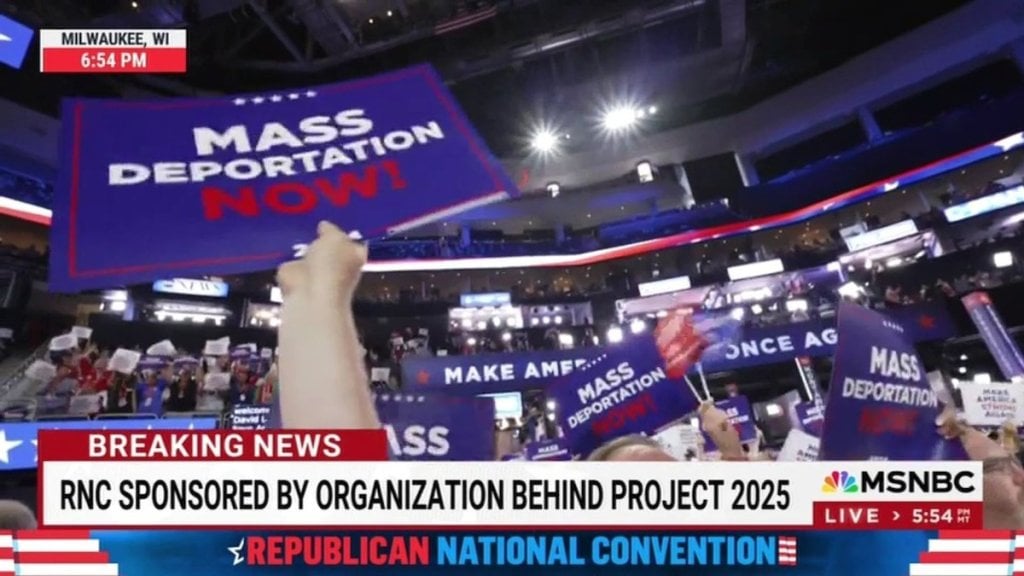
A screenshot from MSNBC, showing

JD Vance is an obvious, bald-faced opportunist. It makes sense that Trump would pick him as his Vice Presidential candidate; they probably understand each other quite well.

It can’t have hurt that a bevy of tech billionaires told Trump to pick him, and it’s not unreasonable to assume they gated funding on that choice. Elon Musk has pledged to give $45 million a month to a PAC newly formed to back Trump; Palantir co-founder Joe Lonsdale, former Yammer founder David Sacks, and VC Chamath Palihapitiya have also raised money for the group. Eponymous Andreessen-Horowitz founders Marc Andreessen and Ben Horowitz pledged donations and Keith Rabois has also reportedly pledged a comparatively paltry $1 million. (The Winkelvoss twins are also donors, but I wouldn’t exactly call them Silicon Valley insiders.)

Andreessen explained why, saying that the future of America is at stake:

Biden’s proposal to tax unrealized capital gains is what Andreessen called “the final straw” that forced him to switch from supporting the current president to voting for Trump. If the unrealized capital gains tax goes into effect, startups may have to pay taxes on valuation increases. (Private companies’ appreciation is not liquid. However, the U.S. government collects tax in dollars.)

One could argue, of course, that the future of America is at stake. As The 19th reported about Project 2025, the Heritage Foundation’s suggested plan for a next Trump administration whose authors include over 140 people who were a part of the last one:

Much of Project 2025 relates to gender, sexuality and race, aiming to end most all of the federal government’s efforts to achieve equity and even collect data that could be used to track outcomes across the public and private sectors.

The other sweeping changes it proposes include firing civil servants and replacing them with Trump loyalists, removing the Department of Education, gutting our already-insufficient climate change protections, reinstating the military draft, conducting sweeping immigration raids and mass deportations, and condemning more people to death sentences while making them swift enough to avoid retrial.

All this despite being on shaky legal ground:

Some of these ideas are impractical or possibly illegal. Analysts are divided about whether Trump can politicize the civil workforce to fire them at will, for example. And the plan calls for using the military to carry out mass deportations on a historic scale, which could be constitutionally iffy.

Trump has lately distanced himself from the plan in public, but privately said something quite different at a Heritage Foundation dinner:

“This is a great group and they’re going to lay the groundwork and detail plans for exactly what our movement will do, and what your movement will do, when the American people give us a colossal mandate to save America.”

For his part, Kevin Roberts, the President of the Heritage Foundation, said out loud on Steve Bannon’s podcast:

We are in the process of the second American Revolution, which will remain bloodless if the left allows it to be.

JD Vance is walking this line too. My employer, ProPublica, recently reported that he, among other things, believes that the Devil is real, and that he had some unpleasant things to say about trans people:

He said that Americans were “terrified to tell the truth” and “point out the obvious,” including that “there are real biological, cultural, religious, spiritual distinctions between men and women.” He added, “I think that’s what the whole transgender thing is about, is like fundamentally denying basic reality.”

So, yes, all things considered, it feels a bit like America is in the balance.

What’s particularly bald about involvement from the Silicon Valley crowd is that they are, according to them, overlooking all of this and concentrating solely on their business interests. If policies like a tax on unrealized capital gains or tighter anti-trust actions are enacted, those investors may have to re-think some of their investment strategies.

For what it’s worth, those taxes are only applicable for individuals with a net worth of over $100M, with payments at an automatic minimum tax rate treated as prepayments against future realized gains. The effect could actually be to encourage startups to go public and realize their value sooner, which wouldn’t be a terrible thing for the ecosystem (but might limit the heights private valuations can reach). Given that people with that level of worth don’t usually make taxable income, this new levied tax on investment gains makes sense as a way to encourage the very wealthy to pay the same sorts of tax rates as the rest of us — but, clearly, Musk, Thiel, et al feel differently. (Invasive thought: where’s Sacks and Palihapitiya’s podcast co-host Jason Calacanis on this? Is he a sympathizer or just an enabler?)

Do tighter regulations and a new minimum tax for the wealthy risk the future of America, though? Maybe they have a different definition of America than I do. If, to them, it’s a place where you can make a bunch of money without oversight or accountability, then I can see how they might be upset. If, on the other hand, America is a place where immigrants are welcome and everyone can succeed, and where everyone has the freedom to be themselves, all built on a bedrock of infrastructure and support, then one might choose to take a different view. The tax proposal at hand is hardly socialism; it’s more like a correction. Even if you accept their premise, single-issue voting when the other issues include mass deportations and gutting public education is myopically self-serving, leave alone the barren inhumanity of leaving vulnerable communities out to dry.

Responses by prominent Republican supporters to the inclusion of a Sikh prayer in Punjabi in the Republican National Convention — one line reading, “in your grace and through your benevolence, we experience peace and happiness” — lay bare what the unhinged Christian nationalist contingent believes in:

Andrew Torba, CEO of the far-right social media platform Gab, ranted to his 400,000 followers on X, “Last night you saw why Christian Nationalism must be exclusively and explicitly Christian. No tolerance for pagan false gods and the synagogue of Satan.” Republican Oklahoma state Sen. Dusty Deevers seemed to agree. “Christians in the Republican party nodding silently along to a prayer to a demon god is shameful,” he posted.

From my perspective, there are no upsides to a Trump win. Even if you accept the idea that Project 2025 has nothing to do with him (which, as I’ve discussed, is laughable), his own self-published Agenda 47 for his next administration is similarly horrible, and includes provisions like sending the National Guard into cities, destroying climate crisis mitigations, mass deportations, and removing federal funding for any educational institution that dares to teach the history of race in America. It also includes a version of Project 2025’s call to fire civil servants who are seen as disloyal. JD Vance wants to end no-fault divorce(ironically, given his running mate), trapping people in abusive relationships. The effects on the judicial system from his first administration will be felt for generations; a second administration will be similarly seismic. He will gut support for vulnerable communities. I have friends who will directly suffer as a result of his Presidency; he will create an America that I do not want to bring my son up in.

Silicon Valley is supposed to invent the future. That’s what’s so inspiring about it: for generations, it’s created new ways of sharing and working that have allowed people to communicate and work together wherever they are. These new moves make it clearer than ever that a portion of it has never believed in that manifesto; that it is there solely to establish itself as a new set of power-brokers, trying to remake the world in their own image. The rest of us need to oppose them with our full voices and everything we can muster.


· Posts · Share this post


Ethicswishing

[Robin Berjon]

This is somewhere between a call to action and a wake-up call:

"If you wish to be moral, you have to also pay attention to whether what you're doing actually works. And the best way to do that is to set up a forcing function for it: that's what checks and balances do."

"[...] Imagination isn't just a trite word to make your heart glow in pulp-class young-adult dystopia — imagination is the ability to depict justice, to see what we ought to aspire to. It is not a gift but rather a skill to hone."

There is an inherent question here about how you can create binding systems that enforce ethical standards - but also, how you can determine which ethical standards actually lead to the outcomes you want to establish.

I think there's a lot here that can be addressed through more distributed equity. As Robin says, "anywhere a powerful entity operates it is at risk of unethical behavior and therefore must be held in check by a control mechanism". One system of control - insufficient in itself but I think still necessary - is to ensure that power is spread among more people who are more connected to the effects of that power.

Distributing equity literally means handing over the means of production not just to workers but to those impacted by the work, reconnecting the decisions to their consequences. I don't know that you can have ethical tech that is motivated by centralized power. As Robin implies: so far, it hasn't worked.

[Link]

· Links · Share this post


Innovation in news is an oxymoron

2 min read

If you’re waiting for permission to build something, or if you want to see how well something has worked for your peers or competitors before you implement it yourself, you will never, ever innovate.

That’s the trap that news media seems to be in: nobody wants to be the first to build something new. Perhaps it’s that times are so dire that experimentation feels like too much of a risk; perhaps it’s just an extension of top-down editorial culture. But there’s nothing out-there in media technology right now. I’m aware of some stuff coming down the pipe that I’m really excited about, but the most innovative thing that’s actually been shipped is getting people to subscribe by addicting them to puzzle games. Forgive me for thinking that’s not particularly exciting.

How can the news industry break out of its shell? How can it act like technology is something that it can shape, rather than something that just happens to it? How can it put value not just in product management but actual nuts-and-bolts technical innovation?

This feels existentially important.

Thinking about it. Working on it. I know I’m not alone.

· Asides · Share this post


Todoist is really good

3 min read

I’m, uh, very bad at task management. I wouldn’t want to pathologize, but I’ve never been a particularly organized person. I’ve always aspired to be more organized, but I’ve never found a tool or a methodology that really works for me. They were either too rigid and opinionated or brought too much overhead: I had to remember to use them, and that was enough of a blocker to not.

Over the last two months, everything has — weirdly — changed.

Someone mentioned Todoist over on Threads, and although I had a vague memory of trying it years ago and it not working for me, I decided to install it again. Maybe it was just the right time for me now, or maybe the design has evolved, but it clicked pretty much immediately.

There are two things that make it great:

  1. It’s everywhere I work
  2. It gets the hell out of my way

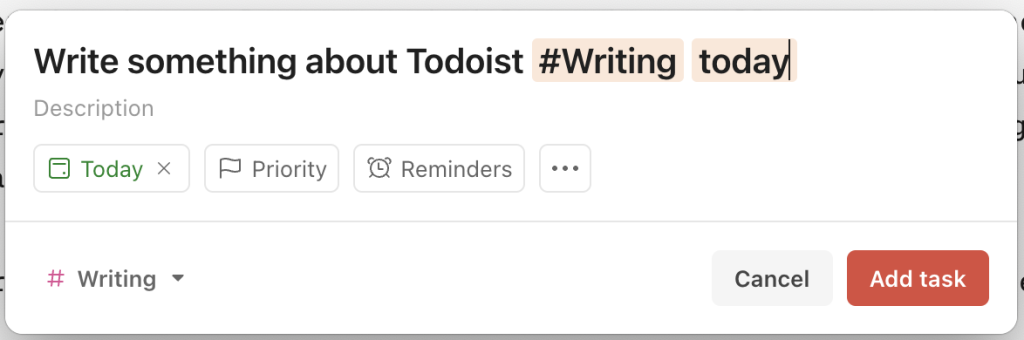
Whenever I need to remember to do something, I press a key combo — I’ve configured shift-command-T — and a modal lets me quickly tap it in using relatively natural language. That’s a similar workflow to what I’ve been doing with Alfred for years and years, so adding this new combo isn’t a giant feat of muscle memory.

Todoist modal

Then, whenever I want to check what’s on my plate, I can bring up the app (desktop via ctrl-command-T, or phone), or click the toolbar icon in my browser to bring up the browser extension version. Because I spend most of my life in my browser, that’s particularly handy. It’s just always there.

Todoist desktop app

I’ve found myself adding new tasks via modal while I’ve been in meetings, so I don’t forget to follow up. Or I’ll be in a Google Doc and add a task the same way. (There’s a way to automatically sync Google Tasks with Todoist, but I don’t use that — I’d rather have direct control over my task inbox.)

It’s made me more productive, more organized, and as a result, much less anxious. And I feel really good about it.

This post isn’t an ad, by the way. It’s just so rare that I really love a piece of software, so I thought I’d let you know.

· Asides · Share this post


15 books that made an impact

A lot of books, piled up in the best kind of bookstore

I really like Lou Plummer’s list of 15 books which made the most impact on him, which I discovered via Tracy Durnell’s own list:

I think you can figure out a lot about a person if you know what books have had the most impact on them. At one point or another, each of these books was my current favorite. They all had a lasting impact on me. I'd love to see your list.

Tracy has smartly split hers up into categories. I’ll do the same here. And just as Lou said, I’d love to see your list!

Formative Books

These books disproportionately influenced me when I was a much younger adult, and helped contribute to the way I saw the world in a hundred ways, from my sense of what was possible to my sense of humor.

  1. The Hitchhiker’s Guide to the Galaxy, by Douglas Adams — I don’t quote it, but the clever irreverence still sweeps me off my feet. A large part of me wishes I was Douglas Adams and always will.
  2. Constellations: Stories of the Future — a mind-blowing collection of science fiction short stories, some of which became episodes of The Twilight Zone and so on. Jerome Bixby’s It’s a Good Lifeand Fritz Leiber’s A Pail of Air are standouts for me.
  3. Something Wicked This Way Comes, by Ray Bradbury — There’s a warm, beating heart at the center of this story, and that’s what draws me in every time (and I’ve reread it countless times). There are better Bradbury books which have probably aged better — you’re probably thinking of them right now — but at the time, it resonated.
  4. Maus, by Art Spiegelman — It was much later until I really understood how my own family was affected by WWII, but I connected to this hard. It was also the first graphic novel that made me really think about the possibilities of the form: something that was clearly far beyond superheroes and fantasy.
  5. The Handmaid’s Tale, by Margaret Atwood — Practically a documentary at this point, but it’s always been a riveting work of speculative fiction that does what that genre does best: help us grasp with elements of our present. To most of us, it’s a warning. To the Heritage Foundation, I guess it’s a manual.
  6. 1984, by George Orwell — It’s hard to imagine a more culturally influential science fiction novel. I love it: although it has a lot to say, I find it to be a page-turner. If you haven’t read Sandra Newman’s follow-up, Julia, run to get it: it’s an impressive work of fiction in its own right that reframes the story in brilliant ways.
  7. Microserfs, by Douglas Coupland — Coupland sometimes reads like a funnier Bret Easton Ellis (which is to say zeitgeisty but hollow — Shampoo Planet and The Rules of Attraction are cousins), but at his best he captures something real. Microserfs gave me that first taste of the community and camaraderie around building software together: it’s set in an earlier version of the industry than I got to be a part of, but its depiction of those early years is recognizable. Even the outlandish characters don’t feel out of place. I don’t think it’s probably aged at all well, but it resonated with me hard in my early twenties.

Motivating External Change

These books helped me think about how we need to change, and what we might do.

  1. The Jakarta Method: Washington’s Anticommunist Crusade and the Mass Murder Program That Shaped Our World, by Vincent Bevins — I’m convinced that every American citizen should read this, in order to better understand how we show up in the world. (Spoiler alert: we don’t show up well.)
  2. Evicted: Poverty and Profit in the American City, by Matthew Desmond — Visceral, accessible, memorable reporting on poverty and housing. Again, it should probably be required reading for American citizens.
  3. The Ministry for the Future, by Kim Stanley Robinson — There’s a very silly passage in this book about the role of blockchain in solving climate change (come on), as well as quite a bit in favor of climate engineering, which I think is highly dubious bordering on terrifying. But at the same time, the novel succeeds at painting a visceral picture of what the effects of the climate crisis could be.
  4. Caste: The Origins of Our Discontents, by Isabel Wilkerson — A key to understanding America. There’s a lot spelled out here that I simply didn’t know, running the gamut from the details of peoples’ everyday lived experiences to the chilling fact that Hitler based his Nazi caste system on Jim Crow.

Books That Changed Me

These books either left me a different person somehow or touched something in me I didn’t know existed.

  1. Kindred, by Octavia Butler — I wish I’d discovered Butler earlier. Her work is immediate and deeply human, and while it shouldn’t have had to change a whole genre, it absolutely did. Parable of the Sower is seismic, of course, and rightly famous. (It’s also getting to be a harder and harder read in the current climate.) But it was Kindred that opened the doors to a different kind of science fiction to me, and through it, all kinds of possibilities.
  2. How High We Go in the Dark, by Sequoia Nagamatsu — I have never read a more effective metaphor for grief and change. I read it when I was in the depths of grief myself, and the way this book captures the nuance, the brutality, and the beauty is poetry. I still think about one chapter almost daily. (It’s the rollercoaster. If you know, you know.)
  3. The Color Purple, by Alice Walker — A breathtaking example of a modern novel: a masterclass in form as well as content. Not a word is wasted in bringing the lived experiences of her characters to life (and through them, so many more). I’ve read this many times, and I’ve never made it through without absolutely weeping.
  4. Bird by Bird: Some Instructions on Writing and Life, by Anne Lamott — So often recommended to writers for really good reasons, Bird by Bird is not just the best book I’ve ever read about writing but also about embarking upon any large project. It’s hopeful, nourishing, actionable, and lovely. Its lessons still motivate me.

Do you have a list of your own that you would like to share? Let me know!

· Posts · Share this post


Introducing Plausible Community Edition

[Plausible Analytics]

"We’re real people who have rent to pay and mouths to feed. We make $300 per month from donations from our self-hosted users. It would take us more than ten years of donations to pay one month of salary for our small team. If we cannot capture the economic value of our work, the project will become unsustainable and die."

It's more than a little painful to see new open source businesses re-learn what I and other open source founders have learned over time.

I'm fully in support of Plausible moving to AGPL and introducing a Contributor License Agreement, but I don't believe this will be enough. Indeed, Plausible is moving to "open core" and privatizing some of the more lucrative features:

"We’re also keeping some of the newly released business and enterprise features (funnels and ecommerce revenue metrics at the time of being) exclusive to the business plan subscribers on our Plausible Analytics managed hosting."

What's particularly interesting to me is that they're maintaining source availability for these features - it's just that they're not going to be released under an open source license.

Open source purists might complain, but I believe it's better for the project to exist at all and use licensing that allows for sustainability rather than to maintain open source purity and find that the developers can't sustain themselves. I'd love for these things to be compatible, but so far, I don't believe that they are.

[Link]

· Links · Share this post


‘It’s about survival’: Athens mayor focuses on getting capital through extreme heat

[Helene Smith at The Guardian]

"Barely six months into the job, the mayor of Athens’s top priority is simple: ensuring that the people of Greece’s capital – mainland Europe’s hottest metropolis – survive the summer. After a June that was the hottest on record, the city has already witnessed record-breaking temperatures and wildfires."

We're deeply into the climate crisis at this point; a major city having to make major changes in order to "survive the summer" is just another example.

When you get into the detail, it's terrifying - particularly considering that we're still only at the foothills of where the crisis will lead us:

“It’s not a matter of lifestyle, or improving the quality of life; it’s about survival when 23% of the green lung around Athens has in recent years been destroyed by fires. It’s vital we have more trees, more air-conditioned community centres and more water stations on our streets and squares.”

Over time, we're going to see mass migrations and real, sustained changes to the way people live. We're also going to see a great deal of suffering. These are things we've been warned about for many decades, but the stories are transitioning from projections from climate experts to being the news headlines.

The onus is on the international community to respond to the crisis with robust energy, but we've been waiting for decades for this to really happen. Instead we get carbon trading schemes and economic deals that don't cut to the core of the problem.

There's an individual responsibility, too. These days that responsibility goes beyond making sensible choices about our own energy use (although most of us don't) and extends to voting, taking to the streets, and making it clear to our leaders that continued inaction is not acceptable.

If there isn't change, wars will be fought over this. In a certain light, they already are.

[Link]

· Links · Share this post

Email me: ben@werd.io

Signal me: benwerd.01

Werd I/O © Ben Werdmuller. The text (without images) of this site is licensed under CC BY-NC-SA 4.0.