Some thoughts on Brendan Eich and Prop 8

I'm trying to decide where I stand on Brendan Eich and Mozilla.

A quick recap: Brendan Eich, inventor of JavaScript and co-founder of Mozilla, became CEO of the corporate arm recently. Unfortunately, he also donated $1000 to Proposition 8, the Mormon-sponsored movement against marriage equality. Mitchell Baker remains Chairperson of the non-profit. She is also the former CEO of the Corporation.

Obviously, as both an educated person and a functioning human being, I'm in favor of marriage equality. I'm happy to put it in those terms: I have never seen an intelligent argument against it. I therefore feel very unconflicted about saying that I'm appalled by Eich's donation to the Proposition 8 campaign.

Here's where I'm conflicted. Eich made the donation, not Mozilla. Mozilla has, at least until hiring Eich as its CEO, been very clear about promoting diversity in all kinds of ways. They're good people, fighting for our rights by creating respectful software. I know many people at Mozilla personally, and they're brilliant. People I'm glad are on our side.

I don't like the idea that my own political beliefs might affect my hiring potential. Freedom of thought is important as a principle. Furthermore, it's not like Brendan was hired off the street: he's been instrumental to Mozilla's progress over the last few decades. He created JavaScript, which helps power the web. I feel like his personal political beliefs, as repugnant as I find them, should not necessarily affect his ability to be professional and run a company.

Where that would be different is if his political beliefs informed his management decisions. That's a tough line to walk; I know my personal beliefs would encourage me to, for example, provide equal benefits for same-sex couples. There are pragmatic, data-driven reasons to take these measures, but it would also be drawn from my own values. Elsewhere, we've seen that the management of Hobby Lobby has made terrible, likely illegal decisions based on their personal beliefs. Mozilla actually has great diversity policies, and is ahead of legislation; there's, so far, no sign of Eich's own beliefs regarding marriage equality showing up in company policy. However, there is obviously a danger that this might occur.

I'm inclined to think that he should be allowed to be CEO of Mozilla and prove his commitment to diversity through his actions.

However. His donation is obviously a terrible signal, and it smacks of blind idealism to suggest that a CEO's personal beliefs don't reflect on the company he or she runs. The reality is that a CEO of a major corporation is scrutinized in all kinds of ways. Mozilla doubtless knew this, and doubtless decided to proceed anyway because of their blind idealism.

I've seen many people say that they'll stop using Mozilla software because of Eich's beliefs. For any corporation, these issues have to be the bottom line. He is actively harming Mozilla by not making a proper statement on these issues and making things right. (I suspect he has non-public reasons for not doing this, which I won't speculate on here.) People are actively choosing to use software that demonstrably spies on you over software created by a company whose CEO has distasteful personal views.

Unfortunately, for a while Firefox was slower and more bloated than other browsers. That's no longer true, but the stigma has remained, and it's been losing out to Chrome in particular for a while. I strongly believe that you should be using Firefox over Chrome, for both ideological and technical standards-based reasons. Firefox does not spy on you, and its complete code can be inspected. Given everything we know about the NSA, GCHQ and corporate surveillance, I think it's a travesty that these issues are playing second fiddle to an idiotic $1000 political donation.

For this reason, I'm also inclined to think that Brendan Eich needs to either step down or step up and make a real apology, both for the good of the organization he represents, and the rights of users on the web.

Like I said, I'm conflicted. Principles vs pragmatism. It's not clear-cut for me.

Update: It's also worth mentioning the Ascend Project, which aims to promote underrepresented populations in open source.

· Posts · Share this post


Seeking an #indieweb alternative to Google Voice

The whole time I've been in the US, I've been using a Google Voice number to communicate.

Here it is: +1 (312) 488-9373.

The reasons are numerous: I can get phone calls on any of my connected devices, even when I'm out of the country. I can change phone service providers at any time. I can make calls in places with wifi but no cellphone reception. I get voicemails as text, so I don't have to listen through an endless series of recorded messages.

Phone numbers themselves are kind of an archaic technology, but it's not feasible to ditch them just yet. So I was disappointed to read that Google Voice is going to be rolled into Hangouts.

That's Google's prerogative. Any silo service provider could make a similar decision at any time. So the question becomes: how can I create my own Google Voice setup on my own infrastructure?

I want four things:

  1. Phone calls that come to me wherever I am, on whatever device
  2. The ability to change phone provider without hassle
  3. Voicemails in my email
  4. Cheap international calls

I also don't want to use Skype or another proprietary provider.

I'm really not sure what to look for here. I know about SIP and Asterisk, but setting up and maintaining them sounds like a pain to me. Is there something user-friendly I can use?

I'll be following up in a subsequent post with what I discover.

· Posts · Share this post


A list of independent, non-military drone projects

Here are some independent, non-military projects involving drones. These are projects that aren't selling drones in themselves, but rather are using drones as the backbone of the project. I've listed a single contact person for each one, which is usually the CEO but may also be the lead engineer:

Deliveries & Commerce

Tacocopter (Star Simpson)

QuiQui: Automated Drone Delivery of Pharmacy Items (Joshua Ziering)

Matternet, a kind of drone postal service (Martin Ling)

Flirtey, "the world's first autonomous aerial delivery company" (Francis Vierboom)

Skymail, "shipping things from door to door in 30 minutes or less" (Lukas Wrede)

Space Leap, robotic transportation (Erik Unger)

Personal Drones

Fleye: Your Personal Flying Camera (Laurent Eschenauer)

Lily, "the first personal autonomous camera in history" (Henry Bradlow)

Fotokite, a kind of flying steadicam (Sergei Lupashin)

AirDroids, which carry a GoPro, sold separately (Chance Roth)

Business Drones

Skycatch, programmable private drone surveillance (Christian Sanz)

Ceres Imaging, spectral data to optimize water and nitrogen for agriculture (Roberto Bunge)

Open Source Libraries

NodeCopter, which powers many of the above projects (Felix Geisendörfer)

Have I missed any? Let me know!

· Posts · Share this post


"Every time a company hires someone who isn't a young male, they run a risk."

Obviously, the title to this post isn't my opinion. Instead, it's a paraphrase of something from a Dave Winer post today:

I don't know if there's any solution to this. I certainly don't advocate not hiring people Roy's age -- I'm now older than he was then. But every time a company hires someone who is not a young male, they run the risk that the new hire isn't there to work, rather is there to scam you.

Dave's assertion is that young males (who are white, he later clarified in the comments) are a safer hiring bet, based in part on an anecdote about a poorly-performing employee he had in 1985. It's also very clearly meant to be analogous to Julie Ann Horvath's experience at GitHub, and not in a positive way.

This is bullshit, and it's important to call it out as such.

  1. Whether intentional or not, the timing of this post demeans the experience of a woman reporting harassment in a major tech company. The implication that she might be a scammer is noxious, but also implied rather than clearly stated; if this is the intention of the post, why not clearly state it, and if it isn't, why was this post published now?
  2. There is no evidence that young, white males are more productive, more trustworthy (!), or better hires in any way. They certainly dominate the industry, but there are all kinds of unmeritocratic reasons for this. Model View Culture is doing a great job of debunking some of these ideas. The solution is smarter hiring and a better culture, not very unsophisticated demographic judgments.
  3. This harms all of us. A monoculture that empowers systemic harassment makes for worse software, a weaker market and a worse experience for our customers. If you're building products for sale, you want to draw on the best possible skills and experience for the job. Why on earth would you limit the kinds of people who can help you based on their gender or ethnicity?

White males like Dave Winer and myself have inherent privilege that must be acknowledged. It's our responsibility (at least partially) to make the tech industry a more welcoming, diverse place. Posts like today's throw all the good, brave work that's being done by vulnerable people directly back in their faces. It's not acceptable, and it must be called out.

· Posts · Share this post


Some things I learned as a technical co-founder

The other day I got an email from someone asking about being a founding CTO of a tech startup. I replied with some brief advice, but it got me thinking: I've been doing this for a decade now, and was creating projects on the Internet for a full decade before that. A hallmark of the teams I've been lucky enough to work with has been the ability to punch far above our weight: online magazines edited by 15 year olds that ended up being distributed by the established press; the number one linked-to site on Blogdex (remember that?); a social platform used by the most prominent universities in the world, as well as national governments and Fortune 500 companies; and a video platform used by some of the world's largest broadcasters. These are solid achievements for groups and companies that, for the most part, contained fewer than 10 people.

The web is rife with articles giving universal advice based on subjective experience. For whatever reason, there's a tendency for technical people to think, "this worked for me, so why aren't you doing things the same way?" I don't think that's usually truthful or productive, so take this post with a pinch of salt. These are my opinions, not a manual.

Nonetheless, if you're just starting out, with few resources, what advice can I offer? Here are a few things I hold to be true.

Enjoy yourself.

Few things are as exhilarating as creating your own thing from scratch - making something from nothing - and releasing it into the world. People will notice if you're loving the experience. Don't lose your joy.

Focus on people.

For "people", read: your end-users, your customers (if they're different), your coworkers.

Your satisfaction must come from pushing code to the user and building something that creates value, rather than the act of programming itself. If you don't like people, and you don't want to interact with people, don't found a startup. If you're starting a business, you need to be relentlessly social (in the human sense), communicate well, and love getting feedback. Otherwise, do something else.

This is a refrain I'll repeat many times below: communication, communication, communication. You need to communicate clearly, and you need to listen, both to your customers and your team.

This is, of course, in addition to having great technical skills. These things together will allow you to build great software.

Understand your responsibilities.

As a co-founder, you are jointly responsible for the direction of the company, and creating an awesome, valuable product.

As the technical lead, you have a lot of responsibilities and pressures on your shoulders. You need to make sure your product or service is technically as good as it can be. You need to ensure that the technical side of the operation is able to meet business objectives. You need to be a software architect, and an infrastructure architect, and a technical designer, and a lead developer. As you grow, you need to be a product manager, ensuring that everyone in the engineering team understands the business goals (and hits them), and ensuring that everyone in the business team understands the technical challenges (and has a sense of the technical realities of your projects).

Ultimately, the technical buck stops with you. If the technology doesn't work, it's your fault. That's fine, but it's therefore doubly important that you are candid with everyone in the team about technical challenges that you might face, and the requirements for success.

Pick the right cofounder.

Before you begin working on a startup, it's also important that you check if your business co-founder or co-founders are able to bring something to the table to the same degree. If you're doing all of this and picking up a disproportionate degree of the business side, you will find yourself quickly burning out, serving nobody. Be a cog, not the engine.

One particular danger is that people see you as someone who can make their ideas a reality; that you will, essentially, build what they tell you to. (In one particularly toxic situation I was referred to as "the back-room guy".) This is an employee relationship, not a co-founder one. The company needs to be a true collaboration between founders, and everyone must have the skills and focus to participate more or less equally.

An oft-quoted metric for finding technical cofounders is if they have a past record of building things under their own steam, and an understanding of the intersection between business and technology decisions. Well, guess what? That applies to non-technical co-founders, too. Do they have a past record of starting their own ventures? (They don't have to be businesses, but their own projects, and so on.) Do they have an understanding of the intersection between business and technology, and the kinds of trade-offs you have to make? They do? Great.

Build small pieces, loosely joined.

Don't fall into the trap of building elaborate frameworks or overly elegant technical solutions. Your role as a startup founder is to test and change rapidly. By building too much of a framework around your code, you lose the ability to react to customer feedback. The ideal is that you can learn as much as possible from your users, and then shift your code to take these things into account.

Nonetheless: always, always, always make sure code is commented and well-documented, no matter how little time you have to spend. Comments are part of the code, not an afterthought, and the people who tell you that decent programmers should just be able to read the source are flat-out wrong.

That you should use decent source control, issue management software, etc, is obvious. When you're starting out, a paid GitHub account should work fine. (I've used Beanstalk, Assembla, and a bunch of other things, and GitHub is more stable, is easier to use, and has the best ecosystem.)

Be proud of your system's code, but be proud of how small, nimble and well-documented it is. Don't be afraid to plug in existing, well-tested frameworks and libraries, as long as they're well suited to your goals.

Don't be trapped into caring what the cool kids think about programming languages. The only material way your choice of programming language will affect your software (within certain bounds, of course) is in the choice of people you are able to hire.

Remember design.

User experience, interaction and interface design will probably come under your remit to begin with. They are the first impression that your product makes. Don't make the mistake of thinking of them as an afterthought (or, as more than one developer has expressed to me in the past, "pretty pictures"). Design is equally as important as architecture. You need to make sure every one of your engineers - as well as the business team! - is thinking in terms of the impression the product you're all making is having on its users, rather than a list of features and capabilities. If you can, bring a professional in to help you with design. It'll make a disproportionate amount of difference (see my note about the team, below).

Expect to scale.

If you're building technology, build it with an understanding of how it'll work when it has 10,000x the usage it does now. A few years ago, there were a lot of articles warning about premature scaling, which is a danger: you can easily sink all of your time and resources into building infrastructure that scales beautifully, when your focus needs to be on shipping as early and as often as you can. Nonetheless, not paying enough attention to scalability is dangerous. The old programming maxim - never assume you're going to be able to come back to anything - certainly holds true in a startup. Ask yourself what'll happen when you exceed the capacity of one server, or five, or fifty. When scaling becomes a business need, you'll need to do it very quickly. You'll have to do work in each case, but if you've thought about it and prepared while you were building, you'll be much more agile.

Again: small pieces, loosely joined, with queues and late binding. You'll thank me later.

Don't skimp on tech, but don't waste money, either.

I've written before about my long, slow journey to Mac. I just think they're better computers: more reliable, faster, and, crucially, more compatible with the software you're probably running on your servers. They're not more compatible than Linux laptops, of course, but there you'll still run into a world of hardware incompatibilities and time-wasting fiddling that you really can't afford. Leave the tinkering to your spare time. The last thing you want to be doing is fiddling with drivers or mucking about with wifi settings when you should be working on your product or your next pitch.

Think about what you actually need. My first Mac was a 2011 Macbook Pro that I upgraded to 16GB of RAM; theoretically it's blazing fast. In fact, though, the computer I use the most is my Macbook Air, which is less than half the cost, and theoretically vastly underpowered. It just works, and the battery is impressive enough to last a coast-to-coast flight. These things matter.

On the other hand, don't buy a peripheral, or something like an iPod Touch, unless you absolutely need it to test or run your software. You don't need to be awash in computers and technology. Just buy the things that affect your business directly, at least to start with. Most of us are gadget-heads to some degree; resist the temptation to buy cool stuff because it's cool.

Strong milestones are good - but it's okay to change the plan.

A set of strong milestones, with associated tickets, allows anyone in the team to get a good sense of the roadmap. I like arranging tickets onto a kanban board, so you can see what people are working on right now, as well as the backlog. Standups are great for this, too, as long as you follow the rules and do it standing up, for a short period. Don't be tempted to devolve into a long meeting; that's not going to get you anywhere.

Sometimes, you'll find that you need to change the plan completely, perhaps to take advantage of a sales opportunity, or because you've realized you need to take a change in direction. Early on, that's both okay and sometimes necessary. You need to be okay with not sticking to the plan, and you need to reassure your team that this isn't a terrible thing. As ever, good communication is key, and it's a good idea to go into the "why"s.

Your team is everything.

When I was working on Elgg, we knew we needed a designer to help build better interactions and interfaces, and create the brand identity for the company. When we found the person we wanted, we paid him more than our own salaries; we had equity, after all, and adding him to the team would create a huge amount of value for the company.

Do your best to hire well, and never hire someone because they're cheap. Sometimes they won't know their own value and it'll work out, and sometimes you'll find someone who is genuinely under-skilled. Either way, by paying them far below market rate, you're screwing them, and that's a lousy footing to start off a relationship on. It's certainly true that you'll have to pay less than many companies, but you can offset that with the freedom that a startup can offer. (Equity and the promise of value later on isn't enough; at this stage, most potential engineers are wise enough to know that share options are a lottery ticket.) If you're creating a corporate, hierarchical environment with all the resource constraints of a startup, and not offering anything tangible in return as people, you're creating a poor working environment. Freedom, trust, and a creative environment are all motivators. It doesn't have to all be about money, although money really does help; salary should be one of the first things you bring up when you can. Employees who are worrying about making ends meet are needlessly distracted.

It's okay to let go of someone if they're underperforming. You should do it early, both for your and their sakes. Sometimes, it's just not a good fit. Nobody likes working somewhere where they're doing badly, and there's no need to be nasty about it; if it isn't working, it isn't working. It's better to end an unproductive relationship quickly than let it limp on. This is, for me, a very hard thing to do. Nonetheless, it's sometimes necessary.

Be nice, by the way. Steve Jobs was famous for yelling at people, and he wasn't alone. It's completely unnecessary, and creates a poor environment. You and your team are allies, and if something's going wrong, remember where the buck stops?

By the same token, your team has to know that if you're asking them to do something, it's for a reason. While you should always be open to the idea that you could be wrong, and interested in listening to opinions from your whole team, everyone does need to know that you have the final say, and that they need to be adhering to the milestones you've set down. (If those milestones are realistic, of course; you need to be receptive to the idea that they might not be.)

Hire well. Get people excited. Be a steward of their well-being, and give them the space to build amazing things. Don't dictate tasks; your team are your collaborators. Talk them through what needs to be done, and why. Smart people question things, so give them reasons.

One last thing: part of communicating clearly is making sure people feel like they can approach you to talk about anything. Your workplace has to be a safe place. If someone is being harassed, or feels put upon for any reason, or they have any concerns at all, they need to be able to talk to you about it without fear of reprisals. Similarly, they need to feel comfortable. If someone's making sexist jokes, or otherwise making anyone feel uncomfortable, it's down to you to stop it.

Everyone should do support.

By which I mean, everyone in the company. It's important to understand the problems your customers are experiencing, and this is a great way for everyone to get a good handle on that. But it's also important for everyone in the company to understand how the product works - something that non-technical members of the team might have less of an understanding of, as they're not in its guts day in and day out. By ensuring that everyone takes support phone calls (if you take calls) and emails, you ensure good product & customer knowledge throughout the team.

It all comes down to empathy.

Good communication is empathic. You need to be able to understand your customers, your team, and your co-founders, and react when you sense that any of them are unhappy. Tech startups may have technology running through their veins, but more than anything else, they still have people at their core. A little love goes a long way.

Good luck!

· Posts · Share this post


4d 79 20 6c 6f 76 65 20 69 73 20 6c 69 6b 65

My love is like base64 encoding. Lossless and incomprehensible.

My love is like an alphanumeric URL variable. Easily escaped.

My love is like JPEG. It looks good at first but it's full of distortions.

My love is like GIF. Surprisingly hard to say out loud.

My love is like Prolog. Backwards.

My love is like git. My pull requests are often denied and rebasing is a mystery to me.

My love is like an unfixed bug. It just keeps escalating.

My love is like emacs. It's been around a long time and I guess I understand the attraction but, honestly, I think you should be looking elsewhere.

My love is like IPv4. Full.

My love is like TLS. A brief handshake and we're set.

My love is like an HTML document. Marked down.

My love is like XMPP. Noisy.

My love is like a legacy PHP function. It's hard to predict the parameters and it might yell some Hebrew at you for no reason.

My love is like an RSS reader. You've got to keep feeding it.

My love is like the web. This is for everyone.

· Posts · Share this post


Elgg, Latakoo & Idno: in defense of weird names

1. Elgg

I've written before about how Elgg got its name. I had just recently graduated, and due to an unwise predisposition for flippant humor, I didn't have a single serious email address to my name. I needed one in order to apply for jobs. My full last name is Werdmüller von Elgg, and a brief search revealed that elgg.net was available. I used ben@elgg.net as my email address for years, without any web presence - so when I wrote a prototype social networking platform for education, it made sense to put it there.

Nobody was very comfortable with the name. Alternatives that were suggested over the years included Learning Landscaper, but none of them stuck. Past a certain point, the project was well-known enough that changing its name would have been silly; and anyway, it was a short, easily-memorized domain name.

Imagine, though, if we'd decided to call it Learning Landscaper. While that fit our original idea, Elgg morphed quickly from a social eportfolio engine for capturing informal learning into a multi-purpose engine that anyone could harness in order to create a social networking site. Had we picked a more domain-specific name, we would have limited our scope automatically, and possibly even unconsciously. Had we picked a more rational name (Engine, for example), we would have possibly isolated Elgg's large non-English-speaking userbase, and cut out a huge number of opportunities to talk about it. I lost count of the number of times someone asked us "what does Elgg stand for?" - it was unusual, and people were curious about it.

In fact, my only real regret is that I no longer have use of my ben@elgg.net address.

2. Latakoo

A latakoo is a kind of African lark: a bird that flies high and fast. For a service that allows people to send media footage quicky from and to anywhere in the world, that makes some thematic sense. But there's a good chance you might have never heard of a latakoo before.

When we were brainstorming names, a close contender was Cloud Compressor. The "cloud" was a big innovation back then, and latakoo achieves the bulk of its speed improvements through data compression. On face value, it makes sense. But not only is it a lifeless set of words, like Learning Landscaper, it thematically contrains what the company does.

Today, compression is just one part of the Latakoo service. It's still core to what we do, but we use it hand-in-hand with advanced routing, access permissions, and both service and datacenter integrations. We take media footage via any Internet connection, and deliver it anywhere, in the format it needs to be, securely. That's in no way covered by Cloud Compressor.

Our customers use us as a verb: "latakoo it". That's both a wonderful endorsement of our service and something that would only be possible with the right kind of name. What do you think YouSendIt were after when they changed their name to Hightail? Try to construct an elegant sentence involving sending something with YouSendIt. Now, switch it out to Hightail. "Hightail it". The kind of word you choose matters, because the sentences people use to describe you affect the way they think about you.

3. Idno

Lately, I've been spending some time with Idno, which I started in order to explore what a social publishing engine might look like on today's web.

It's another weird name, whose origins lie in the very unlively term ID node. I lopped off the de, because I wanted the word to phonetically end in a vowel. The idea was to create something that was at once friendly (I think ending in a vowel makes it feel like a nickname), reminiscent of terms like "ID", "id", "know" and "number", and weird. (It's also sometimes used as an acronym for in desperate need of, and a shortened form of I don't know; neither are bad connotations.) My idea is that people would remember idno in a way that they might not remember a more normal name.

We'll see what happens. I've been talking about perhaps changing its name while I can, but part of me likes having a name that's a little unexpected. Maybe that's because I have a bit of a weird name, too, but I genuinely think that standing out and being a bit skew-whiff to everyone else is a positive trait. There are situations where choosing a very conservative name is appropriate - for example, when your customers are, themselves, very conservative - but typically in technology you want to be seen as innovative.

And the way you are perceived starts with what you choose to call yourself.

· Posts · Share this post


People vs traction is a Rorschach test

From Amber Case's wonderful talk on the Rise of the IndieWeb:

When the storytelling is told by people, not by traction or real implementation, then whoever tells the best story wins.

- Blaine Cook

Her slides are over here.

It strikes me that this quote is a Rorschach test. People like me are likely to have a visceral reaction to this: of course the winner should be dictated by traction and active implementation. Whatever solution to a problem ends up being used is the winner. It makes sense.

But there's going to be a whole other set of people who see this and think, yes! Of course the winner should be the best, most persuasive storyteller.

In technology, I'm pretty adamant that the winner should very rarely be the best storyteller. Of course, in the real world, it's the people who can spin a story (or have some other advantageous property) who often win.

What this really means is that implementers - the people who do the real work - need to learn to tell better stories, as a group. That's why I very much appreciate people like Amber, who are not just deep thinkers and implementers, but also great storytellers. It's an important skill, and being able to convey as well as build multiplies your ability to effect change.

· Posts · Share this post


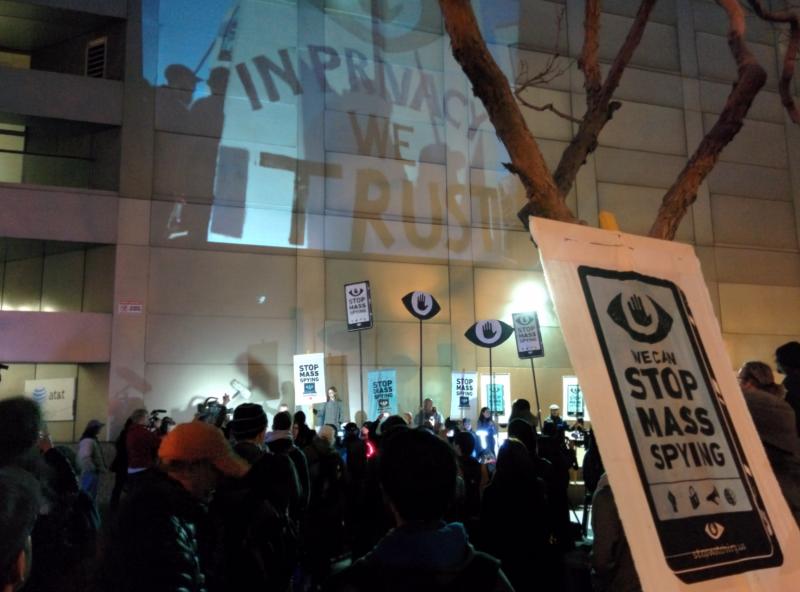
At a demonstration against surveillance, why film all of our faces?

I've just come back from the Day We Fight Back protest, which was held outside the AT&T office where Mark Klein revealed a secret room where the NSA was intercepting communications. Mark himself came out to speak, and it was wonderful to see so many people coming out on the streets of San Francisco to protest against unconstitutional surveillance.

thumb.jpg

There was one thing that I thought was a bit of a sour note. This protest, fundamentally, is about privacy. While I can understand the importance of photodocumenting the event in order to raise awareness and demonstrate support - I took quite a few myself - there was a point where, I think, this crossed the line into unnecessary intrusion. Unfortunately, it was done in the name of Aaron Swartz.

We were encouraged to all stand in a circle, so we could observe a minute's silence in his name. That's great. I was less impressed that we were expressly instructed to form the circle so that nobody was overlapping anybody else. And then horrified when two sets of cameramen went around the circle and filmed every single one of our faces.

This was a brilliant event, created for an important purpose. Surveillance and civil liberties are the key issue of our age, and we must fight to create the society we want to live in. But, while nobody has any legal expectation of privacy in a public space, and while documenting these protests is important, I feel like this kind of recording sends the wrong message.

For transparency's sake, I'd like to know who the cameramen were. But more to the point, I'd urge anyone holding a protest against rampant surveillance to think twice about engaging in this sort of activity themselves.

Nonetheless, this was an important event. At the time of writing, 82,448 calls have been made to congressional representatives supporting legislation that will severely limit surveillance powers in a meaningful way. There's a long way to go, and we need to keep fighting for what is right - while questioning everything that is happening around us.

· Posts · Share this post


This showed the promise of the social web to an aspiring academic. Could it happen today?

Rereading the Guardian article about Elgg, I'd forgotten this detail, which is true:

The idea was conceived in late 2003, when Ben Werdmuller and Tosh were working at Edinburgh University developing e-learning and e-portfolio systems. Werdmuller (an avid blogger) persuaded Tosh (who had just started a PhD in e-portfolios) to start a blog of his own to support his studies. Within a week, Tosh had received comments on his blog from people pointing him to relevant resources and others bloggers had begun to link to him.

Dave and I shared an office at the University of Edinburgh. He was skeptical about blogging at that point, so what I told him was this: start a blog, post every day, and leave a meaningful comment on someone else's blog every day.

I wasn't sure that it would work, but thought that it probably would. Sure enough, within a week or two, he was part of the global elearning community, and was participating in conversations with its thought leaders. It was through this medium that we put out the initial white papers (completely unofficially) that provided the basis for Elgg, which went viral in the elearning community.

Could that happen today? I'm not sure.

· Posts · Share this post


Look Out MyBlogLog - Here Comes Explode (or, how everything changed one Friday afternoon)

The turning point for my first startup came one rainy Friday afternoon, in February 2007.

As TechCrunch reported:

A new open source cross-site social networking service called Explode launched today and looks like a very appealing alternative to the now Yahoo! owned MyBlogLog. Built by UK open-source social network provider Curverider (whose primary product, Elgg, is similar to PeopleAggregator), Explode offers an embeddable widget that links out to users’ respective profile pages on any social network but allows commenting and befriending in one aggregated location. I found Explode via Steve O’Hear’s The Social Web, one of my new favorite blogs.

Steve O'Hear had written:

Although comparisons with Yahoo's MyBlogLog are inevitable, Explode isn't primarily intended as a way to turn an existing blog into a social network, nor as a way to monitor traffic. Instead, think of it as a loosely joined network that works on top of existing social networking sites and blogs, to allow a user of one site to 'befriend' and communicate with a user from another.

Curverider co-founder, Ben Werdmuller, says that Explode is very much a 'work in progress', and that they are already working on an API, and also have plans to add support for OpenID.

Dave Tosh and I had been working on Elgg for three or four years at that point, and had obtained a two-person office above a bookstore in Summertown, an affluent area in North Oxford, awash with coffee shops and restaurants. Our startup was fully bootstrapped; not a single penny of investment had been put in, except for our own work, and the non-monetary support of the people around us.

As Februaries in England can sometimes be, it was a cold, overcast day, with nothing to recommend it. Because we were bootstrapping, we had been working hard, as always, and we were exhausted. Also because we were bootstrapping, our waistlines had seen the effects of long hours in front of the computer sustained only by relatively cheap food, so we'd decided to buy ourselves gym memberships and try to go regularly. (I think we managed eight or nine times.)

As we worked out, we decided that, screw it, we weren't going to work on Elgg for the rest of the day. There was nothing to be gained, we were feeling kind of burned out, and surely there had to be something more fun we could do.

Elgg was a full-blown social networking engine, and although we later completely rewrote it, it was still a pretty powerful piece of software used by companies and institutions all over the world. And I had a simple idea.

When we got back, I got to work widgetizing all of Elgg's functionality: writing templates that would take pieces of its output - the friends list, for example - and embed it in JavaScript such that it could be made to display on any website. This was back when people still had websites where people could embed HTML and JavaScript, and the effect would be that any website could be part of a larger social network. That wasn't a small idea: it captured questions people were already having about siloed sites, and would later be tackled by projects like Google Friend Connect. (Of course, the IndieWeb movement is answering those questions today.)

search_three.gif

Dave created a template for the site so people could sign up and get their widgets. At the last minute, we created a logo. I made it in about 5 minutes in MS Paint, which seemed appropriate for a hacky site, and we both agreed that a ridiculously bad logo was probably good: it captured the scrappy ethos of the whole afternoon project.

explode.png

After four hours of work in total, we made it live, and pinged some people we knew, like Marshall Kirkpatrick, who at the time was a TechCrunch writer (now the CEO of the excellent Little Bird), and Steve O'Hear, who had previously written about us in the Guardian. For us, it was a bit of a lighthearted thing we'd put together at the end of the week, and we didn't really expect anyone to cover it. To his credit, Dave proactively got in touch with everyone anyway.

Boom. Steve wrote about us, and then Marshall wrote the story on TechCrunch. This was more coverage than the tech press had ever given us.

The fact that we had executed quickly on our idea, which in turn had developed out of having worked on social networking platforms for years, mattered. The fact that we didn't try and make it perfect, or spend ages putting it through careful design cycles or product feedback loops, was unimportant. We had a working first version, and we put it in front of people, who thought it was compelling. This directly led to many more customers for Curverider, as well as our first investors, who got in touch because they had seen the coverage.

Those four hours of work - and the quick decision to muck about, be creative, and follow our whims for an afternoon - literally changed the fate of our company, and both of our careers.

· Posts · Share this post


We can still bring back net neutrality. And we should - for the sake of the Internet.

Net neutrality is the principle that "Internet service providers and governments should treat all data on the Internet equally, not discriminating or charging differentially by user, content, site, platform, application, type of attached equipment, and modes of communication." In other words, all of my Internet data is treated the same, whether it's from Netflix, Skype, Baidu, your personal website, or a startup nobody's heard of. If I'm competing with Netflix, I can't pay your access provider to have my movies stream faster than theirs.

When net neutrality rules were adopted in the US by the FCC in 2010, the conservative Wall Street Journal columnist John Fund disingenuously painted it as follows:

The Federal Communications Commission's new "net neutrality" rules, passed on a partisan 3-2 vote yesterday, represent a huge win for a slick lobbying campaign run by liberal activist groups and foundations. The losers are likely to be consumers who will see innovation and investment chilled by regulations that treat the Internet like a public utility.

These rules were themselves a compromise, which neither pleased conservatives like Fund, nor net neutrality advocates. However, it did ensure that Internet traffic saw some protection.

Fund was flat-out wrong. The Internet should be a public utility; whereas some have tried to paint net neutrality as being a set of anti-business principles, they in fact protect the Internet as an open marketplace for innovation. The rules ensure that businesses will not be penalized on the network for being new, and allow new technologies and approaches to flourish. Removing these rules allows ISPs to control the market, whereas a utility Internet ensures that free trade is possible.

Verizon, the US telco formerly known as Bell Atlantic, had been fighting to overturn the FCC ruling for commercial reasons:

And in court last Monday, Verizon lawyer Helgi Walker made the company's intentions all too clear, saying the company wants to prioritize those websites and services that are willing to shell out for better access.

She also admitted that the company would like to block online content from those companies or individuals that don't pay Verizon's tolls.

On January 14th, Verizon won.

The implications are that net neutrality is dead and buried, and that carriers can begin to charge the fees for access that Verizon referred to. In turn, this may open the floodgates for unequal access to the Internet everywhere; although the FCC only has jurisdiction over communications in the United States, enough of the Internet is transmitted over the domestic backbone to make a difference.

Not only does that affect the quality of the Internet and the ability for new Internet businesses to operate - it also, together with last year's extensive NSA revelations, disproportionately affects American Internet businesses. One of the founding principles of the Internet's architecture is that traffic can be re-routed; why wouldn't other nations begin to work around the United States's compromised network?

All is not necessarily lost. Michael Copps, a former FCC commissioner, recently wrote that broadband should be reclassified as "telecommunications".

On Wednesday, Copps wrote a blog post titled, "The Buck Stops At The FCC," calling upon the commission to "reclassify broadband as 'telecommunications' under Title II of the Communications Act." The effect of that move would be to designate Internet service providers as "common carriers," making them subject to increased FCC regulation.

Common carriers "transport goods or people for any person or company and [are] responsible for any possible loss of the goods during transport" - as opposed to contract or private carriers, which may refuse to carry anyone else's goods. This would effectively turn the Internet into the utility John Fund was so afraid of.

Copps continues:

Without this step, we are playing fast-and-loose with the most opportunity-creating technology in all of communications history. Without this step, we are guaranteeing an Internet future of toll-booths, gatekeepers, and preferential carriage. Without this step, we stifle innovation, put consumers under the thumb of special interests, and pull the props from under the kind of rich civic dialogue that only open and non-discriminatory communications can provide.

Lest we think it's as simple as this, the EFF recently released its opinion that the FCC can't - and shouldn't - save net neutrality. Granting the organization power over the Internet itself gives it too much power to regulate what has been, traditionally, an open, international medium:

Internet users should be wary of any suggestion that there is an easy path to network neutrality. It’s a hard problem, and building solutions to resolve it is going to remain challenging. But here is one guiding principle: any effort to defend net neutrality should use the lightest touch possible, encourage a competitive marketplace, and focus on preventing discriminatory conduct by ISPs, rather than issuing broad mandatory obligations that are vulnerable to perverse consequences and likely to be outdated as soon as they take effect.

The Internet is a marketplace; there can be no doubt about that. I think that the incumbent businesses coming out against net neutrality tend to be ones deeply entrenched in old technologies: after all, both telephone and broadcasting are effectively technology businesses. They just happen to be ones whose underlying technologies are obsolete. Their businesses are hurting because something better has come along, which is meeting the needs of consumers in a more efficient way, and they're struggling to adapt.

Too bad. The Internet will win, and with it, consumers. There is nothing to be gained by restricting it; certainly not in the long term. Net neutrality will create wealth, it will create jobs, and it will set the stage for innovation for decades to come.

· Posts · Share this post


RIP Pete Seeger. He will be missed.

I grew up on American folk music. My fondest memories are gathering with my extended family in Massachusetts to sing informally. I knew the lyrics to This Land is Your Land or Charlie and the MTA long before I knew the words to anything they would play on the radio.

I also grew up with progressive values. On the American side of my family, there have been union leaders, college professors, thinkers and writers; people who cared about social justice, for whom the works of people like Pete Seeger were meaningful. As the New York Times writes:

His agenda paralleled the concerns of the American left: He sang for the labor movement in the 1940s and 1950s, for civil rights marches and anti-Vietnam War rallies in the 1960s, and for environmental and antiwar causes in the 1970s and beyond. "We Shall Overcome," which Mr. Seeger adapted from old spirituals, became a civil rights anthem.

He was in a group called the Almanac Singers, which also included Woody Guthrie, another legendary progressive folksinger. Their album Talking Union and Other Union Songs was admitted to the Library of Congress as a historically significant recording. Union Maid is on that album, as well as a famous recording of Which Side Are You On?; but it's the lyrics of Talking Union itself that I think are particularly brave. It was originally written in the 1940s, in the midst of World War II - and then re-released at the height of the McCarthy era!

If you want higher wages, let me tell you what to do;
You got to talk to the workers in the shop with you;
You got to build you a union, got to make it strong,
But if you all stick together, now, ‘twont be long.
You'll get shorter hours,
Better working conditions.
Vacations with pay,
Take your kids to the seashore.

He was the kind of artistic hero who embodied the values I aspire to, and who does not seem to exist anymore.

Over on MetaFilter, I commented:

He was, sadly, blacklisted for being a communist, and recognized as a living legend by the Library of Congress. An anti-war singer, a champion of workers rights, a Rock and Roll Hall of Fame inductee and a children's entertainer; an undeniable part of America's cultural history. I enjoyed this full-length concert with his half-sister, Peggy.

Here's his version of If I Had a Hammer, which he co-wrote; there's also a Smithsonian Folkways episode about him, which is an hour long and a free download.

· Posts · Share this post


Trading games in the playground, trading games on the web

Like a lot of people, the thing that first got me into programming was games. I'd learned rudimentary BASIC as a kid, but it was as a teenager that I started to get a taste for the thrill of making something and sharing it with other people.

Adventure games had always been my favorite. I remember playing a port of the Colossal Cave Adventure; later, I got hooked on Infocom's very well-written output, particularly the Hitchhiker's Guide to the Galaxy game, which was co-written by Douglas Adams himself. Finally, I came across LucasFilm Games, who published The Secret of Monkey Island, which is still my favorite piece of digital entertainment of all time. (Honorable mentions from other genres include SimCity 2000, Railroad Tycoon and Populous; to my shame, I never got into Civilization.)

But it wasn't those games that inspired me to build.

Whereas Monkey Island and its brethren were produced by companies that sometimes felt like (and sometimes literally were) movie studios, the shareware games movement was a rich mine of scrappier, but somehow more creative games. Jeff Minter's Llamasoft was probably the pinnacle of this; its game Llamatron was an off-kilter take on Robotron: 2084 but featuring a llama that battled against mutant Coke cans, Mandelbrot fractals and Mr Potato Heads. (It's worth mentioning that I've never been particularly interested in illicit substances, although I can't speak for Mr Minter.) Its anarchic design was liberating, and it felt doable. It was actually doing some sophisticated things behind the scenes, but nonetheless, for a beginner coder, Llamatron felt within reach.

I started learning as I wrote in Prospero Pascal, and then shared what I'd built with my friends Marcus Povey and Tom Nunn, who were also building. Something happened that was new to me: I felt playfully competitive with them, and everything they built spurred me to try and create something better. It was a virtuous circle. We were 14.

My first game involved a simple maze that was slowly revealed as you walked around it, cribbed in part from one that Marcus had already written. Subsequently, each game became a little more sophisticated. The Numerator ("he's always on top") was a take on Llamatron with a wave audio backing soundtrack. Mr A Goes For a Block was a psychedelic take on Sokoban that made it onto some early-90s shareware CD-ROMs. I wrote a space game with 3D starfields and a collaborative maze game where you flipped between two characters at different ends of the same labyrinth who needed to work together to get out. My crowning achievement, eventually, was Mr Sheepz, another game clearly heavily inspired by Jeff Minter, wherein you had to eat sheep grazing in increasingly-complex fields before giant sheep-eating snails got to them first.

And then I turned my attention to the web and never looked back.

Lately I've become aware of a whole new subculture of independent game developers, who have been experimenting with new forms, narratives and designs, using the web as a medium. Using HTML5 and JavaScript, sometimes in conjunction with engines like CreateJS, Turbulenz and many, many others. Others are building mobile apps; others are building the same kinds of full-screen desktop games that I used to.

My friend Tef recently moved into a flat of indie games devs, one of whom organizes an event called The Wild Rumpus, after Where the Wild Things Are:

It was in August 2011 in a glamorous Nandos (a sordid middle-class chicken hut chain where every dish tastes like cayenne pepper dissolved in lemon juice) that George says he was asked to help form a committee to hold something called ‘The Wild Rumpus’. The Wild Rumpus is game roughhousing: the informal event takes place in a hired bar, features simple lo-fi multiplayer games you can play with friends between drinks. They use projectors and huge screens, and the games are always visually mesmerising, competitively thrilling, or require players to engage in social theatre lubricated by beer. It’s always busy, and there is as much pleasure in spectating the bright colours and social friction that the games bring as there is in actually playing games there. “Closer in spirit to party, playground, or even drinking games, these are all games that you can’t play at home on your own” it is declared. The atmosphere is in between that of a game night with friends and an electro-pop club night with extremely well-behaved patrons.

At the first XOXO, meanwhile, one of the standout moments was discovering a game called Johann Sebastian Joust, which is played by multiple people with controllers, but no screen. It's the kind of game that blurs genres, but that's not the point; it's fun, sometimes hilariously so, and the technology creates a framework that feels like an augmented playground. Indie Game: The Movie, screened at the same event, is as inspiring as any movie about individual creativity.

Games never really went away, but the interconnectivity of the web, the openness of our platforms and the ubiquitous availability of simple technology means that there's more opportunity to experiment than ever before. It's not all about running and shooting things, which I've always found pretty snoreworthy (dalliances with the original Wolfenstein 3D and Doom aside).

It's been a while. I think it would be nice to pick up some tools and build some stupid fun.

· Posts · Share this post


We're looking for some people to help us. #ios #php

My employer, Latakoo, is an enterprise media management company. We help people send files - mostly video, but we're expanding - really fast using any Internet connection.

A lot of our customers are involved in news and journalism. Here's a sample:

It's not uncommon for us to get support requests from journalists in places like Syria who need to get footage out quickly and securely. Shortly, we expect to talking to people in Sochi a lot.

So here's the thing. We're a small, very agile (with a small "a") startup, and we need a little bit of help getting some of our upcoming projects out the door. They're all high profile, directly affect customers who themselves high profile, and are full of really meaty, interesting engineering problems. Oh, and they're based out of Austin or San Antonio in Texas.

Here's what we need:

  • A freelance Objective-C iOS developer to help us with our completely redesigned iPhone and iPad apps.
  • An experienced freelance PHP developer to help us build our media management interfaces, further expand our international file upload network, and integrate with things like ElasticSearch and CloudFront. Knowledge of HTML5, WebRTC and real-time application development are a big plus.

Sound interesting to you? Great. Email me at ben@latakoo.com, and let's talk!

Please, please, please, no agencies, offshore or otherwise. I want to work directly with individuals, and you have to be local to Austin or San Antonio.

· Posts · Share this post


How idno handles #POSSE syndication to third-party sites #indieweb

Last week at Homebrew Website Club, I was asked how Idno syndicates to third-party sites like Twitter when I post content.

Here's how it works.

First of all, Idno has a plugin system, that allows new functionality to be added system-wide. As well as new kinds of content like slide presentations, plugins are available that interact with the APIs of Twitter, Facebook, Foursquare and Flickr.

When I install any of those plugins in Idno, I'm taken through a process where I register my Idno site with the third-party API. Each of those sites has a slightly different process, but in each case it takes about 30 seconds.

Once the link has been made, the plugin shows up as an option in Idno's user settings screen. I click "settings", and then click a button to link my account to the site:

52ddc8a9bed7de923bd9b28b

This is exactly the same procedure as logging in with any of those sites, or attaching any third-party application. It's about two clicks: in the case illustrated above, I'm taken to Twitter, which asks me to confirm that I want to give Idno permission to use my Twitter account, and then taken back to my Idno settings. Internally, my OAuth token for that site is saved to my user account.

Here's where things get interesting.

Remember I said that Idno's content types are also provided via plugins? There's a plugin for status updates, for photos, blog posts, events, etc etc. Whenever I want to add a new content type to Idno, I add a plugin. (They're really easy to write; the presentations plugin was written in about an hour, while I was recovering from a root canal operation.)

As well as descriptive content type - "status update" - each plugin announces a generic content type that maps to those used by the activity streams specification. A status update is also a "note"; a blog post is an "article". This allows plugins to extend functionality for certain kinds of content without dictating which plugin you use for that content. Someone can add extra logic for status updates, while not caring which status update plugin I actually use.

When I post new content, the system pulls up an interface supplied by that content's plugin, and also asks any syndication plugins if they're able to handle content of this type. So when I click on my "status update" button, Idno asks plugins if they're able to syndicate content of type "note".

Idno automatically renders some buttons for me based on those plugins. If I enable the "Twitter" button, my content will be syndicated to Twitter when I post it. If I enable the "Facebook" button, it'll go to Facebook, too. If I later decide to add a button for Path or LinkedIn or Friendster via a plugin, it'll show up there, and work in exactly the same way, without me having to change any of the status update plugin.

529a339fbed7ded008743763

When I hit Save, the syndication plugin receives information about the content type (but not which plugin created it), as well as information about my account. It retrieves my API token from when I linked my account through my settings panel, and uses that to sign an API request posting the content to that site. It then retrieves the URL of the syndicated content and saves it to the local content in Idno, so a "syndicated to" link can be displayed underneath it. (Check at the bottom of this post's page: you'll see a link to Twitter.)

This process works throughout Idno. Photos (of generic type "image") can be syndicated to Facebook, Twitter and Flickr, and while the logic is different for each site, the user interface flow is the same for each one. This works whether I'm posting from a laptop or a phone, and whether I'm on the standard web interface, a custom interface or the API.

It's important to note that none of this takes much time, for any of the parties involved. Writing a content plugin takes about an hour; writing a syndication plugin can take much less time, if the third-party API uses OAuth. Site admins can install a plugin and set it up in a few minutes. The process for the user takes mere moments, and that's the most important thing.

· Posts · Share this post


The NSA is counter to everything America stands for.

Bruce Schneier had to brief a branch of government on a government agency today:

This morning I spent an hour in a closed room with six Members of Congress: Rep. Logfren, Rep. Sensenbrenner, Rep. Scott, Rep. Goodlate, Rep Thompson, and Rep. Amash. No staffers, no public: just them. Lofgren asked me to brief her and a few Representatives on the NSA. She said that the NSA wasn't forthcoming about their activities, and they wanted me -- as someone with access to the Snowden documents -- to explain to them what the NSA was doing. Of course I'm not going to give details on the meeting, except to say that it was candid and interesting. And that it's extremely freaky that Congress has such a difficult time getting information out of the NSA that they have to ask me. I really want oversight to work better in this country.

If there's this level of government oversight on the NSA - i.e., practically none - and if the NSA is actively spying on government, which seems likely, it's fair to describe them as a superlegal organization. They're effectively above the law, above the government, and above democracy. All in the name of security. Is this the kind of agency that should exist in a country whose stated principles all relate to representative democracy and individual freedom?

· Posts · Share this post


I'm making 50 pieces of art. Do you want one? #indieweb

The following is doing the rounds on social media. It sounds like fun, so I thought I'd adapt it:

I, Ben Werdmuller, promise to send a small work of art for the first fifty people who comment on this post by replying from their own website. Twitter or Facebook is not enough. Just link to this post and let me know you want in; I'll update this and provide an easy way to do that shortly. (If you're a developer, you can get started right away.)

***You may in turn post this on your own site and make something for the first fifty people who comment they want in on your post.***

The rules are simple: it has to be be your work, made by you and the recipient must receive it by the end of 2014 . It can be anything: a drawing, photo, video, a conceptual work of art or anything in between ...

· Posts · Share this post


Trust but verify (or why Firefox is my primary browser, & why we should be wary of h.264)

This weekend, Mozilla CTO Brendan Eich called on the world to examine Firefox's source code to protect it from NSA intrusion:

Through international collaboration of independent entities we can give users the confidence that Firefox cannot be subverted without the world noticing, and offer a browser that verifiably meets users’ privacy expectations.

Firefox is the only major web browser that's fully open source; by extension, it's the only browser that can be publicly verified to be free of unwanted surveillance code (and other malware). This is a great example of how open source software is more secure, and can be more trustworthy than closed source platforms.

However, browsers are more than their core, so it's important to bring up the issue of plugins and components. These are not necessarily as verifiable, so users should proceed with diligent caution. (Perhaps a site could be established that verifies software and plugins in an auditable way?)

For example, the closed-source h.264 video codec has typically not been supported by Firefox's core code. Instead, the browser links to operating system libraries if they exist, or can use the Adobe Flash plugin to play these videos. In most cases, neither the OS libraries nor the Flash plugin are open source, and therefore are not verifiable. Additionally, you may remember that Cisco has released a component that will allow for cross-platform h.264 support:

We plan to open-source our H.264 codec, and to provide it as a binary module that can be downloaded for free from the Internet. Cisco will not pass on our MPEG LA licensing costs for this module, and based on the current licensing environment, this will effectively make H.264 free for use in WebRTC.

Note that it's the binary module, not the open source codec, that will be license-free, and this is what will be incorporated into Firefox:

We are grateful for Cisco’s contribution, and we will add support for Cisco’s OpenH.264 binary modules to Firefox soon. These modules will be usable by downstream distributions of Firefox, as well as by any other project.

This remains a great move by Mozilla, because it opens up sites like YouTube (and latakoo) without forcing users to install Flash, but it does mean that the h.264 codec component in Firefox will be unverifiable. In turn, this continues to highlight the importance of truly open source, license-free media codecs, not just to maintain a healthy software development ecosystem, but to protect all of our privacy, too.

The problem is not that there aren't any open source h.264 implementations; it's that the MPEG-LA issues licenses for the technology based on patents it controls, which effectively means that anyone who wants to create h.264 files at scale must build significant license costs into their model. Cisco's binary distributions include an agreement that they will pay for these license costs.

It's worth noting that Mozilla continues to work on Daala, its fully open source codec, and Google has made some strides into kind-of-license-free video with VP9. However, h.264 has established itself as a standard - we use it at latakoo for that reason - and is unlikely to be displaced in the near future.

· Posts · Share this post


Workwashing & "do what you love"

thumb.jpg

I found this piece about the "do what you love" mantra challenging:

By keeping us focused on ourselves and our individual happiness, [Do What You Love] distracts us from the working conditions of others while validating our own choices and relieving us from obligations to all who labor, whether or not they love it. It is the secret handshake of the privileged and a worldview that disguises its elitism as noble self-betterment. According to this way of thinking, labor is not something one does for compensation, but an act of self-love. If profit doesn’t happen to follow, it is because the worker’s passion and determination were insufficient. Its real achievement is making workers believe their labor serves the self and not the marketplace.

It goes on to describe how this way of thinking actually erases peoples' work:

But by portraying Apple as a labor of his individual love, Jobs elided the labor of untold thousands in Apple’s factories, conveniently hidden from sight on the other side of the planet — the very labor that allowed Jobs to actualize his love.

The whole piece is worth reading.

I don't think it's completely right, but there's no doubt that "do what you love" comes from a place of privilege, and is only available to a small subset of people. It certainly shouldn't diminish the work done by other people, as the article rightly points out. And there is an implied distinction there, which implies that someone is somehow less of a person if they aren't in the privileged position of being able to work in a particular way.

That implication is unjust, and harmful in a variety of ways. From a technology standpoint, I find myself coming back to the obvious questions: How can we empower? How can we help remove these kinds of divides? And then wondering if these are the right questions at all.

· Posts · Share this post


Objectives and Key Results look like an interesting way to grade company performance

I like the sound of the Objectives and Key Results system that Google uses:

First, you set up an Objective. Then you set up a number of "Key Results" that are quantifiable that will help you hit your objective.

Your objectives should be definitive and measurable. Don't say, for instance, I want to make my website prettier. Say you want to make your website 30% faster. Or you want to increase engagement by 15%.

This is great, but only if every single person in the company does it. If you limit OKR to certain people, for example engineers, then you create a two-class system: people whose performance is graded, and people who aren't. Everyone up to and including (and in some ways especially) the CEO needs to be a part of the system.

On a Google Ventures post about the system, Rick Klau clarifies:

Low grades shouldn’t be punished [...] OKRs are not synonymous with employee evaluations. OKRs are about the company’s goals and how each employee contributes to those goals. Performance evaluations - which are entirely about evaluating how an employee performed in a given period - should be independent from their OKRs.

Makes sense, right? It encourages employees to set ambitious objectives, and ranks the company as a whole on how its constituent members hit their targets. I think the transparency - everyone can see everyone else's OKRs - is an important facet of that.

Have you used them? How did they work out for you?

· Posts · Share this post


What I love about Silicon Valley

I enjoyed, but didn't fully agree with, TechCrunch's piece Silicon Valley Lost, And Found:

However, in other ways, what drew my mother and my grandfather here is very much alive. A desire for non-conformity and a grandness of aspiration still exists in certain entrepreneurs here. The 150-year-old Gold Rush mentality lingers on in the engineers who show up every year from all over the world to try their luck at starting new companies. The Valley’s unique cultural language around materialism and status persists. While it does get flashier every year, there is still a certain discretion about being well-dressed or having a nice car here, at least compared to New York or Los Angeles.

"Non-conformity and a grandness of aspiration" is what I love about working in tech. I find subversion comforting, so find a lot to love in cities like Berkeley, Oakland and San Francisco (just like I enjoyed the anarchic artistic scene in Edinburgh). As well as the cultural environment in those places, which developed independently of the technology industry, I enjoy tech's ability to look at the status quo and decide that it can be made better. Contrast that with many industries, which remain stagnant, or worse, start to see themselves as institutions.

But let's not forget the petty bigotry and wealth-imbalance-related issues that have started to come to a head this year. Or the more-and-more audacious displays of wealth. That "discretion" about materialism that the author discusses is important to me; even in the short time I've been here, it's become more and more visible to me. I'm interested in what I consider to be the "real" Silicon Valley, by which I think I mean the "authentic" one: the one that's about making things better with your skills, rather than people turning up because they think they can make a fast buck.

The difference is illustrated ably, earlier in the article:

Working with bankers and traders also wasn’t the same as dealing with founders, engineers and hackers day in and day out. People were sharp, but they didn’t love their work - not the way my grandfather or dad did. Jobs in banking were a means to accumulate year-end bonuses and holidays. They didn’t spend their spare time messing with a half-dozen oscilloscopes or building makeshift telescopes.

Those people - the folks in the basement with their oscilloscopes and telescopes, tinkering on their own terms - are my heroes. The people with that nerdy tinkerer mentality, and the freedom to pursue it that is still fairly unique to Silicon Valley, are the ones who changed the world, and will keep on changing it.

It's not written about much these days, but out there in the rest of the world, engineers still draw scorn. You hear them being talked about as "back-room guys", with the implications that the other, "normal" people should be front of house. Geekdom is still niche, and in places, taboo. And that's one of the other things that makes Silicon Valley special - here, geeks have freedom to be themselves, outside these constraints. And it turns out that when they have this freedom, they create the world's most valuable companies, develop transformative technologies, and so on.

This is important. What worries me a little about the latest trends are that the engineers have been co-opted into a resource by incoming people with dollars in their eyes. Factories of willing developers are being established based on the promise of the previous generation, and the lottery-like idea that maybe your company will succeed to the tune of millions, or billions, of dollars. As one engineer told me at a well-funded company that will remain unnamed, "yes, you work weekends, but everyone else does too, so your coworkers kind of become your family." That's nothing short of a bullshit deal, and it seems to me that this kind of exploitation risks killing what's special about the Valley. It also perpetuates the inequalities we've heard so much about this year.

But the non-conformist geek engineers are still there, tinkering on their own terms, side-by-side with San Francisco's counterculture, which lives on. It's one reason why I've fallen in love with the community (and its spin-off, Homebrew Website Club). These movements are no less likely to change the world, but they're on our terms, for us and for everyone, rather than the predatory desires of a generation of hopeful MBAs.

· Posts · Share this post


Designing exercise into my daily routine.

I hate gyms. At their best, I'll stick a podcast on, hook myself up to a machine, and do a circuit of resistance training to follow. If it's a good podcast, I will have learned something, but I don't think they're interesting, and I don't think they're real exercise. I also don't think that one burst of exercise is as healthy (or feels as good) as spreading exercise throughout the day. I've never been good about building them into my routine.

My career and livelihood also demands that I sit in front of a computer all day, at high levels of alertness. This isn't a recipe for good health, and it's not uncommon (although, I think, less common now!) to see laptop warriors swigging at soda or chugging a Red Bull to keep their energy up. I don't want to be that guy, and the two to three cups of coffee I drink a day already worry me.

I grew up in Oxford, a town where walking is easy; it was as fast to walk the two miles into the city center from my house as it was to catch the bus. So I learned to walk everywhere - something I continued to do when I moved to Edinburgh, and something I still try and do here in the US. It's harder here, even in cities like San Francisco; in some parts of America it's actually a kind of taboo to walk instead of take the car. I hear there's also some kind of obesity epidemic these same places. I'm shocked.

Walking everywhere - six miles or more a day, according to Fitbit - has always been my number one form of exercise. Here, I have to be a bit more careful about it. My work is based in Austin (I'm the outlier here in the Bay Area), and don't have an official office, so I could just pay for something that suited me; I chose Local Office, a perfectly-placed spot in West Berkeley that meant I automatically had a 3 mile walk built into my day. I took another hour to stroll around for lunch, and I had my six miles. This last year, I started to build in other forms of exercise; sometimes, when nobody was in the office and I was at a stopping point on whatever I was working on, and nobody else was around, I'd drop and do 20 push-ups. By the time the office closed, I'd worked my way up to 100 a day. (And lost over 15 pounds.)

Local Office is sadly gone. These days I often work out of RockIT Colabs, a coworking / maker space (they have an office upstairs, 3D printers and welding stations downstairs) right on the edge between Chinatown and the Financial District in downtown San Francisco. The community is perfect for me, but even factoring in my BART ride from Berkeley, the exercise isn't quite there. For some reason, I've also lost my habit of jumping up from my desk and walking around or doing some intensive exercise whenever I hit a stopping point. (The ability to drop and do some exercise with impunity is one of the few benefits of working from home over a shared office space.)

I'm having once again to think more explicitly about exercise - I'm definitely gaining weight, despite mostly eating well and doing the right things - and may, once again, have to try and join a gym. Or I might consider becoming a runner. Or something else.

If you're sat in front of a computer all day, what do you do to keep yourself healthy?

· Posts · Share this post


I will not be a dopamine monster: saying "no" to social media addiction.

The moments when I do my best thinking are always the quiet ones. All my devices are off, there's no sound around me except for (when I'm lucky) the gentle breeze through the trees, or the swish of far-off cars. My mind is at peace; uncluttered and uninterrupted, while at the same time free to meander.

Which is at odds with where my brain is for most of the rest of the time. Compared to many of my peers, I use a relatively small number of devices on a regular basis: really just one phone and one laptop. Nonetheless, I find myself checking social media potentially hundreds of times a day. I'm a dopamine addict, and I'm pretty sure it's killing my creativity, concentration and productivity.

I'm not alone. Earlier today, Tantek Çelik adapted an old saying for the modern age:

In the land of the distracted, the singularly focused person is king.

But how negatively is social media affecting the way I think?

Note that the problem is with multitasking, not lack of focus. Unfocused thought can be an advantage:

In recent years, however, scientists have begun to outline the surprising benefits of not paying attention. Sometimes, too much focus can backfire; all that caffeine gets in the way. For instance, researchers have found a surprising link between daydreaming and creativity—people who daydream more are also better at generating new ideas. Other studies have found that employees are more productive when they're allowed to engage in "Internet leisure browsing" and that people unable to concentrate due to severe brain damage actually score above average on various problem-solving tasks.

The results regarding multitasking, however, are not so positive. Clifford Nass, a psychology professor at Stanford, noted the effect of multitasking on students at his institution, specifically with respect to smartphones:

The research is almost unanimous, which is very rare in social science, and it says that people who chronically multitask show an enormous range of deficits. [...] We have scales that allow us to divide up people into people who multitask all the time and people who rarely do, and the differences are remarkable. People who multitask all the time can't filter out irrelevancy. They can't manage a working memory. They're chronically distracted.

They initiate much larger parts of their brain that are irrelevant to the task at hand. And even - they're even terrible at multitasking. When we ask them to multitask, they're actually worse at it. So they're pretty much mental wrecks.

Furthermore, just as second-hand smoking has effects beyond the original user, this multitasking behavior affects others too:

On a test following the lecture, students in view of multitaskers performed significantly more poorly than those who weren't in view of multitasking. The difference was 17 percent, enough to drop a solid A to a B-. Less surprisingly, a second study confirmed that the multitaskers themselves, not just those who incidentally witnessed multitasking, similarly suffered a drop in performance.

I've struggled with low self esteem for much of my life, which is associated with dopamine levels, and may make me more susceptible to this kind of addiction. Regardless of whether there's any truth to this or not, in 2014, I want my brain back.

Already, I've reduced my social media usage by posting to my own site here at werd.io rather than directly to the silos in question. This month, I'm reducing the number of quick-fix sites and networks I participate in, and have already jettisoned Instagram and Snapchat. It's not that I'm becoming an Internet hermit; instead, I want to focus on the kinds of content and interactions that are enriching to me. If I'm learning, growing and being productive, that's great. If I'm persisting because I get superficial rewards with no real lasting value to me, then it's time to jump ship. Long-form communication and engaging conversations are important.

As is spending more time with everything switched off, a cup of tea in my hands, leaves rustling in the breeze.

· Posts · Share this post


Here's what I want to do more of in 2014.

It's traditional to create resolutions for the new year. I've been thinking a lot about where I want to take my work in 2014; these are some ideas.

Write.

Specifically, I want to write more for other people, following from my previous work for the likes of ZDNet, IBM DeveloperWorks and Packt Publishing. I'm also interested in guest posting on blogs and sites around the web, about the social web, , open source and responsible application development.

Empower independent content creators.

How can we put independent creators on a level pegging with the world's largest media companies? One thing I've been thinking about is that 24-7 news channels are obviously not a future-facing content medium given the web, where you can look up breaking news whenever you want, wherever you want, from whomever you want, without having to wait for a newscaster to restart their 30-minute cycle. Despite the ease of the web, leaning back and watching TV (or some screen) is sometimes pleasurable. Could you create a video newscast that aggregates stories from multiple providers based on your interests and context? Google News meets CNN?

Help support niche communities on the web.

The strength of the web is that we can all publish and communicate with each other, in a variety of different media, and it can all interlink as a single, continuous mesh of conversation and information. Unfortunately, that strength has been undermined by the proliferation of data silos, which make it harder to establish these kinds of links, and also limit certain kinds of content, topics and conversation through conservative design.

There are so many things to talk about, in so many ways, and by limiting ourselves to the platforms that the likes of Facebook provide, and by funneling the value generated by our communities to those sites, we're not using the web to its full potential. I want to help support the full range of communities on the web, and help them be self-sustaining, so that the people who create safe spaces for niche topics can continue to maintain them.

Idno is certainly a part of this idea, and I will continue to develop it as a first-class social publishing platform for both groups and individuals.

Figure out open source for designers.

Open source software suffers by treating designers like second-class citizens.

The open source process for programmers is well-established: we have many different flavors of version control, and the tools that surround them are first-class. I'm as happy as I've ever been working with Git, and software like GitHub and GitLab.

Working with design media is harder. Not only is it hard to represent visual changes using version control, and manage them in a sensible way using our project management tools, but even the accepted file formats for design work are closed. Photoshop comps are the norm, and UX wireframes often use closed software like Omnigraffle. That's because those tools are absolutely the best ones for the job, but standardizing on those formats make it harder to build open tools for design collaboration. And even with this aside, issue trackers are all written with source code in mind.

Collectively, this all means that welcoming designers into an open source community is extremely difficult. Nonetheless, design is an extremely significant part of any software project. It's worth thinking about the first steps towards making this easier.

Build bridges.

It's hard to share from, eg, the Twitter app to my own website, whether it's based on Idno or something else. I'm planning on building a shim that allows me to do that more easily, based on Android's share dialog. But there's more to do. There are ways to take ostensibly closed platforms and find ways to pry them open. For example, functionality to share closed content by email can be used to integrate directly into other, open software. Other integrations are possible, exploiting "growth hacking" features designed to find more people to lock into these platforms.

Work from everywhere.

I've still never been to Seattle. Or Tokyo. Or Melbourne. And it's been too long since I was in London, or Oxford, or Edinburgh. I want to travel more, and use the fact that I can work anywhere there's an Internet connection - and that I am not responsible for a family at this stage in my life - to see more of the world.

If you'd be willing to host me at your office for a few days, wherever you are in the world, let me know!

· Posts · Share this post

Email me: ben@werd.io

Signal me: benwerd.01

Werd I/O © Ben Werdmuller. The text (without images) of this site is licensed under CC BY-NC-SA 4.0.