State of the nation

My colleagues at The 19th just launched our first nationwide poll:

In the weeks leading up to the 2022 midterm elections, The 19th and SurveyMonkey teamed up to conduct a poll to find out what women, particularly women of color, and LGBTQ+ people think about politics, politicians and policy.

It’s an important survey, and there were some interesting findings.

For example, 70% of Americans don’t trust politicians to make abortion policy:

That distrust spans the political aisle: 70 percent of Republicans and 74 percent of Democrats said politicians were insufficiently informed about abortion. It was also consistent across men, women and gender-nonconforming Americans.

LGBTQ+ Americans are more likely to experience healthcare discrimination:

Twenty-four percent of LGBTQ+ Americans said they had been blamed for their health problems while visiting a health care provider, compared with 9 percent of non-LGBTQ+ people. For LGBTQ+ and gender-nonconforming people, or those who said their gender was not male or female in addition to being LGBTQ+, that number jumped to 40 percent.

There’s significantly more to explore. You can read more over on the 19th News/SurveyMonkey poll homepage. And the full data is available to explore over on SurveyMonkey’s site.

· Posts · Share this post


The world is not designed for equitable parenting

So far, I’ve been the primary nappy-changer in my child’s world. That’s not virtue signaling or trying to make a point: it simply seems fair that, given that I’m biologically incapable of breastfeeding or carrying a child to term, I help out where I can.

Aaron Hoyland’s tweet the other day is exactly how I feel:

Putting baby change stations in the women’s washroom (and maybe the family washroom if there is one) but not the men’s washroom sends a very clear message about whose responsibility you think raising children is, and frankly, I hate it.

The world isn’t set up for equitable co-parenting. Bathrooms are one example. Don’t click through to the tweet if you’d like to skip being angry for a morning: the comments are dominated by people making excuses for dads not changing their children, or trying to argue that it’s women’s work like we’re back in the forties. A mother’s sacred duty, apparently, is to be the sole person cleaning their child.

I’m completely on board with having changing tables in every men’s bathroom. I intend to use them; please give them to me. In return, I will spend money in your establishment.

Unfortunately, this chauvanistic design mentality doesn’t stop at bathrooms. They’re everywhere. I call them “mommy defaults”.

I’ve discovered that a lot of the parenting apps we use - primarily Huckleberry, which allows us to track events like diaper changes and different kinds of feedings - don’t provide for more than one parental user account. If both parents want to track events and gain access to the log, they need to share a password. We’re not logging frivolously (our child needed to go to the ER for dehydration on their first night home), and it’s crucial that we both have access to this data.

Even the Snoo, our expensive and overtly high-tech smart bassinet, only allows for one account. If we want to track sleeping and adjust settings, we once again have to share passwords. It’s not incredibly difficult to use a shared 1Password vault, but I expect most parents default to using something easily memorable, and therefore easily hackable.

Finally, the biggest, most irritating version of this is that every provider - starting with hospitals and pediatricians - wants to have a single parental contact number. Go visit parenting forums and you’ll find message after message complaining about this, for good reason. The assumption that there’s one primary carer in parenting is deeply baked into institutional service design, and perpetuates inequality every time it arises. As the dad, I really want to take on my fair share of making appointments, dealing with administration, and otherwise caring for my child.

You can take the boy out of startups, but you can’t take startups out of the boy, apparently. My solution has been to treat our baby like a call center and set up a 24/7 virtual support line using a tool designed for that purpose. Now, we can provide a single number for text messages and calls, but we’re both essentially baby support agents. Whoever picks up first takes the call. It’s not the cheapest, but I couldn’t find an app or other solution that would allow us both to effectively be primary carers in someone’s database. Our own contact details are abstracted away.

The nice thing about this solution is that it also allows for additional caregivers. For example, I have to wonder how my friend David Jay - who is an adoptive third parent - deals with these design defaults. Families come in lots of shapes. Many people also care for children in a communal, village-like environment. Creating a baby call center allows you to bring anyone into that circle, even temporarily. Obviously, I’ve been using tools for business sales and support to achieve this, but maybe there’s a genuine startup here?

There are real cultural headwinds to overcome: just go back to those replies to Aaron’s tweet. Lots of people have lots to say about the place of fathers vs mothers, using language that isn’t far off from “a women’s place is in the kitchen”. They must be overcome, and they will be.

If you’re designing a parenting app or service, I implore you: dads are carers too. Please let us be by giving us full access to services designed to support our child. We’ll reward you with our loyalty. The dads are ready.


Photo by Kelly Sikkema on Unsplash

· Posts · Share this post


A letter to my mother on the event of my child's birth

Dear Ma,

My child was born last Friday. I wish you could meet them.

The first time I saw their face in person (strikingly similar to their 3D ultrasound, but here, not an echo of a person but a real-life human being in front of me), they couldn’t breathe. The doctors whisked them away to a table, and I followed quickly, dumbly, the delirium from sleeplessness and from the surrealism of it all instantly snapping into pure, adrenaline-fueled presence. They put a mask on their face and applied pressure to their lungs, asking each other why they weren’t crying. Finally, there was a sound, like a tiny grunt. And then a little sigh. Finally, they opened up into a small cry; then, another, louder one. The smallest little human I’ve ever seen, finally arrived. I fell in love immediately.

The last time I saw you, just over a year ago, you were in a bed in the same institution, your donated lungs breathing fainter and fainter. I kissed you on the forehead and told you I loved you. You’d told me that what you wanted to hear was us talking amongst ourselves; to know that we’d continue without you. In the end, that’s what happened. But I miss you terribly: I feel the grief of losing you every day, and never more than when my child was born.

They’re so incredibly cute. I just want you to see.

I’ve been thinking about the cassette tape recording we have of when I was born. “It’s a baby!” you exclaimed, and we’ve always thought it was funny, because what else would it be? But I now understand that the enormity of that moment is stunning: a potential human made up of ideas and imagination, that we can only guess about, turns into a real-life human being. It’s a baby. Holy shit. Everything suddenly changes. Everything.

(I want to digitize that recording. Tapes degrade. It might even be gone already.)

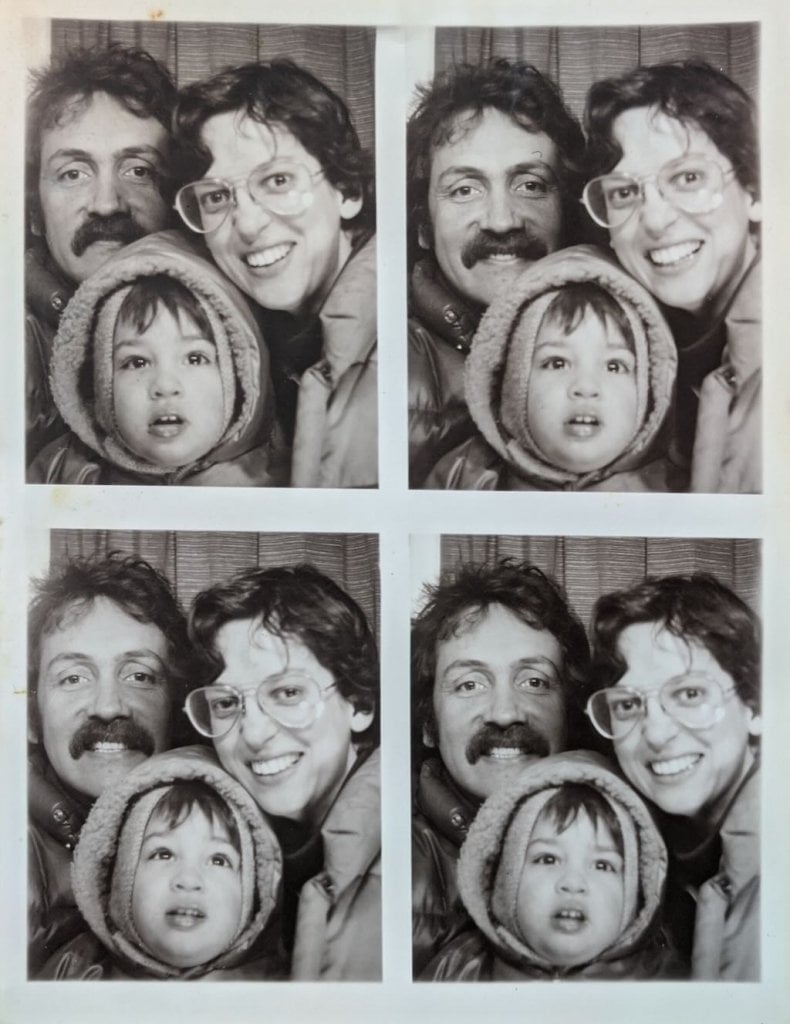
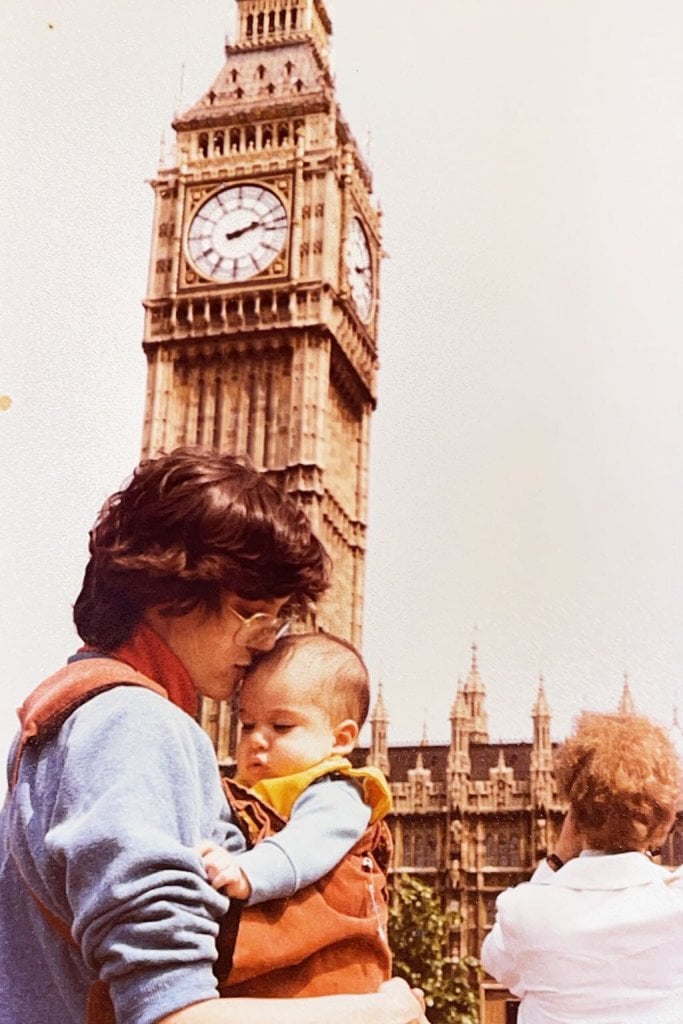
You were always so good with children. Famously so. Babies loved you; children loved you. Every photo I have of you with a child is of you looking delightedly at each other, fully present in a joyful interaction. When you did your career about-face and became a schoolteacher, it was the most natural thing in the world, because it just made official what you’d always done. Of course, I saw the benefit of that care and love, too. I wish they were able to feel it directly. As it is, in this worse universe that doesn’t have you in it, I’ve been intentionally trying to channel you. I’ve been trying to imagine how you would have shown up with them, and what your advice for me would have been. I’ve been trying to convey that good-humored warmth I always felt. You made me feel safe: physically, yes, but more than that, emotionally. I want to make them feel safe, too: to be who they really are.

They have the privilege of a tightly-knit family. I can’t wait to introduce them to my dad, and to my sister, who are the best people I know. I want them to be deeply involved in their life. You will be too, through us, but I wish it could be through a hug or smiles or belly-kisses.

I guarantee you would have loved them. I guarantee they would have loved you.

Erin’s quickly turned into such a good mother, Ma. She really is; you’d love it. She’s so attentive, and smart, and worried about them, and prepared in all kinds of ways that I would never think to be. So far, we’ve made a pretty good parenting team. There’s so much to learn, so much to get better at, so much to worry about. But she’s good. It’s fun to think of them having fond memories of her in the same way I have fond memories of you.

It’s also weird to think of them thinking fondly of me in the same way I love my dad. Those bonds are strong. I have trouble thinking about anyone loving me deeply, but I know I love deeply, and my dad is one of the people I love the most, so the possibility is there. I hope I can live up to that for them. It’s scary to think about.

I remember, very early on, going on a protest march with you. As a child, I inherited your buttons and proudly wore messages to ban the bomb and embrace renewable energy. (Those slogans seem like ancient history now, but also still so relevant.) Progressive values and the value of protest were normalized for me. Living in Oxford, we were surrounded by university, and you were both life-long students, so I was raised in an environment of debate and deep thought. Because I had parents who talked about the world, both around me and to me, I had a better sense of my place in it. I want that for them, too.

We seem to be backsliding into a world where nationalism is a respected value, and where fierce individualism trumps all, even as we plunge deeper into a climate crisis whose only real solution is for us all to work together. We have to think globally, as one people, and we have to care for people on the other side of the globe as if they were our neighbor. We have to call out our own governments when they oppress others, at home or abroad, and we have to be forces for equitable, inclusive, collaborative kindness in a world that is dominated by competition and profit. We seem to have forgotten the importance of community, and of acting collectively - or, worse, rejected it, as if being an actively participative part of a fabric of interconnected souls somehow impedes our individuality. On the contrary, I think it uplifts us. In a world where we all have a duty of care for each other, we can more truly be ourselves.

I got that from you.

I wish those ideas were a given, but they’re going to have to fight for it. We’re constantly re-litigating the same arguments about religion, bodily autonomy, the climate, when we could be building on what we’ve learned to climb ever higher. Their world will have fewer resources, constrained by a heating planet. If it also continues to have widening inequality and an addiction to wealth hoarding, it will also have more conflict. It will be a worse place to live: more dangerous, more authoritarian, more brutal. “Building a better world for our children” is no longer an abstract sentiment for me, and my fear is that they will have this realization one day too: they may find himself wondering how to show up to make a safer, kinder world for their child.

We need to make more progress.

You described yourself as having been radicalized. That word means so many things: to me, your values were never radical. They were simply common sense. We need to take care of each other; we need to love our neighbors, and understand that everyone is our neighbor; we need to undo systems of oppression and inequality. You worked for affirmative action and stood up in court to establish and protect the rights of tenants over landlords. You marched and donated to causes and let your worldview be known. You were a force of light in the universe, not just for how you acted towards everyone who knew you, but how you showed up in the context of wider systems. If you were radicalized, I guess I hope I am too.

You had no time for people who didn’t care about others: hardcore conservatives, neo-reactionaries, libertarians, and fascists. You cared about fairness and inequality. You were an ardent feminist. You were an anticapitalist. You believed in true representative democracy. You continued to learn and evolve your understanding of systems of oppression. I love all of those things about you - just a fraction of all the things I love about you. I want to model that way of thinking and acting for my child.

I want them to have broad horizons, and to understand that all of this - everything - can be changed for the better. Change is inevitable; how we change is up for grabs.

You were always so flexible: so up for the adventure. You traveled thousands of miles to have me in Europe. By the time I was three years old, I’d lived in four cities. As time goes by, I’m more and more impressed by your ability and willingness to just up and leave and try something new. My life has been much better off for it. I think your life was much better off for it.

Remember living in Oxford? You had that upstairs office above Daily Information, where you’d work on predictions for the telecoms industry - you predicted the rise of cellphones, home internet, ubiquitous broadband - while our Jack Russell terrier, Tessie, would patiently sit in her bed. At noon precisely, she would walk over to you to let you know it was time to take a break, and you’d take her on a walk to Port Meadow. Both you and my dad took classes when you wanted to, often just to improve your knowledge for its own sake; you didn’t have to worry about return on investment, or healthcare or education costs for your family. It all just worked, so simply. I miss that lifestyle. I miss the peace of it all: the lack of fear that comes from real support.

So I’m now faced with a similar question to the one you must have been considering. The US is such a big country, and it contains so much, but it’s also so isolated, and by extension, so isolationist. Save for tribal nations, you can drive for thousands of miles without hitting another country. It would be easy to grow up here and have a very insular worldview: look at all the people who swear blind that “America is the best country on earth” but have never lived or spent much time anywhere else, and who consider blind patriotism to be a virtue rather than the cult-like ignorance it is.

When we build software, we learn that the settings we choose to be the defaults are incredibly impactful: those defaults permanently affect how someone will use the product you’ve made. It seems to me that this is even more true in life. Regardless of the choices they make later in life, the defaults I give my child will permanently affect their worldview. By traveling around and seeing the way different people live, not on a tour bus but immersively over time, we learn that there are lots of valid alternatives; we meet and get to know lots of ways of being, and understand that ours is not better than theirs. If we don’t, I’m worried that the way the community around us lives becomes the default, and that the rest of the world becomes a little scary. My child has multiple passports to draw on; they will have the ability to live in, or at least visit, so many places. It would be such a missed opportunity to not give them that perspective. The more easily we can all relate to people from different nations, the easier it will be to have a globally-minded, kinder world.

Make no mistake: I know you would want me to make sure they see alternatives to living like we do here, and I will make sure that I do. So much is wrong. Every school shooting is shocking, but the safety drills they make children do are almost as terrifying; the ideas that are traded as normal are so brutal. Violence is ingrained everywhere. What kind of country watches little bodies be slaughtered and refuses to take any kind of meaningful action? We still kill prisoners. The police commit murder. And we call this civilization? I don’t want my child to grow up thinking any of this is normal. They need to see that it’s a uniquely American problem by spending a lot of time outside of America.

But for all they can learn from it, international travel itself has a climate impact that is worsening the conditions that will make life harder for them over the coming decades. I don’t know how to reconcile that: I don’t think the world is better if people don’t travel. You often told stories of the times you lived in Italy, or Israel, or the UK before I was born. Your parents visited countries all over the world and often took you with them. We traveled often around Europe in particular. Maybe it’s because I inherited that background, or because our own relocations made my sense of place less tethered, but I think the ability to see the world face-to-face should be as accessible as possible.

I think you’d have a smart way to think about that, or to look at it from another angle. You might, I think rightly, point out that the bulk of the climate crisis lies in the hands of corporations and industry. That they spend time and dollars on casting the blame elsewhere. But you’d also care and worry about your own contribution: you wanted an electric car before most, you wanted solar, you supported renewable energy and the politicians who supported it.

As I write you this, my child is fast asleep, lying skin-to-skin on his mother. His face is unbothered by any stress or worry. He hardly cries. When he wakes up, I’ll check his nappy, keep him clean, and we’ll feed him. We’ll talk to him, and play with him, and sing and tell him we love him, and let him drift back off into slumber.

There are people in the world who would wish this sweetest human harm. They’re part-Jewish; they’re from more than one place; they are not being raised to believe in a religion; they are going to be raised to be in opposition to wealth hoarders and rent-seekers and nationalists, in a culture of broad, inclusive love. These would-be-objectionable traits are all the products of dead-end mindsets that should have withered away in the 20th century. With a small amount of luck they’ll live to see the first decades of the 22nd century, and I imagine those ideas still be with us then. But I hope they will be fringe by then, and I hope my child has a part to play in their demise. They do not deserve to define what the rest of us do.

I grew up knowing that my father and his family lived through a concentration camp when he was just a toddler; that my maternal grandfather was captured by the Nazis and thought dead; that my great grandfather escaped White Army pogroms in Ukraine. I heard my grandmother screaming through the walls every night as her dreams took her back. Through my family and the ripples trauma leaves across generations, I understand the consequences of hate. And I understand that the definition of “fascist” isn’t predicated on death camps and goose-stepping; it isn’t set in the early 20th century. It’s a mindset rooted in nationalism, tribalism, and the noxious idea that some people are inherently better than others. It’s an idea that did not go away at the close of the Second World War, is not limited to any nation (of course Americans can be fascist), and is so pernicious that my child and their children will both need to be aware of its toxicity, long into the future.

The period we’re living through now may be just the very beginning stages of a world with fewer resources controlled by ever-fewer people, who will use increasingly-authoriarian methods and appeals to existing divisions to try and maintain their holdings at the expense of others. Ma, the only way I can see through this is by living how you did: with kindness, by not holding back our opinions, and by active work to make everything better.

You showed me the way. I’ll try and do my best.

I love you. I miss you. I wish you were here.

· Posts · Share this post


Reading, watching, playing, using: August, 2022

Happy Labor Day to everyone who celebrates the organized labor movement today in the US. This is my monthly roundup of the books, articles, and streaming media I found interesting. Here's my list for August, 2022.

A note: it’s taken me a while to hit publish on this post because our son was born on September 2nd. We instantly fell in love. More on that soon. For now, please understand if my posting frequency plummets for a little while.

Books

Fiction

The School for Good Mothers, by Jessamine Chan. A ton of ideas about parenting, society, and the present moment, crammed into an emotional near-future science fiction story. I wish the protagonist had been more sympathetic - but the future it paints is alarmingly plausible.

Notable Articles

Business

Workplace Productivity: Are You Being Tracked? “Two years ago, her employer started requiring chaplains to accrue more of what it called “productivity points.” A visit to the dying: as little as one point. Participating in a funeral: one and three-quarters points. A phone call to grieving relatives: one-quarter point.”

The organized labor movement has a new ally: venture capitalists. “White’s solution is to plan an “exit to community.” Once the company starts earning income, it plans to buy out its investors and give their equity to the unions it helped organize, effectively transitioning corporate control to the customer base.”

American Express' platinum-level duplicity. “American Express’ decision to begin donating to Republican objectors reflects the desire of some in the business community to put the events of January 6, 2021, behind them. That, according to an open letter recently signed by former American Express CEO Kenneth Chenault and other prominent business leaders, is a big mistake.”

Varo layoffs are a sign of neobanks’ struggle to break even. ““Most American neobanks cater to lower-income customers, who previously may have incurred overdraft, [non-sufficient fund fees] and maintenance fees at big establishment banks,” Mikula told Protocol. “But these consumers also tend to be higher credit risk, making it challenging to lend to them. No U.S. neobank has built a meaningful lending business.””

Climate

California to Ban the Sale of New Gasoline Cars. “The rule, issued by the California Air Resources Board, will require that all new cars sold in the state by 2035 be free of greenhouse gas emissions like carbon dioxide. The rule also sets interim targets, requiring that 35 percent of new passenger vehicles sold by 2026 produce zero emissions. That requirement climbs to 68 percent by 2030.”

The temperature threshold the human body can't survive. “When the wet bulb temperature gets above 95 degrees F, our bodies lose their ability to cool down, and the consequences can be deadly. Until recently, scientists didn’t think we’d cross that threshold outside of doomsday climate change scenarios. But a 2020 study looking at detailed weather records around the world found we’ve already crossed the threshold at least 14 times in the last 40 years.”

Women are working to make the clean energy transition more equitable. “Women are disproportionately facing the impacts of the climate crisis: They are more likely to be displaced by climate disasters, and due to lower-paid jobs, caregiving responsibilities and the wage gap, they have less economic means to recover and adapt to a changing climate.”

Crypto

More Than Half Of All Bitcoin Trades Are Fake. “More than half of all reported trading volume is likely to be fake or non-economic. Forbes estimates the global daily bitcoin volume for the industry was $128 billion on June 14. That is 51% less than the $262 billion one would get by taking the sum of self-reported volume from multiple sources.”

Insider Trading in Cryptocurrency Markets. “We find evidence of systematic insider trading in cryptocurrency markets, where individuals use private information to buy coins prior to exchange listing announcements. Our analysis shows significant price run-ups before official listing announcements, similar to prosecuted cases of insider trading in stock markets.”

Feds Blacklist Tornado Cash, Ban Ethereum Mixing Tool in US. “In a Monday announcement, the body added the Tornado Cash website and a long list of Ethereum addresses to its Specially Designated Nationals list, banning American citizens from using the tool or transacting with these addresses.”

Pearson Sees NFT, Blockchain Helping Making Money From E-Books Sales. “The chief executive officer of Pearson Plc, one of the world’s largest textbook publishers, said he hopes technology like non-fungible tokens and the blockchain could help the company take a cut from secondhand sales of its materials as more books go online.”

Culture

Queer YA books are selling in record numbers despite bans targeting them. “Of the close to 5 million units of LGBTQ+ books sold in 2021, the biggest absolute gains in this market came from LGBTQ+ YA books, which saw an increase in sales of 1.3 million units from the previous year. Queer YA is more popular than ever — no longer a niche category, but redefining what is mainstream for teen readers.”

As list of banned books in schools grows, ‘soft’ censorship is spreading. “Free speech advocates say these practices are as troubling as bans — particularly when the books singled out overwhelmingly have themes related to race, gender and sexuality and are written by authors who are women, LGBTQ+ and/or people of color.”

Billy Bragg on the difference between the backlash to Salman Rushdie and Jerry Sadowitz. “Over the past decade or so, Rushdie has sought to return to some sort of a normal life, despite the threat hanging over him. The fact that he continued to take the stage at literary events is a tribute to his belief in freedom of expression and he has been rightly commended for his bravery.”

Doctor Who casting director: "We’re casting more disabled actors". “It’s more interesting. Also, if you can’t cast diversely on Doctor Who, what show can you do it on? It goes everywhere, on this planet and others, and you don’t want to see the same kind of people all the time. You don’t want it to be exclusively middle-class white people speaking with RP accents.”

on leading a purposeless life. “Maybe it is okay to not pursue potential and just be okay with being. Why must there be a reason for everything?” Beautiful.

Author Salman Rushdie attacked on lecture stage in New York. “He has said he is proud of his fight for freedom of expression, saying in a 2012 talk in New York that terrorism is really the art of fear.”

Interview: Jake Novak on His Infamous SNL TikTok Video. “Honestly, as horrible as the internet has been to me in the past six weeks, I have really enjoyed this hiatus. I’m getting to see my friends more and just have more meaningful experiences in real life.”

Democracy

Why I Changed My Mind on Student Debt Forgiveness. “It is simply impossible for students to work their way through college in the way previous generations could. And at the same time, states have reduced funding to their public colleges that historically allowed schools to charge low tuition prices.”

We reject the free speech-trampling rules set by J.D. Vance and Ron DeSantis for covering their rally. “Think about what they were doing here. They were staging an event to rally people to vote for Vance while instituting the kinds of policies you’d see in a fascist regime.”

John Mackey: Whole Foods CEO says ‘socialists are taking over’ schools and gun control debate. ““My concern is that I feel like socialists are taking over,” the multi-millionaire organic grocery magnate said. “They’re marching through the institutions. They’re… taking over education. It looks like they’ve taken over a lot of the corporations. It looks like they’ve taken over the military. And it’s just continuing.””

Second Gentleman Doug Emhoff leans in to being a voice for gender equity. “Emhoff is the first second gentleman to the first woman vice president, and for him, tackling gender inequality in ways big and small felt like a natural, and critical, component of creating this role. He is actively attempting to model for others what it means to be an ally in actions, not just words.”

It's Manly Man Summer at the Claremont Institute. “In a piece titled “Men and the Future of America,” Klingenstein praises senator Josh Hawley for a speech trumpeting the “masculine virtues.” And what are those? They are, according to Klingenstein, “stoicism, competitiveness, conquest, achievement and aggression.” These are qualities to be managed, not repressed, because repressing them turns them toxic, into “dysfunctional behaviors—crime, drugs, pornography, and the like.”” I find this ideology so repulsive, so baffling.

How the Claremont Institute, home to Trump lawyer John Eastman, rose and fell. “Lewis said he agreed with Claremont leaders that the country is locked in a cold civil war. “Our country is upside down,” he said. “It’s unrecognizable.” He praised the program and its focus on “the myth of systemic police racism.” […] “They’re trying to train people to take a kind of extreme populist right-wing ideology back with them to Washington.”“

After slow response, Biden administration ramps up abortion access protections. “Helen Silverstein, head of the government and law department at Lafayette College, said that the administration’s actions this week were notable because they sent a clear — if delayed — signal to the Democratic base that the executive branch is taking access to reproductive health care seriously.”

Orbán gets warm CPAC reception after 'mixed race' speech blowback. “The reaction to Orbán’s “mixed-race” remarks was “a little bit overblown,” Ede Vessey said, maintaining that the prime minister was referring to a stark clash of cultures that has taken place in some Western European countries that have accepted refugees from predominantly Muslim countries.”

Senate Judiciary holds hearing on threats to election workers. “Election officials from both the Democratic and Republican parties, as well as nonpartisan officials, testified at the hearing on election workers, a workforce that has received more attention after former President Donald Trump lied about widespread voter fraud in the 2020 election. As Trump considers another run for office in 2024, he has repeated unfounded claims about election security that election administrators say has made their work more difficult.”

Justice Department sues Idaho over abortion ban, citing ‘medical emergency’ violation. ““The law thus places medical professionals in an impossible situation,” Gupta said. “They must either withhold stabilizing treatment required by EMTALA or risk felony prosecution and license revocation. In so doing, the law will chill providers’ willingness to perform abortions in emergency situations and will hurt patients.””

ShotSpotter Asks Court To Hold It In Contempt Rather Than Turn Over Information To Defense Lawyer. “It’s tough to say what a judge will find admissible, but ShotSpotter’s past history suggests it is willing in some cases to alter reports to justify arrests that have already occurred. If the PD contacted ShotSpotter post-arrest to get a report altered, it may show officers had no reasonable suspicion to stop the arrestee — a stop that resulted in his arrest.”

Sen. Tiara Mack says twerking video response has led to harassment, threats. ““It’s been a whirlwind. Anywhere from misogynistic comments, racist comments, classist comments,” she said. “I’ve received death threats. I’ve received emails and phone calls of people calling me the n-word. I’ve received fatphobic comments. Just everything under the sun.””

Republican candidates are changing how they handle abortion after Roe v. Wade. “Multiple Republican midterm candidates have removed from their campaign sites references to particularly strict anti-abortion stances, a shift from primary campaigning to the approaching general election and an indication of growing concern in the Republican Party over how to handle abortion policy post-Roe v. Wade.”

Health

U.S. life expectancy drops sharply, the second consecutive decline. “American Indian and Alaskan Native people have experienced a particularly precipitous drop in life expectancy since 2019, going from 71.8 to 65.2 years. This kind of loss is similar to the plunge seen for all Americans after the Spanish Flu.”

Kids Born Near Fracking Sites More Likely to Have Leukemia, Study Says. “Children who are born near fracking sites are as much as three times more likely to be diagnosed with leukemia later on, according to new Yale research.”

For years, Black trans women have been told their life expectancy is 35 years. That’s false. “Willis says the statistic once communicated an urgency in the community. Today, she thinks trans people need more complicated stories.”

Experts debunk monkeypox myths as misinformation spreads. “Can monkeypox spread on the subway? Can it kill like COVID-19? Experts respond to monkeypox myths and misconceptions.”

Just because some people can pretend COVID is over, doesn’t mean it actually is. “People are still dying of COVID and even more people are getting long COVID (which we’re seeing develop into myalgic encephalomyelitis for many long haulers, and trust me, you don’t want it). The CDC and Food and Drug Administration have mostly abdicated their responsibility to prevent infections, focusing only on serious illness and death, while ignoring long COVID and the impact of the virus on disabled people.”

Media

Person-Centered Terms Encourage Stigmatized Groups’ Trust in News. “Participants trusted articles that used person-centered terms for their group more than articles that used stigmatizing terms.” Understandably.

People of color at 'New York Times' get lower ratings in job reviews, union says. “While there were some fluctuation — on average, the performance of Black employees rose over the intervening years, while it declined for Latinos at the organization — white workers were consistently assessed as outperforming their peers.”

Healing Polarized Communities. “We cannot begin bridging communities beyond our newsrooms without building — and supporting — more diverse communities within our newsrooms.” So proud to work here.

Choose Your Own Literary Adventure. “The colorful recommendation chart, one of many that have rippled through the Twitter and Instagram feeds of book lovers, came from a small bookstore in Madison, Wis., called A Room of One’s Own. […] The charts seem to speak the internet’s language, one that meets people where they are by acknowledging that literature can be overwhelming, and people often don’t know where to start.”

A luxury magazine photo hid relics Cambodia says could be stolen. For me the lede here is: Architectural Digest appears to have deliberately run a photo altered to hide the fact that an article’s subject owns stolen Cambodian artifacts.

After Roe v. Wade Reversal, Readers Flock to Publications Aimed at Women. “Alexandra Smith, the audience director of The 19th, which was founded in 2020, said growth in traffic had been “exponential.” She said an increase in search traffic had continued well after the June 24 court decision, with readers now looking for information on how the decision could impact access to Plan B and IUDs. They were also looking to read about the impacts on other civil rights, such as marriage equality.” Hey, I get to work there!

Alex Jones must pay $50m for Sandy Hook hoax claim. “Despite retracting his claims about Sandy Hook, Jones has continued to use his media platform to argue the case was rigged against him and claimed that members of the jury pool “don’t know what planet they’re on”. His Infowars website depicted the judge being consumed by flames.”

Science

How a theory about transgender contagion went viral. “The problem: Overwhelming evidence shows that your child almost certainly hasn’t been duped. Although some people do reconsider or reverse their transition, once a person starts identifying as trans, it’s quite unlikely they’ll change their mind. No matter how strongly you believe that the internet, social contagion, and positive representations of transgender people turned your child trans, chances are your child disagrees.”

French Scientist's Photo of ‘Distant Star’ Was Actually Chorizo. “But a few days later, Klein revealed that the photo he tweeted was not the work of the world’s most powerful space telescope, as he had in fact tweeted a slice of chorizo sausage.”

Society

Capitalism Gives Me the Freedom to Pursue as Many Side Gigs as I Want to Pay Off My Increasing Bills And Loans. “I like to think of myself as an independent contractor who threw out his nine-to-five job for about five to nine different jobs over the course of a year, a contractor with significantly less of the legal protections established in the past hundred years or so by Congress and the Supreme Court.”

Ask Damon: I want to redistribute my slave-owning ancestor's wealth. “Anyway, if you’re sincere in your desire to attempt to right your family’s wrongs, find those descendants, show them the money and then hand it to them.”

Happiness Is Two Scales. “Instead, happiness and unhappiness are two separate, independent scales. A good life requires tackling each one separately.”

Period poverty: Scotland first in world to make period products free. “It will be for the country’s 32 councils to decide what practical arrangements are put in place, but they must give “anyone who needs them” access to different types of period products “reasonably easily” and with “reasonable dignity”.”

Why a Life-Threatening Pregnancy Complication Is on the Rise. “For African American women, simply the stress of living in America increases the risk of preeclampsia.”

Lionsgate Will Mandate Abortion Safety Protocols, CEO Says in Memo. “Thank you, Lionsgate, for being the only studio who treated this issue with the respect and urgency it deserves. There’s still work to be done, but this is a step in the right direction.”

Races are finally making room for nonbinary runners. “More races across the United States are creating divisions for nonbinary runners to compete, and in some cases, to win awards. The New York City Marathon introduced a nonbinary category last year. The Chicago Marathon also quietly added a nonbinary registration category this year, one runner said. The Boston Marathon will include a nonbinary category in 2023, though athletes say the race needs to flesh out its policy before nonbinary runners can be fully included.”

NJ police used baby DNA to investigate crimes, lawsuit claims. “The blood samples are not directly shared with law enforcement agencies. But if police are able to reliably obtain the samples through subpoena, then effectively, the disease screening process is entering all babies born in the state into a DNA database with no ability to opt out.”

Economic consequences of major tax cuts for the rich. “We find tax cuts for the rich lead to higher income inequality in both the short- and medium-term. In contrast, such reforms do not have any significant effect on economic growth or unemployment.”

The Dangerous Ideas of “Longtermism” and “Existential Risk”. “By reducing morality to an abstract numbers game, and by declaring that what’s most important is fulfilling “our potential” by becoming simulated posthumans among the stars, longtermists not only trivialize past atrocities like WWII (and the Holocaust) but give themselves a “moral excuse” to dismiss or minimize comparable atrocities in the future. This is one reason that I’ve come to see longtermism as an immensely dangerous ideology. It is, indeed, akin to a secular religion built around the worship of “future value,” complete with its own “secularised doctrine of salvation.””

Facial recognition smartwatches to be used to monitor foreign offenders in UK. “Through their opaque technologies and algorithms, they facilitate government discrimination and human rights abuses without any accountability. No other country in Europe has deployed this dehumanising and invasive technology against migrants.”

Federal Judge Places County Jail Into Receivership After County Fails To Comply With Consent Decree. Mind-blowing: “A-Pod is one of four “pods” the prison is divided into. […] Because the inmates have free run of the pod, they can access the roof and escape. For whatever reason, they rarely actually escape. Instead, they leave the prison and return with contraband. No one is assigned to work A-pod because it cannot be controlled in its current state.”

Vast New Study Shows a Key to Reducing Poverty: More Friendships Between Rich and Poor. “The findings show the limitations of many attempts to increase diversity — like school busing, multifamily zoning and affirmative action. Bringing people together is not enough on its own to increase opportunity, the study suggests. Whether they form relationships matters just as much.”

Technology

Opening the Pandora's Box of AI Art. “I’ve never felt so conflicted using an emerging technology as DALL-E 2, which feels like borderline magic in what it’s capable of conjuring, but raises so many ethical questions, it’s hard to keep track of them all.”

Listen up: Podcasts are coming to Twitter. What’s Odeo is new again.

Bay Area tech startup Sanas wants people to sound whiter. “Experts who spoke to SFGATE were troubled by Sanas’ emphasis on people in the Global South making themselves understood to Americans, as opposed to Americans accepting other accented voices.” Indeed.

Whistleblower: Twitter misled investors, FTC and underplayed spam issues. “Twitter is grossly negligent in several areas of information security. If these problems are not corrected, regulators, media and users of the platform will be shocked when they inevitably learn about Twitter’s severe lack of security basics.”

Class action against Oracle's worldwide surveillance machine. “Oracle’s dossiers about people include names, home addresses, emails, purchases online and in the real world, physical movements in the real world, income, interests and political views, and a detailed account of online activity.”

A Dad Took Photos of His Naked Toddler for the Doctor. Google Flagged Him as a Criminal. ““This is precisely the nightmare that we are all concerned about,” Mr. Callas said. “They’re going to scan my family album, and then I’m going to get into trouble.””

Mozilla Foundation - In Post Roe v. Wade Era, Mozilla Labels 18 of 25 Popular Period and Pregnancy Tracking Tech With *Privacy Not Included Warning. “Eighteen out of 25 reproductive health apps and wearable devices that Mozilla investigated for privacy and security practices received a *Privacy Not Included warning label. These findings raise concerns in the post-Roe landscape that data could be used by authorities to determine if users are pregnant, seeking abortion information or services, or crossing state lines to obtain an abortion.”

A new jailbreak for John Deere tractors rides the right-to-repair wave. “Farmers around the world have turned to tractor hacking so they can bypass the digital locks that manufacturers impose on their vehicles. Like insulin pump “looping” and iPhone jailbreaking, this allows farmers to modify and repair the expensive equipment that’s vital to their work, the way they could with analog tractors.”

This Is the Data Facebook Gave Police to Prosecute a Teenager for Abortion. “Facebook gave police a teenager’s private chats about her abortion. Cops then used those chats to seize her phone and computer.”

OnlyFans Accused of Paying Bribes to Put Enemies on Terrorist Watchlist. “According to the suit filed earlier this year by Evans and fellow porn content creator Kelly Pierce, OnlyFans reportedly bribed Facebook employees to wrongfully place the actresses — who used OnlyFans competitor sites to sell their content — on a terrorism watchlist run by a consortium of internet companies, resulting in them being “shadowbanned” on Instagram and other social networks integral to the promotion of their content.”

Teens, Social Media and Technology 2022. “The share of teens using Facebook has declined sharply in the past decade. Today, 32% of teens report ever using Facebook, down 39 points since 2014-15, when 71% said they ever used the platform.”

Who could write protocol fiction for speculative infrastructure? “But we don’t need just design fictions. We need business model fictions, engineering feasibility study fictions, interop protocol specification fictions, investment return fictions.”

Gmail is now officially allowed to spam-proof politicians’ emails. “It’s sad that instead of simply stopping sending spam emails, Republicans engaged in a bad-faith pressure campaign — and it’s even more unfortunate that Google bought it.”

iOS Privacy: Instagram and Facebook can track anything you do on any website in their in-app browser. “With 1 Billion active Instagram users, the amount of data Instagram can collect by injecting the tracking code into every third party website opened from the Instagram & Facebook app is a staggering amount.”

Ex-Twitter employee found guilty of spying on Saudi dissidents. “Abouammo was found to have used his position at Twitter to find personal details identifying critics of the Saudi monarchy who had been posting under anonymous Twitter handles, and then supplying the information to Prince Mohammed’s aide Bader al-Asaker.”

Silicon Valley engineers are quitting for climate change. “Big Tech is no longer the young upstart, and there’s a new kid in town luring away smart people looking for purpose and willing to take a chance on something new: climate tech.”

This startup wants to copy you into an embryo for organ harvesting. ““We are not trying to make human beings. That is not what we are trying to do.” says Hanna. “To call a day-40 embryo a mini-me is just not true.””

The Metaverse Is Not a Place. “But what if, instead of thinking of the metaverse as a set of interconnected virtual places, we think of it as a communications medium? Using this metaphor, we see the metaverse as a continuation of a line that passes through messaging and email to “rendezvous”-type social apps like Zoom, Google Meet, Microsoft Teams, and, for wide broadcast, Twitch + Discord. […] The interactions are not place based but happening in the ether between two or more connected people. The occasion is more the point than the place.”

Joel Kaplan’s Policy Team Sways Big Facebook Decisions Like Alex Jones Ban. “The company could have acted much earlier, one Facebook researcher wrote on the internal message board when they quit in August. The note came with a warning: “Integrity teams are facing increasing barriers to building safeguards.” They wrote of how proposed platform improvements that were backed by strong research and data had been “prematurely stifled or severely constrained … often based on fears of public and policy stakeholder responses.””

· Posts · Share this post


Soon

It’s late in the evening and we’re in the hospital while our son slowly makes his way to birth. I’m a sea of emotions, but one of the biggest is the feeling of uselessness: just as I couldn’t carry the baby, I can’t help take on the pain of contractions or the exertion of birth itself. I’m here to help in any way I can, but sometimes there isn’t any way to do that. I’m a supporter, standing by, and doing so in awe.

Everything is about to change. Everyone says that and I can intellectualize it, but it’s not the same as actually experiencing that seismic shift in what it means to be alive. It’s so weird to be on the cusp of the unknown in a profound way. Tomorrow, it all looks different.

I feel so unready. We haven’t finalized a name. We haven’t figured out how really anything will work. But it’s happening, and I’m not sure anyone can really feel ready for this, even if they think they are.

Will I show up well for him? Will I be the person he needs me to be? I hope so. My friend Jessica Want says that you have to parent yourself while you’re parenting a child, and that makes sense to me. There’s so much learning and growing I need to do. I need to be a better person in so many ways so that I can be the person I want to be for him.

I know this: he will be better than me. I’m excited for that. I’m excited to be there to help and support him, and to be the wind at his back as he grows and comes into his own, even while I feel utterly unequipped to do so.

For now, I’ve hooked up the hospital TV to a rotation between the ISS live feed and a live feed from a cat rescue in LA. And we wait, one person in increasing discomfort, one hoping he’s doing everything he can to help, one waiting to reveal himself to the world.

· Posts · Share this post


Paying for the web

My opinions on web business models have changed over time.

I agree that advertising was one of the web’s original sins, although at this point in its cultural life I’m not sure I’m prepared to say that it was the only original sin. At the same time, I’m not sure if the web would be the web without it: I wonder if it would have been as big or as ubiquitous if it had been harder for platforms to make money on it. Secure web payments weren’t a thing, so online subscriptions were difficult to achieve - and even if they hadn’t been, content with a price tag is by definition exclusionary, with a far narrower potential audience. Ads, for all their evils, kept the web open to all.

It may seem obvious, but money was, and will continue to be, important for the web. While I’d love to live in a post-capitalist, post-money society, we don’t. Asking web creators to build and share for the love of it negates their need to put roofs over their heads and pay for food. And while it’s clear that internet companies grew to be very large and amass a lot more money than an individual creator requires, the advertising these behemoth engines generated arguably fueled the web’s growth and subsequent popularity. I’m not here to defend any tech giant, and I think there’s a great deal wrong with the wealth hoarding they practice and the liberties they often take with human rights, but I don’t think we’d be having the same kind of conversation if they hadn’t existed.

Anyway, It’s a moot point, because ads were everywhere on the web, they were how it grew, and they did create the world’s largest warrantless surveillance network in the process. They weren’t the only thing: centralized web analytics and detailed customer profiling aren’t intrinsically tied to ads. But targeted advertising opened the floodgates for ubiquitous tracking across the free websites that represent most ongoing web activity.

The question isn’t “what would have been better”, but “where do we go from here”. So what now?

For a time it seemed like subscriptions, paywalls, and micropayments might be the answer. But I’ve laid the clues for why they’re not necessarily so above: they intrinsically exclude the majority of a site’s potential audience from being able to see and consume its information. And rather than precluding tracking, taking direct payment still incentivizes websites to tailor a commercial call to action.

Simply put, if you know where a potential customer has spent money on before, and what on, you’re more likely to know what could entice them to spend money with you once they’ve landed on your website or in your app. These customer insights necessitate tracking. And at the same time, not every ad needs to be targeted: advertising does not require tracking to work, and publishers tend not make more money from targeted ads.

I do think shifting to methods of direct support to the web has the potential to be part of a solution, but not inherently to itself. Paying for content and services obviously has its place, but at the same time, business models can’t possibly be one-size-fits-all. Sometimes excluding users who can’t pay is too much friction, or is converse to the mission you’re following, or is even societally harmful - imagine, for example, if the journalism required for voters to make smart democratic decisions all lay behind a paywall. Every business, every creator, everyone who wants to build community has to know what their mission is and who their audience is, and must tailor their approach accordingly.

I’ve come to really appreciate patronage models. You can see this most readily on sites like The Guardian and Wikipedia: great content served as part of a well-made product, with a clear, well-constructed ask that is hard to ignore but also easily dismissable. Neither site, to the best of my knowledge, does anything to subvert user privacy; neither site makes any limitations on who can access their pages. If you don’t have the means or the inclination to pay, you can just close the box and carry on with your day. But if you can, it’s equally as easy to throw them some money. You don’t get much in return (although there may be some tote bag style benefits) aside from the warm glow of knowing that you’ve kept a public resource online.

Here the politics of privacy turn on their head. Whereas nobody wants an ad company to know who they are or to be able to follow them around, people who purchase patronage may want to be recognized. For some, being publicly associated with a creator or community you love may be an incentive in itself. Because it’s a more direct relationship, a site may also feel that it’s in its interests to list its patrons’ names, so that community members can understand who is paying for all this. (In full disclosure, my employer, The 19th, does this.)

I’d love to see an open source patronage widget that uses a built-in web payments protocol to allow anyone with a website to be able to easily take patronage payments without going through a centralized service that could track them, optionally with a requirement to record a patron’s identity for display. This is the kind of thing I know the Unlock Protocol team, which I spent some time on, is working on.

As discussed, though, this is not a problem with a purely technological solution. I’d love to find ways to build a stronger culture of patronage across the web, which I think is tied directly up with finding ways to build stronger community. My hunch is that people with a strong, bidirectional relationship to a content creator or service will be more likely to support it.

Finally, I don’t think we get away with eradicating surveillance capitalism without legislation. Just as every market needs some rules to protect consumers and ensure companies play fair, the internet needs to be governed by real privacy laws. We’re at the foothills of a movement here: the GDPR and CCPA are two examples of what will hopefully become an international agreement about what constitutes real privacy. Because it’s much harder to build a web service that carves out privacy legislation compliance for users in a geography than just to build a service that complies for everyone, these laws have an outsized impact. We’ve seen that a free-for-all open market does not result in an environment that protects consumers from warrantless surveillance; it’s past time that these regulations became mainstream everywhere.

Brought together, I think that’s the future of paying for content and services on the web that I’d like to see:

  • Robust privacy protections, worldwide
  • A flexible, web-native model that leans heavily on patronage for consumer web content and services
  • A way to keep content and services free at the point of use for most users
  • Easy-to-use tools and protocols that allow web creators and consumer service providers to collect funds without having to engage with centralized services that could track customers

It’s clear that alignments have to change to make this a reality. For example, while it might be relatively easy to think of content that you might want to patronize, services might be a little tougher. What would Twitter or Facebook have to do to make you want to be a patron?

As a start, they would need to deliver exceptional value: not as a delivery mechanism for ads, but as communities that you’re excited for people to be a part of because they make the world better. Doesn’t that seem like a much more enlightened model than today’s engagement machines that encourage discord in order to show you more ads?

Yes, it’s a tall order, but so was the web. I believe we can reclaim the commons and build something that’s more nurturing and supportive for all of us - and that allows creators and people who build services to make a living at the same time. In fact, I think the future of the web as a medium may depend on it.


Photo by Chris Yang on Unsplash

· Posts · Share this post


Some principles

Open, collaborative protocols > centralized services.

Impact on people > impact on capital.

Impact on communities > impact on individuals.

Human rights > capital rights.

Distributed equity > limited ownership.

Distributing equity > adding value to exclusionary systems.

Sustainability > get-rich-quick.

Building value > building wealth.

Serving underlying human needs > prescriptiveness for one particular approach, business model, financing strategy, or underlying technology.

Listening, building, and testing > talking.

The best listeners in the room > the smartest people in the room.

Radical inclusion and empathy > radical individualism.

· Posts · Share this post


The baby stack

In the spirit of Uses This, here’s what the baby stack looks like right now, a week or two before birth:

Hardware

Uppababy Cruz. An adaptable folding stroller. What’s super-cool about it is that it supports a bassinet as well as a seat, and can also support an infant snug-seat for very little ones. Theoretically, then, the stroller can last for years, as the baby grows bigger. Although I haven’t yet had the opportunity to try it with a real life baby (soon!), it seems stunningly well-designed in a way that a lot of technology hardware isn’t. Buttons do what you think they should do, and folding it up for storage is one very simple, quick motion.

Uppababy Mesa. A car seat that was shockingly easy to install in my car. Even better, it clicks out of its base really simply, and can actually click into the Uppababy Cruz stroller. It all just works seamlessly, like an Apple ecosystem for babies. I have memories of my parents struggling with belts and braces for car seats, and that doesn’t seem to be a thing anymore. Good.

Happiest Baby SNOO. A smart bassinet. It looks and sounds like something out of a dystopian science fiction novel: it automatically soothes the baby and helps them sleep, like something aliens might do if they were raising humans on a farm. I still don’t know how I feel about it, honestly, but I’ll form a better opinion later on. If it turns out everyone hates the smart features, it also just looks like a well-made baby bed.

Hatch Rest. A combination night light and natural-sound white noise machine. I don’t know about baby, but it helps me sleep.

We have some baby wraps and carriers, but I feel like a three year old learning to put on a sweater. I get lost and I’ve got no idea which ones are good yet; I won’t until later.

Etc

Maven workshops have generally been pretty good, although I really wish there’d been more in-person time.

UCSF are, as (almost) always, brilliant.

We’ve been reading him A Midsummer Night’s Dream in the womb. Beatrix Potter, too. I’m one of those people now.

But also singing! And telling stories! And saying hello! It’s the organic, offline, really human stuff that I think is going to make a real difference.

I don’t know that any of these devices are going to be particularly all that. I’m the least excited about the SNOO and probably the most impressed by the Uppababy ecosystem. Most of all, I’ve got no idea what will happen and how it will actually be - and I’m clinging onto anything that will help me feel like I’m not completely lost.

We’ll see what happens!


Photo by Steven Abraham on Unsplash

· Posts · Share this post


Creeping American fascism

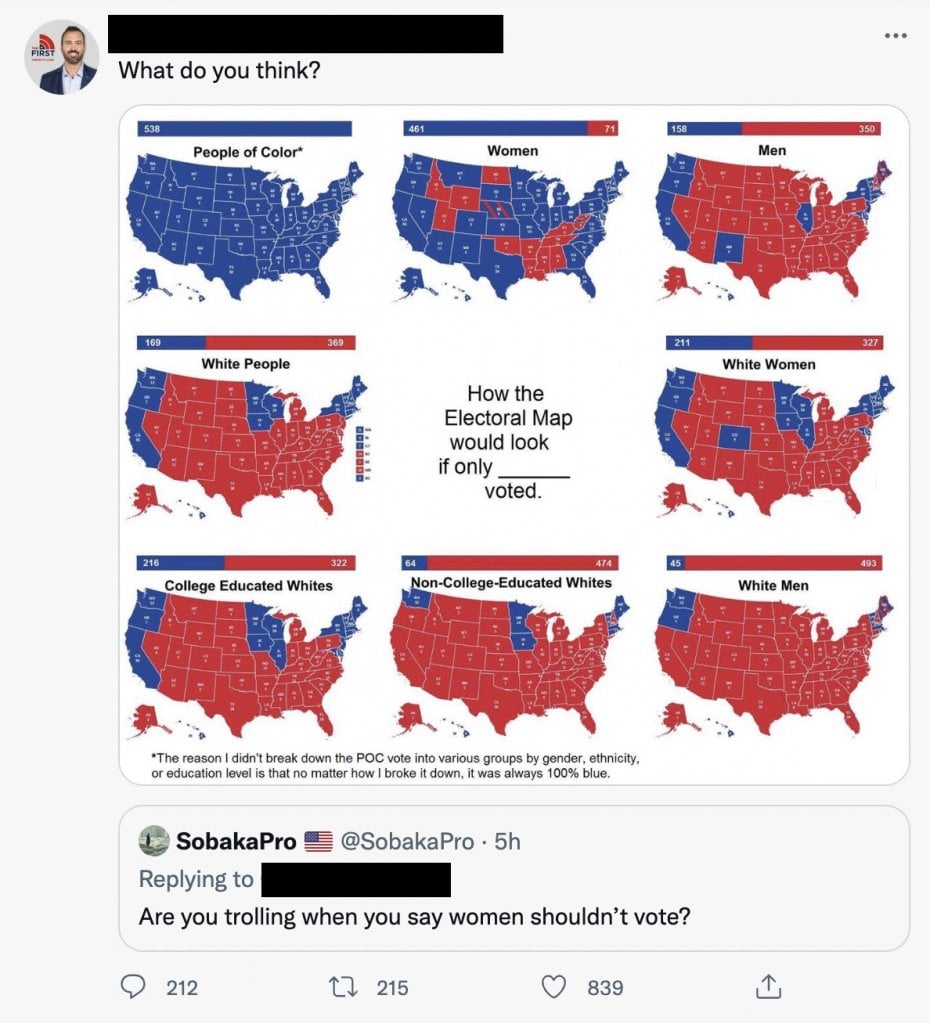
As America becomes more diverse, and as a direct consequence more inclusive, it unfortunately makes sense that more people will come out of the woodwork suggesting that people who aren’t white and male be disenfranchised. This is a racist country, after all. And that’s exactly what’s happening.

Take this radio host, name redacted. I think this messaging is unthinkably chilling:

I didn’t sign up to be part of a fight for the basics of representative democracy, but I’ve got a growing feeling that’s what we’ll all be drawn into. Christian nationalist rhetoric in particular is escalating quickly, and there’s no middle ground to be found with people who want to deny others’ right to exist with the same rights and terms as them. It would be irresponsible to downplay the risks.

How can we turn this back? And particularly given our context of diminishing resources, rapidly-progressing climate change, and off-the-charts inequality, what will life even look like five or ten years down the road?

· Posts · Share this post


Taste

The best part of traveling is the food.

You can learn so much from how and what people eat. The way they gather, the smell of the spices, the sizzle of oil in great pans, the delicacies that only come from the sorts of hole-in-the-wall places that locals protect with their lives.

I’ve never been a fussy eater. I explore new places like a toddler: taste buds first, every nerve in my mouth feeling out a new experience. There’s so much joy and humanity to be found in food - and in particular in the kinds of food that are cheap and accessible. Fancy restaurants are all very well (I’m not knocking the skill and artistry involved in a Michelin-starred meal) but the kind of place that can become someone’s regular joint is beguiling. The food is the basis of a relationship that forms over time.

I drove across the US twice last year. Heading east, we went the northern route, through Glacier National Park and the Montana plains. Heading west some months later, we traveled south. Every time we tried one of the headline places to eat - the tourist traps, in other words - the food paled in comparison to the places where locals went. In New Orleans, Cafe du Monde is a fun experience, but the food doesn’t compare to unpretentious spots like Stuph’D.

And just as food is tied deeply into the identity of a place, so is it tied to the identity of a person. We all have the dishes we love, which make up the fabric of us; the ingredients we enjoy, how and when we cook, if we cook at all, the smells we produce in the kitchen and the smells that attract us at the table. Whether our cooking is a whole thing or if it’s something we do regularly, it’s part of our self-image and the image we project. We need food to survive, and our relationship with it reflects us.

When people ask me where I’m from, I sometimes joke and say, “I come from the internet”. In some ways that’s true, but the joke stops here: I’m in no way from the place that produced pink sauce and baked feta pasta. Food, more than anything, links me to the places I came from.

I really learned to cook from my Oma, who brought her Indonesian dishes to California when my dad’s family emigrated in the sixties and adapted them for locally-available ingredients. She loved cooking for her family, but began to lose strength. So she gave me instructions: sayur lodeh and nasi goreng under her direction were my first adventures in mixing spices and building flavors. I grew up with these meals, regular weekday occurrences rather than exotic events, but no less delicious for it; I was pleased to learn how to reproduce them.

We ate a lot of Italian and French food, common to many American families of any origin (despite being in England): lasagna, quiches, homemade pizzas, spaghetti. But my mother’s Ukrainian Jewish ancestry led us to eat piroshki and borscht on special occasions; matzo ball soup; latkes; challah. Our meals were hearty. “Do you eat foreign food every day?!” one school friend memorable said when he came over. It wasn’t foreign to us; it was ours. “Eat, eat,” my great grandfather used to say, “it’s good for you.” Grandpa Dave was PA Joint Board manager of the Amalgamated Clothing Workers Union of America; here’s a story about a holiday complex he helped build for union workers.

Despite living in England, at no point did we eat English food, which I was left to discover as an adult. I didn’t have so much as a Sunday roast until I was in my twenties: it just wasn’t part of our culinary milieu. Of course, then I leapt on it, and writing this in California I find myself missing Yorkshire puddings and pork pies.

Locard’s exchange principle dictates that every contact leaves a trace. Although it was developed for forensic investigations, it’s equally applicable to people and migration: the places we’ve been all rub off on us, and we rub off on them. I’m a Ukrainian-Jewish-Indonesian-Swiss-Dutch-American who lived in both England and Scotland for decades. Each of those places left some trace on me, directly or via my family, and my descendants will find that they have rubbed off on them too, even if each of those ingredients has a slightly different potency to mine. They will have their own distinct identities, while also reflecting what and who came before them.

And of course, the same is true of everyone. Each of those chefs in the hole-in-the-wall joints serving food to their regulars has their own combination of ingredients that led to them. We’re all constantly leaving traces on each other, part of a tremendous, delicious mix. The more we mix and ebb and flow, the greater the tastes we may experience. To be fussy and reject new tastes, or to demand it be anglicized or made pristine, is to reject new people and other ways of life.

Taste is part of life. It’s one of the best parts of living. We are, literally and metaphorically, what we eat.


Photo by Miquel Parera on Unsplash

· Posts · Share this post


Farewell, house

Well, we sold the house. A new family gets to enjoy the space, and the incredible surrounds. It’s the start of a new chapter for us, too.

I was there over the weekend, and the memories were overwhelming: the four walls of my parents’ former bedroom held newly-staged furniture for show, but I could hear the laughter, remember talking to my mother at the end of the day, could hear her feeding tube apparatus rolling across the floor. So much happened there. It’s sad to see it go, but the memories stay with us. All we’re really leaving behind is wood, stone, and plaster.

Throughout the sale, our agent Florence Sheffer was wonderful. She held our hands through the whole process, and was as fun to work with as she was knowledgable and connected. She consistently went above and beyond to help us. I’d recommend her to anyone who wants to buy or sell a home in Santa Rosa and the surrounding area.

I’m not sure what I’ll end up doing with the indieweb website that I made for the house. Probably I’ll just let the domain expire. Here it is, archived for posterity on the Internet Archive.

· Posts · Share this post


A home on the web, revisited

I’ve been thinking a lot about redesigning my website, or even moving platforms. That’s a bit of an emotional decision, because my website runs on Known, a codebase I mostly wrote myself, and started while I was taking care of my mother post-lung-transplant. It’s the reason I’m connected to the indieweb community, and the Matter community, and a lot of people I care deeply about. All those things are separable from this codebase now, but it got me there, and I’m hugely grateful for that.

The design is looking a little long in the tooth: I can make tweaks, and would commit them upstream into the open source project for other people to use, but I think there’s something to be said for starting again completely, knowing what I know now.

If I had unlimited time and energy - which, sadly isn’t my situation; time and energy are both in very short supply right now - I’d rebuild Known in something like Node, with a cleaner codebase. For now, I think I’ll live with it, and clean what I can.

Incidentally, I also cleaned up my public Obsidian site at werd.cloud. I intend to do more with non-linear, unbloggy writing there.

· Posts · Share this post


What is a man?

What is a man?

The only answer I really care about is “whatever you want it to be”. Like all men, I’ve spent my life in a context of weirdly reductive, gender essentialist expectations - a man is physically strong, competitive, aggressive, stoic - that I couldn’t live up to because, generally speaking, that’s not what I am. Am I less of a man because I’m not aggressive, and because I prefer collaboration to competition? I don’t think so, but there are certainly plenty of people who do.

The reason this matters for me now is not my own experience. I’ve found my way to a kind of self-acceptance, although my teenage years and most of my twenties were pretty rough: a mix of hating my body and receiving hate for not being what people expected me to be. I definitely have some pretty strong character flaws (non-confrontation and people-pleasing among them), which I’m trying to work on. But I feel some degree of pride about who I am, what I’ve managed to do, and the effect I have on the communities I’m a part of. Honestly? I’m glad I don’t adhere to the gender stereotype, even if it’s also true that I couldn’t if I wanted to.

But now I’m going to have a son (or at least, a baby who will be assigned male at birth), who will be subject to all of the same pressures and expectations, even in his first few years. There will be people who will be upset if he plays with dolls; there will be people who want to direct his interests to sports and trucks and whatever-else boys are supposed to like. There’s a fine line to walk here, because if he comes to those interests naturally, there’s nothing wrong with them! And those interests shouldn’t be gendered in the first place! I don’t want to dissuade any of his interests. But I worry about him getting there through external pressure, both explicitly and implicitly. The pressure to conform to someone else’s standard can only lead to anxiety and unhappiness; not to mention the impact it has on perpetuating gender inequality, and how he shows up for other people later in life.

To be clear, I don’t know what I’m doing. I’m not an expert in gender, or parenting, or really anything else. But I want to show up well as a parent, and I want him to show up well in the world (which are two expressions of the same thing). I just want him to be whoever he is, without regard for who other people expect him to be. That goes for every aspect of his (or her! or their!) identity. And I want the experience of that self-expression to be better than mine was, and better than so many people’s are, without fear or friction or conflict.

I guess what I’m really saying is, I don’t care what a man is, or what a boy is. I care who my child is. And that’s all that matters.


Photo by Annie Spratt on Unsplash

· Posts · Share this post


Neumann Owns

This morning, Andreessen Horowitz announced that it had invested $350M into Adam “WeWork” Neumann’s new startup, Flow. Whereas WeWork revolutionized the commercial real estate business and made ad-hoc office space easier for startups, Flow attempts to do the same for residential real estate.

A lot of ink has been spilled on whether it’s okay for A16Z to have invested this money given Neumann’s well-documented, disastrous track record with WeWork, in an environment where lots of other people find it hard to raise even a tiny fraction of this amount. I agree with these comments in the sense that it’s obviously unfair: a sign of an unequal system. It just is.

But for a moment, look at it from a mercenary venture capitalist’s perspective. WeWork is everywhere, which happened under Neumann’s watch - and although Neumann is not the one doing it, it’s finally approaching profitability.

And then there’s housing, which is in need of major reform. I’m not going to shed any tears at the loss of today’s batch of rental agencies and real estate management firms, which have helped hike rents up to astronomical levels, and have often lobbied for preferential legislation that hurts ordinary renters. At the same time, investment properties leave many homes completely vacant in the middle of a housing crisis that is leaving millions experiencing housing insecurity.

The trouble is, Flow is highly unlikely to help with any of that. Marc Andreessen’s announcement hints at as much:

Many people are voting with their feet and moving away from traditional economic hub cities to different cities, towns, or rural areas, with no diminishment of economic opportunity. […] The residential real estate world needs to address these changing dynamics. And yet virtually no aspect of the modern housing market is ready for these changes.

Based on these words, Flow is gentrification as a service: a way for the technorati to rent cushy spaces in lower-cost parts of the country and build community with each other without having to engage with the people who are already there. It’s not a stretch to see what the racial and socioeconomic dynamics might be here, and the effect it might have on local economies. Low-cost housing for people who need it this is not.

“Our nation has a housing crisis,” Andreessen says. But he also said this, as reported by Jerusalem Demsas over in the Atlantic:

I am writing this letter to communicate our IMMENSE objection to the creation of multifamily overlay zones in Atherton … Please IMMEDIATELY REMOVE all multifamily overlay zoning projects from the Housing Element which will be submitted to the state in July. They will MASSIVELY decrease our home values, the quality of life of ourselves and our neighbors and IMMENSELY increase the noise pollution and traffic.

He doesn’t care about the housing crisis. What he does care about is making money, and in Neumann, he likely sees someone who already knows the real estate market well and has the ability to grow a business in the space very quickly. I’m sure we’ll see Flow communities all over the country within the next few years.

Where will he start? We can look at public records. The New York Times points out that he’s now going to donate substantial real estate holdings to Flow. Back in January, the Wall Street Journal reported that he’d bought over a billion dollars of apartments in the South:

Entities tied to Mr. Neumann have been quietly acquiring majority stakes in more than 4,000 apartments valued at more than $1 billion in Miami, Atlanta, Nashville, Tenn., Fort Lauderdale, Fla., and other U.S. cities.

Quoted in the same article, his family office made this statement:

“Since the spring of 2020, we have been excited about multifamily apartment living in vibrant cities where a new generation of young people increasingly are choosing to live, the kind of cities that are redefining the future of living. We’re excited to play a role in that future.”

None of this dissuades me from my original suspicion: this is a place to live for the people who WeWork was originally built for. It’s for young, affluent knowledge workers who want to live somewhere cheaper but don’t care to actually know their communities. It’ll transform residential real estate in the sense that it’ll out-compete all those cookie cutter apartment buildings set up for that same market.

Andreessen is likely to make a fortune.

And what about the actual housing crisis? The one that’s making people housing-insecure?

At best it does nothing for them. At worst, it helps hike up rents in parts of the country that remain affordable. Those people, the ordinary people who make up most of the country, who are struggling to keep a roof over the heads, don’t even make it into the pitch deck.


PHOTOGRAPH BY STUART ISETT/Fortune Brainstorm TECH

· Posts · Share this post


Finding ethical eyewear

I ordered new glasses recently. At some point over the last few months, I accidentally slept on my main pair and bent them out of shape; although I tried my best to put them back, they’ve been a little bit crooked ever since.

I’ve been a die-hard Zenni Optical customer for years, because their frames are affordable, relatively well-made, and can be engraved with my website address. (Yes, I’ve been wearing “werd.io” on my face for the best part of a decade.) But this adherence means I’ve been wearing the same black frames forever, and hey, why not change it up?

I wish Genusee made prescription glasses: they’re made from water bottles in Flint, Michigan, and can be recycled back into the same material stream. I like everything about their mission - but unfortunately, I need prescription glasses to see.

Sunglasses by Pala Eyewear fund eye care across Africa, but is based in the UK, so I’d need to order pairs from overseas.

Solo makes its sunglasses from repurposed wood, bamboo, cellulose acetate and recycled plastic. Great, but while they mention that their frames are prescription-ready, they don’t actually seem to offer prescriptions.

Reader, I gave up and followed the stereotypical Silicon Valley path into Warby Parker. They felt well-made, which turns out to be all I can ask for. But I’m still looking for the right place to get prescription sunglasses.

Perhaps the most sustainable route would be to get laser eye surgery and dispense with the need for glasses at all. I’ve thought about it, but to be honest, despite my understanding of the low risk involved, the idea of lasers cutting away at my eyeballs doesn’t have me running towards a surgeon with money in hand.

If you wear prescription glasses and care about the ethics of the products you buy, have you found an adequate solution? I’d love to learn from you.


Photo by Bud Helisson on Unsplash

· Posts · Share this post


10 things I'm worrying about on the verge of new parenthood

One. Is it even ethical to bring a child into the world right now? During their lifetime we’ll see water scarcity and an increase in global conflict as a result of climate change. It’s going to get worse before it gets better. How, in good conscience, can I bring a new human into that?

It’s an imperfect answer, but I’ve arrived at this: what would the world look like if only the people who didn’t believe in climate change had children? Yes, they’re going to need to be part of the solution, because everyone will need to be. It’s a tough ask for a human who didn’t ask to be born. But I’m confident they’ll be an asset to the future.

Two. What does nationality look like? It’s important to me, but why, exactly?

I’m a third culture kid: living in the US is the first time I’ve spent an extended time in a place where I was a citizen. I’ve written before about how I consider myself to have no nationality and no religion.

The thing is, that’s not quite right: I am a product of all the nationalities and cultures that led up to me. That I don’t exactly identify with any of them doesn’t mean that they don’t belong to me.

But that’s just me: Erin, as the mother, carries a full half of their context, and has a different background to me. How do you honor both backgrounds and contexts, while also downplaying the importance of nationality and patriotism overall?

What’s important to me is that they know they’re from multiple places, and they know that the world is their oyster. Rather than patriotism, I want them to feel proud to be human, and to feel connected to all humans. I want them to have broad horizons and an inclusively global mindset. They can do anywhere and do anything they want: the world is awash with possibilities. And at the same time, everyone, everywhere matters, and people who are more local to them do not matter more than people who are more remote. I want my child to have the privilege of openness and connectedness.

Three. I want to keep them healthy and happy. That, in itself, is incredibly daunting. What if I hurt them somehow?

Four. I’ve spent my life in front of screens. I literally learned to write on a Sinclair ZX81, writing stories that incorporated the BASIC shortcuts on its keyboard. Characters would GOTO places a lot; they would RUN; THEN they would do something else. One of my first memories is watching the animated interstitial network announcements on our little TV in Amsterdam.

What should their relationship with devices be? The going advice is that introducing screens too early can interfere with their development. And at the same time, my dad in particular deliberately allowed me to play with everything. I took apart radios; I mucked around with computers with impunity; I developed, early on, a complete lack of fear of technology. And that’s served me very well.

I’ll admit to feeling a bit judgmental of parents of those toddlers out in the world who have iPads in carry-cases. But what right do I have to feel that way? I’ve never had a child, until now. Maybe I’ll feel completely different.

And actually, I feel very strongly about tablets and phones themselves. I didn’t have a device that couldn’t be hacked until I was in my twenties. Everything could be taken apart, programmed for, adjusted. There were no games consoles in our household, and cellphones weren’t really available until I was older. I like that philosophy: open technology only. Teach them early to be a maker, not a consumer.

Five. Should I buy a domain name for them? Reserve a Twitter username? Is that self-indulgent?

Six. It’s important to make sure babies interact with a wide range of people while they’re very little, to allow them to develop an understanding that every type of face is part of their circle. Infants learn about race in their first year; by 9 months old, they recognize faces from their own race better than others. By 6 months old, they may exhibit racial bias. So it’s incredibly important that their circles are diverse.

While this cognitive wiring is established early, developmental changes obviously continue throughout childhood. For these reasons - and also just because they’re better places to live for all kinds of reasons - it’s important to be in a cosmopolitan, diverse, open-minded location. Homogenous towns and cities are not what I want, both as a person, and for my child.

Seven. No, I don’t think ideological diversity is anywhere near as important as actual intersectional diversity. And I have no intention to allow bigotry or small-mindedness to enter their worldview.

Empathy, inclusion, love, understanding, and connectedness must be core values. Change is inevitable and to be embraced. Difference is beautiful. The world is to be explored and embraced.

Eight. I like the idea and philosophy of free-range parenting. Let the child explore and learn on their own terms, for crying out loud. Let them ride bikes in the neighborhood and hang out with their friends and generally live out The Goonies.

But that seems to be out of vogue? There’s a trend of helicopter parents who schedule their child’s every moment? The idea seems repellant to me - doesn’t it mean that they miss out on developing a degree of autonomy? - but am I right to feel that way?

Nine. My parents made friends through pre-natal and baby classes - and that’s where a lot of my early friends came from, too. Everything’s online now because of covid. Where are baby-friends supposed to come from?

Ten. How do we share photos and information with family and friends without compromising on privacy? Social media sites like Instagram and Facebook will be data-mined; email feels insecure because I don’t know who will end up seeing photos and messages. The really private tools and services are too hard to use for a lot of people. What’s the best practice? What does baby infosec look like?


Photo by Kelli McClintock on Unsplash

· Posts · Share this post


Equality on the ballot: a free event with Stacey Abrams

This is one of those times I can’t believe I get to work at The 19th. We’re putting on a free event on voter equality with a roster of very smart speakers headlined by Stacey Abrams, in partnership with Live Nation Women and Teen Vogue, live in Atlanta or free to watch afterwards online.

Go register!

· Posts · Share this post


Newsletter housekeeping

If you’re subscribing via email, heads up that I’m thinking about changing my newsletter engine, possibly to Buttondown. You shouldn’t see anything particularly different - and if you’re subscribing via RSS, nothing will change at all. But, to be honest, I’ll be paying a lot less money for a lot more power.

As always, I really appreciate it when people share around my posts, or let me know if they’ve disagreed with something I’ve written. Your time and attention are limited; thanks for sticking around.

· Posts · Share this post


Performative productivity and building a culture that matters

I recently heard a story about a company that, when determining who would be laid off in a downsizing event, asked team leads to rank their teams based on who would be most likely to work on the weekend.

Mind-blowingly, while it’s obviously (or hopefully obviously) immoral, this practice appears to be legal in the US, which has at-will employment in every state. This is one of the many contrasts between European and US employment law, which were the biggest culture shock for me when I moved to the US eleven years ago. In Europe, employers must ensure that employees don’t work more than 48 hours during a week and the minimum vacation allocation beyond statutory holidays is four weeks. In America, it’s often seen as a badge of honor to work 70 hour weeks, and it’s one of the few countries in the world with 0 mandatory vacation days.

Perhaps my concerns around compassionate employment are irredeemably European, but as I’ve written before, long hours with little rest are counter-productive. Environments that want you to work weekends and evenings in addition to standard office hours tend to value performative productivity over actual results, or adhere to a kind of religious belief around work ethic. If these employers paid attention to the research and data, they wouldn’t do it.

This is perhaps even more of a problem in flexible and work from home settings. In my previous piece, I quoted a French member of Parliament:

“Employees physically leave the office, but they do not leave their work. They remain attached by a kind of electronic leash — like a dog. The texts, the messages, the emails — they colonize the life of the individual to the point where he or she eventually breaks down.”

I heard recently about another company where the CEO regularly shouts at their team, and if a team lead suggests that a goal can’t be reached, retorts that they’ll find a team who can achieve it instead. These companies share a common trait: a fundamental lack of respect for the expertise and the lives of the people they’ve hired. It’s as if there’s some inherent value to this kind of work, and that the exchange of time for money obviates the need for human care.

It’s cultural. “I don’t think you should work while you have covid,” I told someone recently, mindful of the research about recovery times and long covid. “Maybe I learned the wrong lessons from my Dad,” he replied.

As well as being health and quality issues, these kinds of attitudes compound inclusion problems: only certain kinds of people can work all hours. Carers and parents, and particularly people from lower-income backgrounds, are more likely to have other commitments.

All aspects of a company’s culture are really hard to change when it’s already been set in motion. Either you care about creating a place that cares for its employees or you don’t, and these values affect the choices that are made by founders from the very first day. It’s impossible to do it bespoke, too: every aspect of a company has to pull together with the same cultural underpinnings. The entirety of a community has to pull together or resentments and friction build.

The same cultural change problem doesn’t apply in the same way across the country. While this is a uniquely American problem, not every American company behaves this way: to be frank, most of the successful ones don’t. One of the most promising aspects of the organization I’m at, The 19th, is its excellent, intentionally inclusive culture; it’s among the best, but not the first time I’ve felt valued at work. And it doesn’t take a people ops superhero to understand that people who feel valued do better work overall.

While I think these problems are best solved through legislation and unionization, competitive forces can be a useful fallback. Not everyone has the luxury of being discerning about their employer, but each of the companies I’ve mentioned is in the tech sector: a world where knowledge workers often do have the privilege of choice. Again, it doesn’t take an empath to understand that, given the choice between two otherwise similar firms, employees are more likely to choose to work at the one with a more supportive culture. It goes without saying that yelling doesn’t make for a productive workplace, but if you want to hire the best people, you’ve got to be the best place for them to work, and understand that, past a point, people are motivated by meaning, not money.

From a prospective employee standpoint, if you’re looking for a job, it helps to understand that you have every right to ask for and expect a better, more supportive culture. Having strong standards here makes the employment experience better for everyone, and helps even the worst employers understand that they need to change if they want to be successful.

But make no mistake: the onus is not on employees here. Employers - and the legislators that govern them in the United States - need to drag themselves into the twenty-first century and learn that a strong culture of support in turn makes for strong companies, and strong countries.

· Posts · Share this post


The corpus bride

I got my beta invitation to DALL-E 2, which creates art based on text prompts. You’ve probably seen them floating around the internet by now: surrealist, AI-drawn illustrations in a variety of styles.

Another tool, Craiyon (formerly DALL-E Mini), had been doing the rounds as a freely-available toy. It’s fun too, but DALL-E’s fidelity is impressive enough to be almost indistinguishable from magic.

I can’t claim to fully understand its algorithm, but DALL-E is ultimately based on a huge corpus of information: OpenAI created a variation of GPT-3 that follows human-language instructions well enough to sift through collected data and create new works based on what it’s learned. OpenAI claims to have guarded against hateful or infringing use cases, but it can never be perfect at this, and will only ever be as sensitive to these issues as the team that builds it.

These images are attention-grabbing, but the technology has lots of different applications. Some are benign: the team found that AI-generated critiques helped human writers find flaws in their work, for example. GitHub uses OpenAI’s libraries to help engineers write code, using a feature called Copilot. There’s a Figma plugin that will mock up a website based on a text description. But it’s obvious that there are military and intelligence applications for this technology, too.

If I was a science fiction writer - and at night, I am! - I would ask myself what I could create if the corpus was everything. If an AI algorithm was fed with every decision made by every person in the world - our movements via our cellphones, our intentions via our searches, our actions via our purchases and interactions - what might it be able to say about us? Could it predict what we would do next? Could it determine how to influence us to take certain actions?

Yes - but “yes” wouldn’t make for a particularly compelling story in itself. Instead, I’d want to drill a level deeper and remind myself that any technology is a reflection of the people who built it. So even if all those datapoints were loaded into the system, a person who fell outside of the parameters the designers thought to measure or look for might not be as predictable in the system. The designer’s answer, in turn, might be to incentivize people to act within the frameworks they’d built: to make them conform to the data model. (Modern marketing already doesn’t stray too far from this idea.) The people who are not compliant, who resist those incentives, are the only ones who can bring down the system. In the end, only the non-conformists, in this story and in life, are truly free, and are the flag-bearers of freedom for everyone else.

The corpus of images used to power DALL-E 2 is scraped from the internet; the corpus of code for GitHub Copilot is scraped from open source software. There are usage implications here, of course: I did not grant permission for my code, my drawings, or my photographs to form the basis of someone else’s work. But a human artist also draws on everything they’ve encountered, and we tend not to worry about that (unless the re-use becomes undeniably obviously centered on one work in particular). An engineer relies on “best practices” and “patterns” that were developed by others, and we actively encourage that (unless, again, it turns the corner and becomes plagiarism of a single source). Where should we draw the line, legally and conceptually?

I think there is a line, and it’s in part because OpenAI is building a commercial, proprietary platform. The corpus of work translates into profit for them; if OpenAI’s software does wind up powering military applications, or if my mini science fiction story partially becomes true, it could also translate into real harm. The ethical considerations there can’t be brushed away.

What I’m not worried about: I don’t think AI is coming for the jobs of creative people. The corpus requires new art. I do think we will see AI-produced news stories, which are a natural evolution of the content aggregator and cheap reblogging sites we see today, but there will always be a need for deeply-reported journalism. I don’t think we’ll see AI-produced novels and other similar content, although I can imagine writers using them to help with their first drafts before they revise. Mostly, for creatives, this will be a tool rather than a replacement. At least, for another generation or so.

In the meantime, here’s a raccoon in a cowboy hat singing karaoke:

· Posts · Share this post


Comments are hard

Building a comments system is really hard. I tried to build one for Known, which powers my website, but found that spammers circumvented it surprisingly easily. You can flag spam using Akismet (which was built for WordPress but works across platforms), but this process tends to require you to pre-screen comments and make them public after the fact. That’s a fair amount of work and a fair amount of unnecessary friction for building community.

If you have a blog - you do have a blog, don’t you? - you can post a response to one of my posts and send a webmention. But not everybody has their own website, and the barrier to entry for sending webmentions is pretty high.

So I’ve been looking for something else.

Fred Wilson gave up on comments and asks people to discuss on Twitter. That works pretty well, but I’m not really into forcing people to use a particular service. That’s also why I’m not particularly into using Disqus embeds, which also unnecessarily track you across sites. Finally, I was using Cactus Comments, which is based on the decentralized Matrix network for a while, but it occasionally seemed to break in ways that were disconcerting for site visitors. (It’s still a very cool project.)

I love comments, and I guess that means I’m writing my own system again. To do so means getting into an arms race with spammers, which I’m not very excited about, but I don’t see an alternative that I’m completely happy about.

Do you run a blog with comments? How do you deal with these issues? I’d love to learn from you.

· Posts · Share this post


Do we really need private schools?

One of my most controversial opinions is that private schools should not be allowed. Quite how controversial is always a surprise to me: from my perspective it feels very straightforward.

In a nutshell, my argument comes down to the following complementary ideas:

  1. Every child deserves to have an equal start in life.
  2. As a society, we are better off if people from different backgrounds mix, interact, and get to know each other as early as possible.
  3. Every system of inequality is built around disenfranchisement and blocking access to resources. Giving everyone access to the same education and the connections that inevitably develop while attending an institution helps dismantle these systems.
  4. If the rich are forced to use the same system as the poor, the overall standard of education will rise for everyone.
  5. Education is a human right.

Does this fly in the face of American individualism? Sure, probably. Will it result in a society that is both culturally and financially richer? I think so.

As far as I can tell, the arguments for private education come down to the perceived right to perpetuate inequality by gating a special education system for people with wealth, a defense of American individualism at the expense of community, and sometimes the adjoining right to perpetuate exclusionary values systems. I’m not particularly interested in protecting any of those things.

It’s certainly true that public education needs more funding, more resources, and stronger frameworks around (for example) special needs education. I don’t think the answer to these problems is private alternatives: instead, I think we solve them by providing stronger support for public infrastructure. And one of the ways we guarantee this support is by forcing people with wealth and resources to use the same infrastructure as everybody else.


Photo by ROBIN WORRALL on Unsplash

· Posts · Share this post


Rethinking notable links

I’m thinking about splitting off my notable links into a new newsletter.

For the record, you can always follow them from this page on my site (which also has an RSS feed); I’ve also started to post them consistently to my Twitter feed. But I might move the collated bookmarks to a weekly post (or even daily!), and that might be a bit much for regular subscribers of my non-link posts.

I’d love to hear what you think.

· Posts · Share this post


Building an inclusive, independent, open newsroom

I didn’t make a big announcement about it, but for the last few months I’ve been working as the CTO at The 19th, a nonprofit newsroom that reports on stories at the intersection of gender, politics, and policy.

It was a necessary move for me: I needed stronger work/life balance for my own health, and I also wanted to feel like I was helping in the midst of a very tumultuous social and political climate. It was also a move back into the core ideas my career has been built on.

The 19th was launched in January 2020 by veterans of the Texas Tribune and ProPublica who understood the need to report stories from a more diverse perspective than is normally offered by an industry still dominated by white men. I’ve been following it from the beginning as a prominent subscription in my RSS reader, and was deeply impressed by the detailed, empathetic, unsensational reporting.

The 19th’s technical platform is largely based on self-hosted WordPress, with some interesting theme modifications that allow for visualizations and in-page interactivity. (Did I immediately add simple microformats support to articles as soon as I arrived? Yes, I did.) Importantly for me, the team cares about the same privacy issues I do: particularly in an environment where abortion-related surveillance is becoming a safety issue, dealing with audience data intentionally is crucial.

Openness is core to what The 19th is. Its financial backers are published in full, so you know exactly whose is bankrolling the non-profit. Since the beginning, the newsroom has also made its content available via a Creative Commons license that allows anyone else to republish it for free. Those partners have included the Guardian, USA Today, Teen Vogue, PBS NewsHour, Ms. Magazine, RawStory, and many more. It could be you, too, if you wanted to: you can find the full HTML source to republish on every article page. Because The 19th’s newsroom is more diverse, every republished article furthers its mission of improving representation in the news media overall.

It’s an obvious extension to this strategy to make our technology available as well, via a permissive open source license. That’s my ambition: to package up some of our supporting tools and make them available in a way that other newsrooms can take advantage of. If they have the technical capability to collaborate on building them, great; if not, they can still pick up the technology and use them. Open source itself has a giant diversity problem, and if we can apply an equity lens to building our technical community in the same way we build our journalistic ecosystem, perhaps we can be a part of the solution there, too.

I’ve long been a member of the indieweb community, which encourages everyone to own and control their own website and domain. Both technically and ideologically, the overlaps with news are obvious: every newsroom must own its relationship with its audience in order to build trust, understand their needs, and above all to build community. Trends on the web have been in the opposite direction for most of the last decade: social media platforms like Facebook seek to intermediate and monetize that relationship, stripping newsrooms of resources and undermining the ability of voters to receive information in the process. Building an independent website for representative news content and community, and then helping others to do the same, is an important mission.

Right now it’s a very small team: Abby Blachman and me. I’m looking for a third member of the technology team to help with everything I’ve discussed.

And so far, it’s been joyful. Abby is amazing; everyone is. I’ve never been part of an organization - least of all a remote team - that understands the need for a supportive culture so clearly. As an organization, it continues to listen and evolve. The people team - led by Jayo Miko Macasaquit - has put procedures and benefits in place that I haven’t seen in organizations ten times the size. To build representative, empathetic news, you first need to build a representative, empathetic organization, and that’s what’s happening here. I hope they do more to tell their story and share what they’re doing, because it’s genuinely phenomenal.

I can’t believe my luck; it’s a real privilege to be on this team. I want to be a good ambassador: although I knew about the journalism, which should always be front and center, I wasn’t as familiar with the organization’s ecosystem and openness chops before I joined. It was the nicest of surprises, and I want to tell you more about it. We don’t have an internal blog right now, so from time to time I’ll discuss what we’ve been working on over here.

I’m also working on building some tools of my own to support my management process; the first is all about building a consistent culture of transparent feedback. More on that when I’m ready.

In the meantime, if you have any questions, I’d love to answer them. And if you happen to be interested in our technology position, you should definitely apply.

· Posts · Share this post


Reading, watching, playing, using: July, 2022

This is my monthly roundup of the articles I found interesting. Here's my list for July, 2022.

Notable Articles

Business

Bank of America Memo: “We Hope” Worker Power Worsens. “A Bank of America executive stated that “we hope” working Americans will lose leverage in the labor market in a recent private memo obtained by The Intercept. Making predictions for clients about the U.S. economy over the next several years, the memo also noted that changes in the percentage of Americans seeking jobs “should help push up the unemployment rate.””

Amazon to Acquire One Medical Clinics in Latest Push Into Health Care. “One Medical, which is based in San Francisco, operates a network of primary care providers that offer in-office and virtual medical services, and is one of the leading competitors to a similar but smaller service Amazon had started to offer.” Exercise for the reader: should end-user healthcare provision be a place where you can make a lot of profit?

Climate

Is accepting the end of humanity the key to climate action? This scholar thinks so. “Accepting that human civilization is finite, he says, will challenge us to change our priorities, from worshiping extraction and growth to uplifting the most marginalized in society.”

Wildfires Are Setting Off 100-Year-Old Bombs on WWI Battlefields. “The area where the fire rages was the site of 12 battles during World War I. More than 200,000 people died and untold numbers of explosives were used. It’s a major problem across Europe that lingers to this day. The Royal Air Force and U.S. Army Air Force dropped 2.7 million tons of bombs on Europe during World War II alone. Seventy years later, those bombs are still killing people.”

NOAA introduces heat.gov as climate change worsens. “Heat.gov is geared toward a wide range of decision makers, from companies to local governments to individuals, Spinrad told Protocol, “whether it’s a mom trying to decide whether it’s safe for kids to play outside, or a construction foreman trying to decide if it’s OK for their workers to be out on the job, or a public works manager trying to figure out when road repairs can be undertaken.””

Carbon removal trade group launches with ‘Hippocratic oath’ for the industry. “The statement is brief, just 15 sentences, and commits signatories to abstract ideals like acting with humility and honesty, being guided by science, and recognizing the value of “including voices from all backgrounds in conversations” about carbon removal.”

North Carolina Republicans Push Bill Forcing Towns To Destroy Electric Car Chargers. “In North Carolina, Trump GOP lawmaker Ben Moss has pushed forward a ridiculous bill (HB 1049) that would require towns and cities use up to $50,000 in taxpayer funds to destroy free electric vehicle stations on public land, if local authorities don’t build free gas and diesel pumps alongside them. There’s, of course, no provision included in the bill that works in the opposite direction.”

Covid

The Huanan Seafood Wholesale Market in Wuhan was the early epicenter of the COVID-19 pandemic. “While there is insufficient evidence to define upstream events, and exact circumstances remain obscure, our analyses indicate that the emergence of SARS-CoV-2 occurred via the live wildlife trade in China, and show that the Huanan market was the epicenter of the COVID-19 pandemic.”

COVID cases and deaths are spiking in nursing homes, AARP data shows. “One in 35 nursing home residents tested positive for COVID-19 in June, a 27 percent increase from the previous month. The death rate from COVID between May and June of this year nearly doubled, from 0.04 deaths per hundred residents to 0.07 deaths per hundred residents.”

Crypto

Web3: The hope for protocols over platforms. “Let’s experiment in ways that let us slowly deconstruct platforms, by replacing some of the core primitives that they own with open protocols that are collectively owned and governed by their own communities.”

The Consequences of Silence. On the Celsius freeze: “My entire business is secured and backed by these funds. If they are not returned, my business would go bankrupt, my 15 employees would be let go, and 14 years of my life’s work lost and at the age of 49 years old, I would have to start over with nothing.” “Having my funds frozen has been devastating to me and my family both financially, mentally, and physically. I cannot sleep most nights and am over-whelmed with worry and dread for my family’s future. I have two small children. A 3-year-old daughter and a 2-year-old son. I am the sole bread winner for my family, and I pride myself on making smart financial and parental decisions for them to provide a better life and a bright/positive future.”

How Crypto Is Evolving the Future of Books and Publishing. ““Imagine when all of an author’s readers can suddenly make money as well,” says Margarita Guerrero, head of partner and publishing relations at the publishing startup Readl. “How much more would they be engaged?”” Seems like a complete misunderstanding of why people like books to me.

Lost at OpenSea. “Like social audio, NFTs were a pandemic fad. This fad, however, was aimed at allowing kids who were too young to buy bitcoin when it first launched to pretend to be savvy investors. The results, when the market crashes further, will be catastrophic.”

The sinking of Voyager. “I have no problem with a hedge fund lending only to seven counterparties, if it is lending its own funds or those of professional investors who understand the risks they are taking. But Voyager marketed high-risk investments to retail depositors with promises of safety and (non-existent) insurance. To my mind, this isn’t just bad, it is criminal. But crypto is an unregulated, borderless space. Even if Voyager has lied to its customers and embezzled their funds, it is unclear what if any power national authorities have to hold it to account. And even though there will undoubtedly be a forest of lawsuits, the money is gone.”

Crypto collapse reverberates widely among black American investors. “A quarter of black American investors owned cryptocurrencies at the start of the year, compared with only 15 per cent of white investors, according to a survey by Ariel Investments and Charles Schwab. Black Americans were more than twice as likely to purchase cryptocurrency as their first investment. The value of those investments has imploded. The total market capitalisation of cryptocurrencies has plunged below $1tn from more than $3.2tn last year. The fall in digital assets comes alongside a bear market in US stocks.”

Culture

Aboard the World's First Hot-Air Balloon Restaurant. “During the flight, Schmeinck serves wine and gives more information about her dishes. Standing-room only encourages interactions between the chef, pilot, and other diners as the balloon sails above the countryside, taking in the view from a cruising altitude that ranges 500 to 2,500 feet. “Sometimes when the clouds are low, we can go right through them,” says Schmeinck. “It’s a little bit misty. Then we’re above the clouds and see the sun shining. That moment is unforgettable. It’s amazing for me, after all these years.”” Bucket list.

For Centuries, English Bakers' Biggest Customers Were Horses. “But in pre-industrial England, horse bread carried the taste of shame. The dark bran bread sat at the bottom of a hierarchy that gave brown bread to farmers and servants and reserved white bread for the elite. Indeed, Englishpeople turned to horse bread during times of strife, and the abject poor likely ate it year round. And since horse bread was fed to laboring animals, humans who ate it were looked upon with disdain.”

After 37 Years, the Sunny World of ‘Neighbours’ Comes to an End. “At that time, the world of “Neighbours” offered an antidote to the contentious impact of conservative, Thatcherite legislation in Britain, Carr said, which supported “do it yourself” economic policies that its opponents said widened inequality. “Neighbours” offered “a different, wildly positive vision of what a community could be,” Carr said. “Everyone tends to work together rather than be adversarial.”” As a kid, I loved it.

Announcing the Shortlist for the Inaugural Ursula K. Le Guin Prize for Fiction. “The nine shortlisted books will be considered by a panel of five jurors—adrienne maree brown, Becky Chambers, Molly Gloss, David Mitchell, and Luis Alberto Urrea. The winner will be announced later this year on October 21st, 2022, Ursula K. Le Guin’s birthday.”

Erotica Author Chuck Tingle Has Some of the Best Writing Advice. “Having spent the last few days with Tingle’s voice in my head, the only way I can describe the experience is that it feels like the sun has come out after days of rain. To have a voice that is relentlessly upbeat and positive, telling me I can do anything I try to, and that my best efforts will be enough? It’s like my brain was just, I don’t know, pressure washed?”

All [White Supremacist Capitalist Patriarchy] is Local. Words of warning from Librarian Shipwreck: “What about books banned for depicting people of color and queers in a positive light, providing accurate information about health and sexuality, or for acknowledging the truth about American history? Bills (that thankfully didn’t pass) to fine and jail librarians for “obscene” (read: queer, comprehensive sex education, anatomy) books? Or librarians being told they can’t help patrons find information about abortion, or even say the word?”

James Beard Awards 2022: Cristina Martinez brings the best Mid-Atlantic chef prize to Philadelphia. “Chef Cristina Martinez, an advocate for immigrants’ rights and an undocumented immigrant herself, was named the best chef for the Mid-Atlantic region Monday by the James Beard Foundation, in its first black-tie ceremony since 2019.” I just ate at South Philly Barbacoa and it was fantastic.

representation matters. Winnie Lim’s blog is one of the best things I read. This is a great example of why.

Netflix criticised for shooting Stranger Things in Nazi prison and marketing it as hotel. “Internet streaming giant Netflix and hit show Stranger Things are facing criticism for shooting part of its new season in an infamous Lithuanian concentration camp and making plans to convert the site into a hotel in collaboration with Airbnb.” Combined with it resharing photos of serial number tattoos fans are getting on their wrists, it’s not a great look, to say the least.

Unknown Number by Azure. A beautifully-written story told through text messages and published as a Twitter thread. Now nominated for a Hugo.

Hell Yeah, Tom Cruise. “So, 45 seconds in, I realized what Top Gun really was: propaganda. Never again tell me you can’t make a conservative movie in Hollywood. After its release there was a 500 percent increase in applications to the Navy’s flight program.”

Democracy

San Francisco Mayor Wants PD To Be Able To Commandeer Cameras Owned By Residents Because Reasons. “Having dumped its “progressive” District Attorney, Chesa Boudin, the city of San Francisco has decided it’s going to be far more Dirty Harry in the future. The alleged justification is (perhaps temporary and anomalous) increases in crime. It’s time to run roughshod over constitutional rights again.”

A radical attack on the First Amendment. “Prohibited topics include endorsing the concepts of white privilege or male privilege. Specifically, employers cannot conduct trainings that state an individual can be “privileged” or “oppressed” due to their “race, color, sex, or national origin.” Further, trainings cannot suggest that anyone should “feel guilt, anguish, or other forms of psychological distress because of actions, in which the individual played no part, committed in the past by other members of the same race, color, sex, or national origin.””

The billionaires buying the midterm elections. “The largest donor to the main Republican super PACs is billionaire Ken Griffin, owner of Citadel, a hedge fund. Griffin donated $28.5 million to the SLF and CLF through the end of March. In a 2012 interview, Griffin was asked if “the ultrawealthy have an inordinate or inappropriate amount of influence on the political process.” “I think they actually have an insufficient influence,” he replied.”

‘There are a lot of people who don’t want to know the truth’: Why an Arizona election official is leaving her job. “The impact of lies about America’s most secure election is still taking shape around the country but has included harassment and threats of violence aimed at a women-led workforce. A survey of election workers conducted by the Brennan Center for Justice earlier this year showed 30 percent of poll respondents said they knew of one or more elec­tion work­ers who had left their jobs at least in part because of fear for their safety, increased threats or intim­id­a­tion. Twenty percent said they planned to leave before the 2024 elec­tion.”

Correction director: Arizona cities would collapse without prison labor. “There are services that this department provides to city, county, local jurisdictions, that simply can’t be quantified at a rate that most jurisdictions could ever afford. If you were to remove these folks from that equation, things would collapse in many of your counties, for your constituents.” The 13th Amendment abolished slavery except for people convicted of crimes. And here we are.

The City Where Investigations of Police Take So Long, Officers Kill Again Before Reviews Are Done. “Now, Open Vallejo and ProPublica have looked at what happens inside the department after those killings occur, examining more than 15,000 pages of police, forensic, and court files related to the city’s 17 fatal police shootings since 2011. Based on records that emerged after dozens of public records requests and two lawsuits filed by Open Vallejo, the news organizations found a pattern of delayed and incomplete investigations, with dire consequences.” Remarkable reporting.

Indiana doctor performed abortion for a 10-year-old girl, document shows. “For the past two weeks, the veracity of a story of a 10-year-old girl who was raped and got an abortion has been debated in the media. But a document reviewed by The 19th shows that the Indiana physician who performed the abortion submitted record of it to the Indiana Department of Health and the Department of Child Services.”

Pharmacies can’t deny prescription birth control or emergency contraception, HHS says. “Pharmacists cannot deny people prescribed medication — including hormonal birth control or emergency contraception — because those people are pregnant or might become pregnant, per new guidance from the Biden administration.”

Republican-backed measure to restrict filming of police officers passes Senate committee. ““We believe that this bill stacks the deck against the public check on officer misconduct,” Timothy Sparling, a lawyer and legislative advocate for Arizona Attorneys for Criminal Justice, said during a Senate Judiciary Committee hearing on Tuesday.”

Biden Team Rejected Emergency Declaration Over Roe Decision. “The Biden administration considered declaring a public health emergency to preserve broad access to abortion services following the US Supreme Court’s decision last month to overturn Roe v. Wade, but officials ultimately decided against the move, according to people familiar with the matter.”

Biden to sign executive order on abortion access, legal backing, privacy. “The executive order will direct the White House counsel and the U.S. attorney general to coordinate volunteer lawyers who will defend patients and medical providers facing state-based charges for “lawfully seeking or offering reproductive health care services throughout the country.” Those lawyers could, the White House suggested, defend people who are prosecuted for traveling from a state that has banned abortion to one where it remains legal.”

‘They are preparing for war’: An expert on civil wars discusses where political extremists are taking this country. “That’s when I started to follow the data. And then, watching what happened to the Republican Party really was the bigger surprise — that, wow, they’re doubling down on this almost white supremacist strategy. That’s a losing strategy in a democracy. So why would they do that? Okay, it’s worked for them since the ’60s and ’70s, but you can’t turn back demographics. And then I was like, Oh my gosh. The only way this is a winning strategy is if you begin to weaken the institutions; this is the pattern we see in other countries. And, as an American citizen I’m like, These two factors are emerging here, and people don’t know.”

Supreme Court Justices 'Prayed With' Anti-Roe Activist Before Ruling. “At an evangelical victory party in front of the Supreme Court to celebrate the downfall of Roe v. Wade last week, a prominent Capitol Hill religious leader was caught on a hot mic making a bombshell claim: that she prays with sitting justices inside the high court. “We’re the only people who do that,” Peggy Nienaber said. […] In other words: Sitting Supreme Court justices have prayed together with evangelical leaders whose bosses were bringing cases and arguments before the high court.”

Christian Nationalists Are Excited About What Comes Next. “It is also a mistake to imagine that Christian nationalism is a social movement arising from the grassroots and aiming to satisfy the real needs of its base. It isn’t. This is a leader-driven movement. The leaders set the agenda, and their main goals are power and access to public money. They aren’t serving the interests of their base; they are exploiting their base as a means of exploiting the rest of us.”

DeSantis signs bill requiring Florida students, professors to register political views with state. “Public universities in Florida will be required to survey both faculty and students on their political beliefs and viewpoints, with the institutions at risk of losing their funding if the responses are not satisfactory to the state’s Republican-led legislature. […] Based on the bill’s language, survey responses will not necessarily be anonymous — sparking worries among many professors and other university staff that they may be targeted, held back in their careers or even fired for their beliefs.”

Mitt Romney: America Is In Denial. “I hope for a president who can rise above the din to unite us behind the truth. Several contenders with experience and smarts stand in the wings.” I wonder who he means.

Florida's 'Don't Say Gay' bill isn't the only anti-LGBTQ+ bill taking effect today. “Collectively, the bills build toward an atmosphere of silence around LGBTQ+ people and restrict how LGBTQ+ youth can learn about themselves and participate at school, advocates say.”

‘It’s Scary’: Students Fear Going to College in Red States After Roe. “After the overturning of Roe, millions of college students found themselves attending institutions where they would no longer have access to certain types of reproductive healthcare. Now, students who had committed to attending colleges or universities in majority conservative states are rethinking their decisions. Meanwhile, rising high school seniors say they now have something new to consider when compiling their lists of prospective schools: the access and right to an abortion.”

Media

Meta officially cuts funding for U.S. news publishers. “As the company moves forward with sweeping changes to the Facebook experience, news has become less of a priority.”

How Florence Nightingale Changed Data Visualization Forever. “Recognizing that few people actually read statistical tables, Nightingale and her team designed graphics to attract attention and engage readers in ways that other media could not. Their diagram designs evolved over two batches of publications, giving them opportunities to react to the efforts of other parties also jockeying for influence. […] The reforms Nightingale fought for […] would be driving forces—along with the development of vaccines that conferred immunity to diseases and artificial fertilizer that boosted crop yields—in doubling the average human life span during the following century.”

Edinburgh is the Best City in the World in 2022, According to Time Out Index. “The Scottish capital scored high across the board, and performed exceptionally high for walkability (93 percent) and being ‘easy to express who you are’ (88 percent) – better than basically everywhere else in the world. It also scored 95 percent for being beautiful – and with an ancient castle slap-bang in the city centre and loads of green space, it’s hard to argue with that.” I miss it!

Influencers take to TikTok for abortion-related paid partnerships. “The company decided to use its entire influencer marketing budget for May 15 to July 15 on sponsored content on TikTok, asking influencers and micro-influencers on the platform to talk about what overturning Roe could mean for people’s access to health care. Favor declined to share the total dollar amount spent on influencer marketing during this period.”

The Knight Foundation is Betraying its Mission. “By sponsoring a journalism event featuring Tucker Carlson, the philanthropy is mistaking openness for strengthening democracy.”

Wisconsin School District Bans Book on Japanese-American WWII Internment. “Ann Zielke, a parent of a student in the district, told NBC News that School Board Vice President Terri Boyer claimed the book offered an “unbalanced” account of historical events. “What she said to me was that we actually need an ‘American’ perspective,’” Zielke said, adding that the people in the internment camps were Americans.”

When truth is another casualty: Why Ukraine is losing ground in the war by not telling the whole story. “John Mair, co-editor of the book, says we should not confuse the proximity of this war with ease of access to information, saying: “The challenge for British journalists… is not just safety but keeping the right side of the so far invisible Ukrainian censorship machine.””

Science

Two decades of Alzheimer's research may be based on deliberate fraud that has cost millions of lives. “[…] it looks like the original paper that established the amyloid plaque model as the foundation of Alzheimer’s research over the last 16 years might not just be wrong, but a deliberate fraud.”

Habitual use of GPS negatively impacts spatial memory during self-guided navigation . “Although the longitudinal sample was small, we observed an important effect of GPS use over time, whereby greater GPS use since initial testing was associated with a steeper decline in hippocampal-dependent spatial memory.” Using GPS regularly makes you worse at finding your own way to places shocker.

Society

Vice President Kamala Harris was criticized for using visual descriptors. Why? “The ongoing dustup over Vice President Kamala Harris describing herself during a meeting with disability rights leaders this week is much ado about an increasingly common practice and a distraction from the substance of the gathering, advocates say.”

Should class snobbery be banned under the Equality Act? “One experiment cited in the report found teachers “give grades according to class”, explained Rickett. “When the pieces of work were identical, they’d give lower marks to children perceived to be working class.””

Hyundai subsidiary has used child labor at Alabama factory. “A subsidiary of Hyundai Motor Co has used child labor at a plant that supplies parts for the Korean carmaker’s assembly line in nearby Montgomery, Alabama, according to area police, the family of three underage workers, and eight former and current employees of the factory.”

Dr. Caitlin Bernard Was Meant to Write This With Me Before She Was Attacked for Doing Her Job. “On Wednesday night, our state’s attorney general said his office would be investigating Dr. Bernard. So I’m writing this essay myself, not only to bring attention to the chilling effect on medicine we’re seeing at this moment — but also because I’m terrified that I or any one of our colleagues could soon face what Dr. Bernard is going through after delivering care to our patients.”

Philadelphia created American obstetrics. Black women were exploited from the start. “America’s maternal mortality crisis traces back to Philadelphia, home to the nation’s first delivery wards. From the start, Black people received unequal treatment and were exploited for science.”

Pet Rent Is the Newest Tool of Housing Discrimination. “To no one’s surprise, the burden falls heaviest on those least able to bear it. In a recent paper, “Pet Friendly For Whom?” Jennifer W. Applebaum, a Ph.D candidate at the University of Florida and data researcher Kevin Horecka, Ph.D., reported the results of their survey of pet friendly housing across Texas. The conclusion was stark: “Low-income communities and communities of color were more likely than higher income and predominantly white communities to pay disproportionately higher fees to keep pets in their homes.””

Security director: Suspect in July 4 Highland Park shooting was ‘sizing up’ synagogue. “Authorities have not yet attributed a motive to the shooting that killed seven and injured dozens at a Fourth of July parade. Highland Park has a significant Jewish population and is home to several other synagogues and Jewish institutions.”

Abuse, discrimination, exclusion: Transgender men explain domino effect of losing reproductive care post-Roe. “The 2015 U.S. Trans Survey found that nonbinary people and trans men report being sexually assaulted at a higher rate than other LGBTQ+ people. Fifty-one percent of trans men and 55 percent of nonbinary people out of over 27,000 respondents said they had been assaulted in their lifetime. […] “It’s just become a pure rape culture out there for trans men in particular. This law will be horrific.””

Akron Police Officers Placed on Leave After Fatal Shooting of Jayland Walker. “A lawyer for the family of Mr. Walker said the footage shows that he was running away, unarmed, when police officers fired at him more than 90 times. The lawyer, Bobby DiCello, reviewed footage of the shooting on Thursday. His legal team also visited the medical examiner’s office on Friday and reviewed the autopsy, which has not been finalized. Mr. DiCello said it showed that Mr. Walker had been struck at least 60 times.”

California late start law aims to make school less of a yawn. “Beginning this fall high schools in the nation’s most populous state can’t start before 8:30 a.m. and middle schools can’t start before 8 a.m. under a 2019 first-in-the-nation law forbidding earlier start times. Similar proposals are before lawmakers in New Jersey and Massachusetts.” This is a big deal. I can’t believe they were making teenagers go to school before 8am.

Technology

Who Is Collecting Data from Your Car? “The Markup has identified 37 companies that are part of the rapidly growing connected vehicle data industry that seeks to monetize such data in an environment with few regulations governing its sale or use.”

Abortion rights supporters are trying to reduce barriers to access through search keywords. “Anti-abortion activists have long dominated the online search strategy game, driving traffic to crisis pregnancy centers. Post-Roe, that’s starting to change.”

Open-Source Security: How Digital Infrastructure Is Built on a House of Cards. “As is characteristic of public goods, market participants lack incentives to correct this inefficiency. Companies can profit from open source without expending any resources to improve it. Psychologists call this the bystander effect. When multiple parties have the capacity to solve a problem, each individual party feels less responsibility to take action. Although securing this public good is in every company’s self-interest, very few companies want to be the ones to take on that burden. There is little reason to think the market will correct itself without intervention.”

Facebook's TikTok-like redesign marks sunset of social networking era. “The leadership of Meta and Facebook now views the entire machine of Facebook’s social network as a legacy operation. They aim to keep cranking it to generate the cash they need to subsidize their decade-long plan to build the metaverse — where, maybe, social networking will be reborn in a 3D interface.”

The entire world is about to get a lesson in Revlon. “I claim no insight into the personal feelings of the board members, their fears, their hopes, their dreams, but their legal obligation here is to maximize stockholder wealth, and though they could, consistent with those duties, decide that in the long term Twitter is more valuable as a standalone company than the $44 billion Musk agreed to pay right now, that seems … unlikely … and so their legal obligation is to pursue that $44 billion. And if investors can win in a courtroom, there is absolutely a benefit to fighting with Musk about it. The $1 billion dollar break fee won’t begin to compensate the company for the damage Musk has done, but more importantly, $1 billion is less than $44 billion.”

Today I learned Amazon has a form so police can get my data without permission or a warrant. “Here is something I didn’t know when I purchased Amazon Ring cameras and Amazon Echo Dots: there is a webpage where law enforcement can fill out a form, say there’s a life-threatening emergency, and get access to your data without your consent, a court order, or any kind of warrant. There’s nothing in the Terms of Service about this, and the company has maintained for years that it helps police get consent first, but it’s happening anyhow.”

“We’re just fucking illegal”: Uber Files reveal a pattern of shady behavior around the world. “The documents lay out how the company’s deep pockets during this era — Uber’s lobbying and PR budget was $90 million in 2016 alone — was used to secretly influence politicians, oligarchs, and regulators around the world, and even sometimes break local laws. Dozens of stories about the contents of the leak have been published since the documents surfaced. Rest of World compiled the most glaring findings from the leak concerning Uber’s operations in non-Western countries, including South Africa, India, Nigeria, and Russia.”

Microsoft Mapped Broadband Affordability Gaps Because The U.S. Government Couldn’t Be Bothered To. “The FCC’s maps historically also haven’t been willing to map broadband prices and affordability. To that end, the NTIA has been doing some good work trying to illustrate broadband affordability gaps, again caused by regional monopolization. As has Microsoft, which, last week, offered an updated look at digital equity, a measurement that heavily integrates broadband availability and affordability.” Click through to the dashboard, which is illuminating.

The week the open web won. “I want to address a few suggestions that have been made to me implying that my recent blogging had been the final shove which yeeted this Bill over the edge. […] I’m just…well, me. A random and rapidly ageing Scottish woman with a vegetable garden, albeit a woman who has been Extremely Online since 1994 and Extremely Perturbed by this Bill since 2019, blogging in a personal capacity, in my spare time, 400 miles away from the centre of power.”

A New Attack Can Unmask Anonymous Users on Any Major Browser. “When you visit a website, the page can capture your IP address, but this doesn’t necessarily give the site owner enough information to individually identify you. Instead, the hack analyzes subtle features of a potential target’s browser activity to determine whether they are logged into an account for an array of services, from YouTube and Dropbox to Twitter, Facebook, TikTok, and more. Plus the attacks work against every major browser, including the anonymity-focused Tor Browser.”

Europe faces Facebook blackout. “The Irish Data Protection Commission on Thursday informed its counterparts in Europe that it will block Facebook-owner Meta from sending user data from Europe to the U.S.”

How China uses search engines to spread propaganda. “[…] as authoritarian states like China increasingly use online platforms to disseminate narratives aimed at weakening their democratic competitors, these search engines represent a crucial battleground in their information war with rivals. For Beijing, search engines represent a key—and underappreciated vector—to spread propaganda to audiences around the world.”

Vast Cache of Chinese Police Files Offered for Sale in Alleged Hack. “A vast trove of data on Chinese citizens allegedly siphoned from a police database, some of which checks out as legitimate, is being offered for sale by an anonymous hacker or hacking group. If confirmed, it would mark one of history’s largest leaks of personal data.”

Facebook Asks Judge to 'Crack the Whip' in Attempt to Silence a Black Whistleblower. “He was fired by Facebook’s outsourcing partner, Sama, in 2019 after he led more than 100 of his colleagues in a unionization effort for better pay and working conditions. He suffers from post-traumatic stress disorder as a result of his work, and is now suing both Meta and Sama in a Nairobi court, alleging that he and his former colleagues are victims of forced labor, human trafficking and union-busting.”

Google will start auto-deleting health clinic location data. “Jen Fitzpatrick, SVP of Core Systems at Google, wrote in a blog post that the company will start deleting visit data from facilities like abortion clinics, fertility centers, counseling centers, domestic violence shelters, addiction treatment facilities and weight loss clinics “soon after” the visits take place when its system identifies that a visit has taken place.”

Social Media Can Be Reimagined for the Good of Society. “Yet what well-meaning regulatory proposals lack is a vision of social media that could be good for society. At best, these regulatory approaches seek to make existing social media less awful. But an emerging movement that we might call “the Good Web” envisions the possibility of social media that has a salutary role in a public sphere. What’s less clear is which of several dueling visions of the Good Web might lead us to a healthy social media environment.”


· Posts · Share this post

Email me: ben@werd.io

Signal me: benwerd.01

Werd I/O © Ben Werdmuller. The text (without images) of this site is licensed under CC BY-NC-SA 4.0.