Six Months Ago NPR Left Twitter. The Effects Have Been Negligible

One organization I know audited their social media use and learned that Twitter had their worst effort:reward ratio. This seems to support that finding.

[Link]

· Links · Share this post


Public corruption prosecutions rise where nonprofit news outlets flourish, research finds

"Prosecutions for public corruption are more likely in U.S. communities served by a nonprofit news outlet, a relatively new business model that often aims to fill the void left by shuttered traditional local newspapers." Journalism in the public interest works.

[Link]

· Links · Share this post


Engage a Wider Audience With ActivityPub on WordPress.com

Every hosted WordPress site - millions and millions of sites - can now be first-class members of the fediverse. This is a huge deal that has the potential to change the whole web.

[Link]

· Links · Share this post


23andMe user data targeting Ashkenazi Jews leaked online

Pretty much the worst thing that could happen as an outcome of using a service like this.

[Link]

· Links · Share this post


The Repressive Power of Artificial Intelligence

"Advances in AI are amplifying a crisis for human rights online. While AI technology offers exciting and beneficial uses for science, education, and society at large, its uptake has also increased the scale, speed, and efficiency of digital repression. Automated systems have enabled governments to conduct more precise and subtle forms of online censorship."

[Link]

· Links · Share this post


Re-introducing comments

This blog has had kind of a weird relationship with comments since I started it ten years ago. My previous blogs, in contrast, have always intentionally been spaces that can be homes for conversations. Over the years lots of people have asked me to fix this situation.

So, okay! Here’s what I’ve chosen to do:

As of today, you can comment on every blog post. I’ve chosen to use Commento, an open source comments platform. You can leave anonymous comments, authenticate independently, or use a few common SSO providers.

As an indieweb platform, the underlying Known software that powers this site supports webmentions. These haven’t displayed well on my site for a little while, so I’m committing to fixing them by next Monday, October 16. At this point every webmention that’s been sent will be displayed.

· Posts · Share this post


Spinning a tech career into writing

I have a lot of admiration for Eliot Peper, who has spun a career in tech into a career in writing science fiction novels rooted in the intersection of technology and society. They’re fun reads, first and foremost, but there’s always an insight into how technology is made, and what that means for the rest of us.

His latest, Foundry, is a kind of spy novel about semiconductors that takes you on a knockabout ride before arriving at a satisfying conclusion that could — if he wanted — be the start of a series that I would happily read. Along the way, small details betray an interest in just about everything. (I particularly appreciated a discussion of how people of partial-Indonesian descent are treated in the Netherlands.) His books are very much in the tradition of pageturners by authors like Michael Crichton and John Grisham. I’ve enjoyed them a lot.

One of the reasons I admire Eliot’s work is that this is absolutely where I want to take my life, too. Writing was always my first love: there was a Sliding Doors decision point where I could have chosen an English / journalism or computer science route. Despite a career in technology that has taken me to some interesting places, it’s a testament to that original love that I still don’t know if I picked the right path.

I ended up going into computers specifically because the nascent web was so perfect for storytelling. My computer science degree has been a useful bedrock for my work in software, but there was far less exploration of computing in intersection with the humanities (or any kind of humanity at all) than I would have liked. Over the last few years I’ve allowed myself to pursue my original interest, and it’s been rewarding. Lately, I’ve been getting 1:1 mentorship through The Novelry, which has helped me to overcome some imposter syndrome and put a more robust shape to the plot I’m working on. Eventually, I’d like to try for a creative writing MA, once I can demonstrate that I’m more than some computer guy.

I’ve been lucky to have people in my life who have made a living through writing stories. (I wrote about this recently with respect to opening up possibilities for our son.) My childhood friend Clare’s dad was the author and Tolkien biographer Humphrey Carpenter. I remember being enthralled that he could sit and write stories for a living. I was similarly enthralled, years later, when my cousin Sarah became a wildly successful young adult author. (She’s just started blogging again, and it’s quite lovely and worth subscribing to.) They demonstrated that it’s possible. It’s reductive to say that you’ve just got to sit down and do it — there is a craft here, which needs practice and attention — but that is, indeed, the first step, for them and every writer.

Giving myself the permission to just sit and do that has been difficult. Blogging is second nature for me: I can take an open box on the web, pour out my thoughts, and hit publish. An intentional long-form work requires a leap of faith, a great deal more craft and editing, and significantly less of a dopamine rush from people commenting and re-sharing. It’s possible that nobody else will see what I’ve written for years. It’s equally possible that it’s terrible and very few other people will ever see it. But I’ve decided that giving myself permission to sit down and write means giving myself permission to fail at it. In turn, I’ll learn from that failure and try again, hopefully writing something better the next time. I do want it to be a work that other people enjoy, but there’s also value in allowing myself to create without needing an immediate follow-up.

In the meantime, I have huge admiration for people like Sarah, Eliot, and Humphrey, who gave themselves the space and cultivated the dedication to write.

You should check out Eliot’s work and go subscribe to Sarah’s blog.

Now, onto today’s word count.

· Posts · Share this post


AGI Researchers Stop Quoting White Supremacists Challenge (Impossible)

White supremacist rhetoric is endemic in AI research. An interesting (and complex) point is also made here about preprint journal sites and how they allow companies to whitewash embarrassing mistakes.

[Link]

· Links · Share this post


X/Twitter may be terrible, but it’s still the go-to place for certain types of conversations

This is still a widely-held sentiment. What do we need to build for this not to be true?

[Link]

· Links · Share this post


Jawboned

Jawboning tech companies is part of a much bigger trend of government influencing the private sector to accomplish what it can't legislatively. These are suggestions to curb and regulate the practice - but do they acknowledge the societal failures of the tech companies themselves?

[Link]

· Links · Share this post


Teens Love LinkedIn

I no longer think the kids are alright.

[Link]

· Links · Share this post


40 global technology companies beating their Western rivals

A fascinating list of 40 market-leading tech companies that are founded and run outside of the west. There are some familiar names here, but lots were new to me - they might be to you, too.

[Link]

· Links · Share this post


More Thoughtful Reading & Writing on the Web

"The combination of taking more time (as longer form writing encourages) and publishing on a domain associated with your name, your identity, enables & incentivizes more thoughtful writing. More thoughtful writing elevates the reader to a more thoughtful state of mind."

[Link]

· Links · Share this post


Why side projects are essential for creatives—and employers should embrace them

I firmly agree with this stance (and my career wouldn't have been possible without it): let employees build and release side projects. It'll make them better at their jobs and a lot happier to boot.

[Link]

· Links · Share this post


AI summarization and the open web

Arc, my default browser for a year now, recently launched a set of AI-driven features. I’m finding two to be particularly useful — and one of those is problematic in a way I want to discuss. They’re worth considering because, while Arc has a relatively small userbase for now, they’re likely to come to other browsers before too long.

The first is AI-enhanced search. If I hit command-F, the browser will try and find my search term in the page as it normally would. If it can’t, it’ll answer a question about the content of the page using AI.

As an illustration, here’s Arc answering a question based on a Verge article:
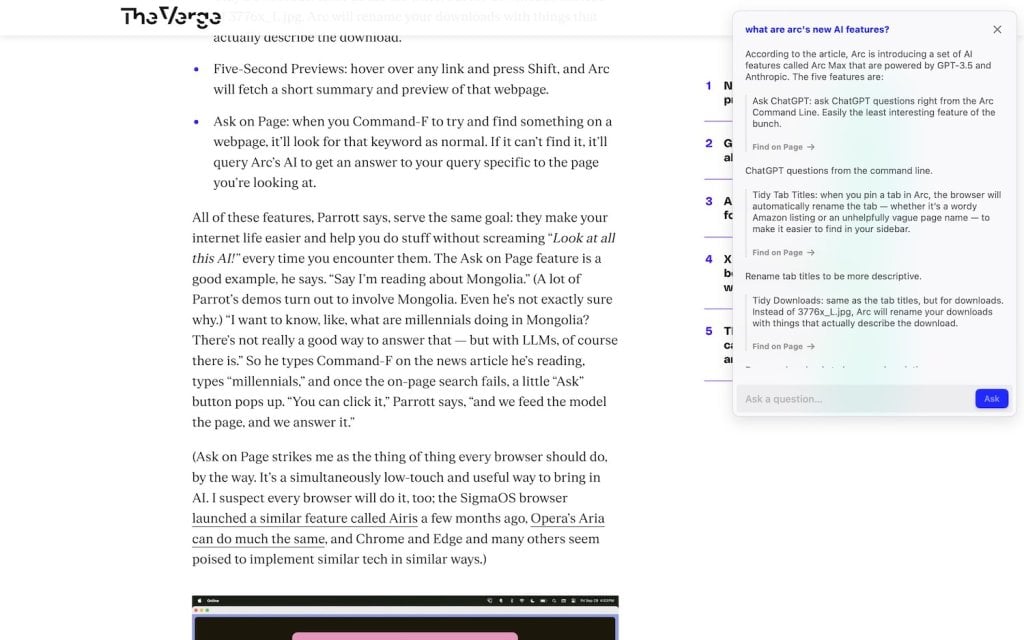
Arc summarizing an article on The Verge

The second is AI summaries of links. If you hit shift and hover over a link, it’ll tell you what the page is about. Here’s Arc previewing a link from my website:
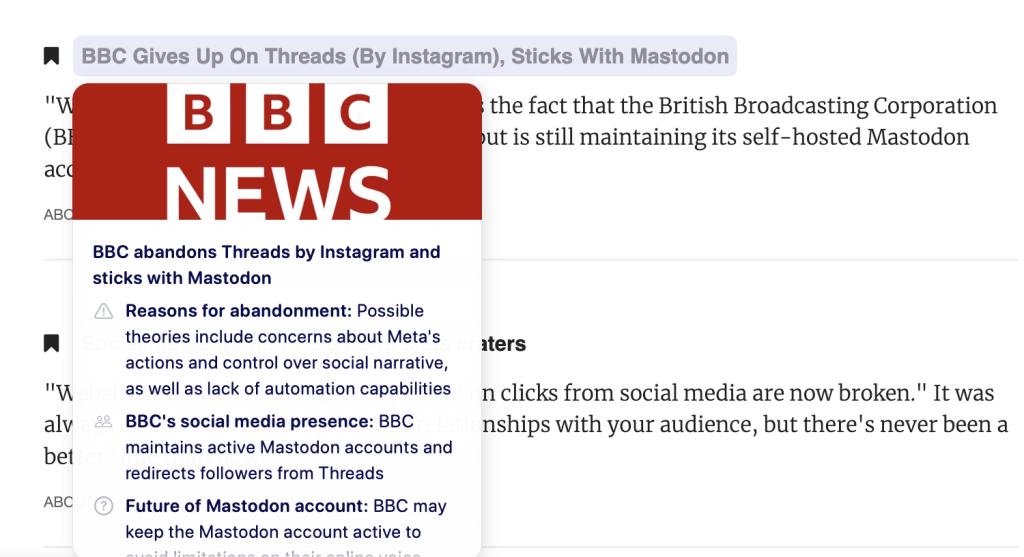
Arc previewing a link from my website

This is both useful — I don’t necessarily want to open a new tab to look at a cited source — and potentially really problematic for a lot of the web. This isn’t unique to Arc: the feature is not markedly different from, say, ChatGPT’s browser capabilities, which is similarly problematic. Here’s ChatGPT answering questions about my website:
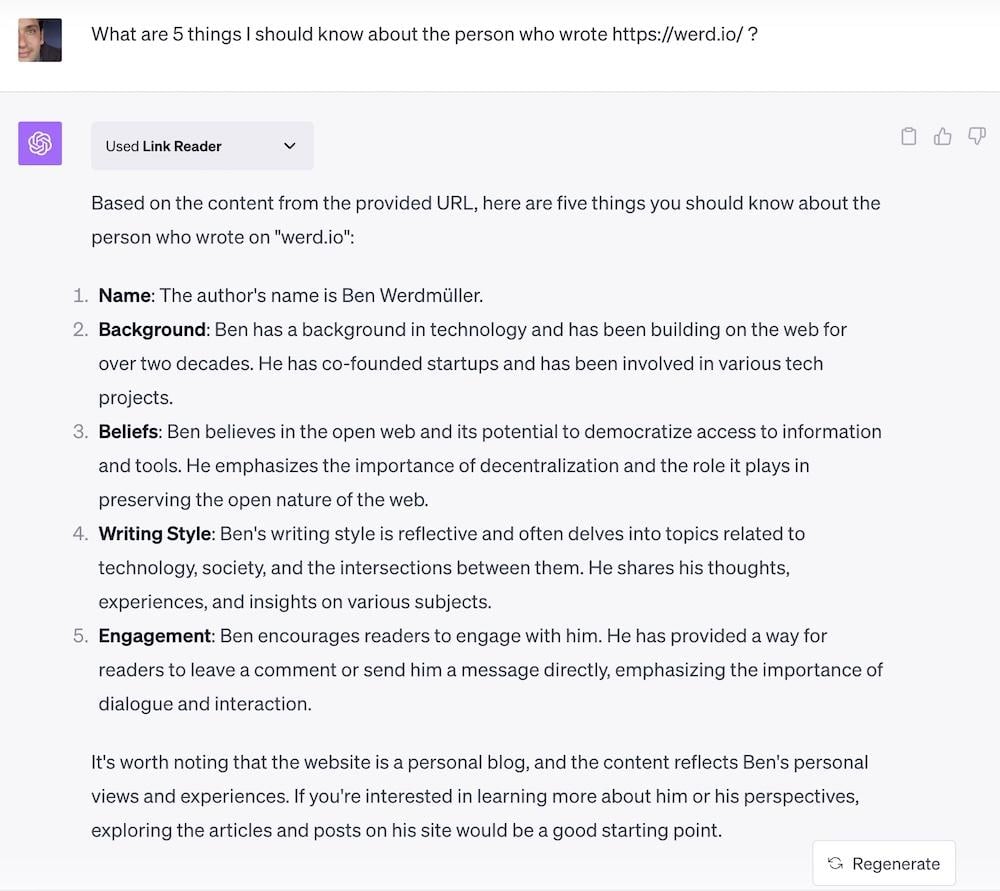
ChatGPT answering a question about my website

If you’re getting an automated summary of an information source, you’re extracting the content without thought for how that source sustains itself. For some, that will be display ads. I don’t really care for ad-driven business models, but they exist, and if a significant number of people suddenly start looking at AI summaries instead of an actual page, ad revenues will drop proportionately. For others, it’ll be donations — and AI summaries don’t have any calls to action to contribute. And some, of course, sit behind a paywall. The AI summaries appear to even summarize content that would otherwise be irretrievable without payment.

Here’s Arc summarizing a paywalled article from the Atlantic, for which I don’t have a subscription:
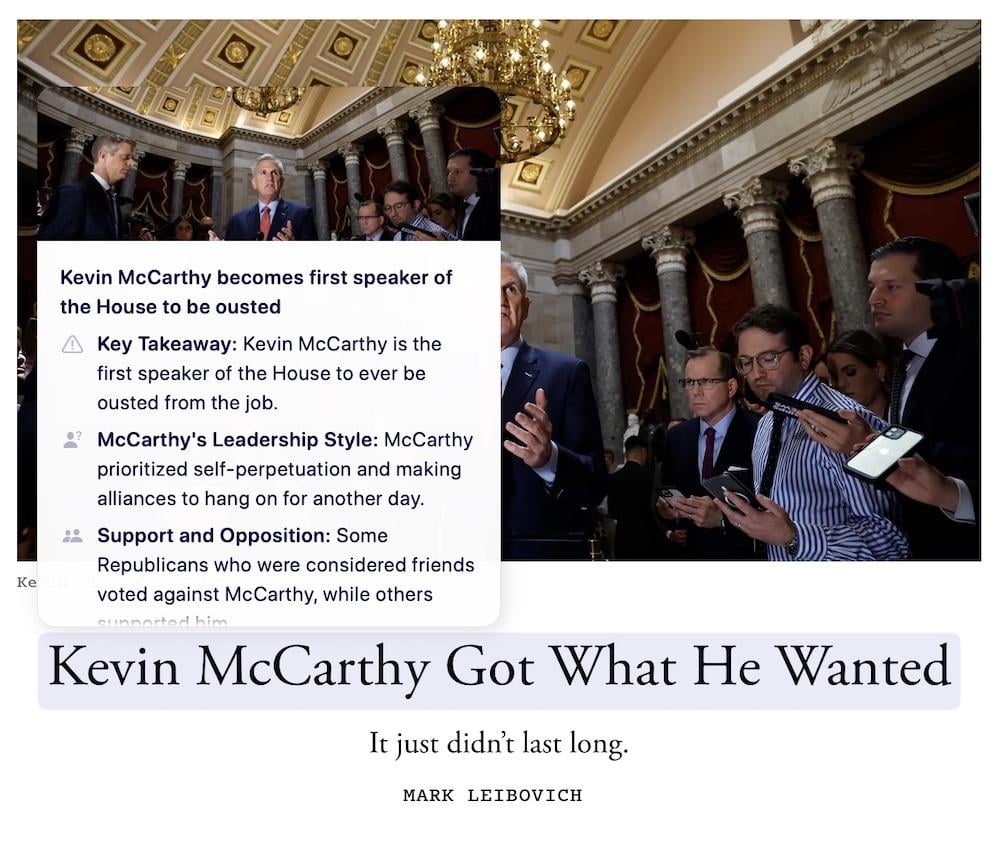
Arc summarizing a paywalled article from The Atlantic

It’s honestly really useful for users, but not super-great for the web ecosystem or the survival of those platforms.

I’m not necessarily suggesting that browsers discontinue these sorts of features. But I do think there needs to be some consideration for platform health and ensuring that the information sources we use on the web can continue to exist. So here are some ideas:

Inline calls to action. Browsers could look for markup in the page that indicates a call to action that a user could take — for example to subscribe or to donate. This could be an ad.

A universal basic paywall. Publications register to receive aggregate payments from browsers that use their content to create summaries. (Itself problematic because it essentially requires every publisher on the web to reveal their identities — unless you use crypto, which has its own issues.)

Allow publishers to set their own summary content. Not every summary needs to be written using AI; metadata in the head could provide a publisher-written summary, giving them control over what is displayed.

A general small web publisher fund. Rather than direct micropayments, browsers pay into a general fund that small web publishers can withdraw from.

Just accept that this is what the web is now. Last but not least: passive acceptance. It’s not great, particularly when browsers are largely manufactured by tech companies like Google that already make a ton of money extracting value from the web. The drop in direct pageviews could adversely affect smaller publishers in particular. But it’s also early — perhaps it will have a different effect on site visits than I think?

But these are my opinions. I’m aware that my lens here is oriented around the perceived needs of publishers on the open web. What do you think should happen? How will the ecosystem adapt?


· Posts · Share this post


BBC Gives Up On Threads (By Instagram), Sticks With Mastodon

"What makes this news more interesting is the fact that the British Broadcasting Corporation (BBC) has abandoned its Threads account but is still maintaining its self-hosted Mastodon accounts online."

[Link]

· Links · Share this post


Social media traffic to top news sites craters

"Website business models that depended on clicks from social media are now broken." It was always a good idea to own your own relationships with your audience, but there's never been a better time than now.

[Link]

· Links · Share this post


Bing Is Generating Images of SpongeBob Doing 9/11

To be fair, you could draw a picture of this in Photoshop, too. But I suspect a few brands might have a few things to say about Microsoft hosting this tool.

[Link]

· Links · Share this post


An open rubric for technology assessment

A laptop showing some dashboard

I’ve written and open sourced a rubric for assessing new technologies as part of your organization. It’s written for use in non-technical organizations in particular, but it might be useful everywhere. The idea is to pose questions that are worth asking when you’re selecting a vendor, or choosing an API or software library to incorporate into your own product.

I originally wrote a version of an assessment template when I was CTO at The 19th. Because they have a well-defined equity mission, I wanted to make sure the vendors of technologies and services being chosen adhered to their values. I’d never seen questions like “has this software been involved in undermining free and fair elections” in a technology assessment before, but it’s an important question to ask.

This new assessment is written from scratch to include similar questions about values, as well as a lightweight risk assessment framework and some ideas to consider regarding lock-in and freedom to move to another vendor.

Some of these questions are hard to answer, but many will be surprisingly easy. The idea is not to undertake a research project: most prompts can be answered with a simple search, and the whole assessment should be completable in under an hour. The most important thing it does is add intention to questions of values, business impact, and how well it solves an important problem for your organization.

It’s an open source project, so I invite contributions, edits, and feedback. Let me know what you think!

· Posts · Share this post


Mastodon Annual Report 2022

Amazing work. Consider how much this team has been able to achieve with a tiny fraction of the budget of a VC-funded tech startup - and the impact of their work is phenomenal.

[Link]

· Links · Share this post


How Google Alters Search Queries to Get at Your Wallet

It turns out that Google quietly alters your search queries into ones it can more easily monetize, without you knowing. It's the kind of anti-user nonsense only a monopolist could pull off.

[Link]

· Links · Share this post


· Links · Share this post


Predictive Policing Software Terrible At Predicting Crimes

"Crime predictions generated for the police department in Plainfield, New Jersey, rarely lined up with reported crimes, an analysis by The Markup has found." In fact, much less than 1% of the time.

[Link]

· Links · Share this post


A New Social Web Working Group at the W3C

A look at the inner workings of getting standards built within the framework of the W3C. It honestly sounds like technical writers should be a part of the mix alongside other practitioners.

[Link]

· Links · Share this post


The Philadelphia Inquirer launches 7-figure ad campaign to lure millennials

Notable to see a newspaper run an ad campaign that genuinely competes with another one. Kind of a bold move in a world where the whole market is declining.

[Link]

· Links · Share this post

Email me: ben@werd.io

Signal me: benwerd.01

Werd I/O © Ben Werdmuller. The text (without images) of this site is licensed under CC BY-NC-SA 4.0.