
 

Last Chance to fix eIDAS

This kind of legislation is fundamentally against the public interest and, I believe, should always be opposed:

"These changes radically expand the capability of EU governments to surveil their citizens by ensuring cryptographic keys under government control can be used to intercept encrypted web traffic across the EU. Any EU member state has the ability to designate cryptographic keys for distribution in web browsers and browsers are forbidden from revoking trust in these keys without government permission."

If this passes, the government of any EU member will have the power to silently intercept and read encrypted web traffic. It undermines the right to privacy and creates a chilling effect for activists and other targeted, vulnerable groups.

[Link]

· Links · Share this post


Confessions of a Venture Capital-Backed Startup Founder

"In the past few years, causality inverted: Start-ups and entire markets were manufactured from whole cloth to meet the demand of overcapitalized venture funds searching for a home run."

I am certain I'll found another startup, and I'm certain it will be a revenue-based business that will not be designed to raise investment. Perhaps ironically, in doing so, it may be more valuable as a result.

[Link]

· Links · Share this post


Which tech companies are funded may be about to change

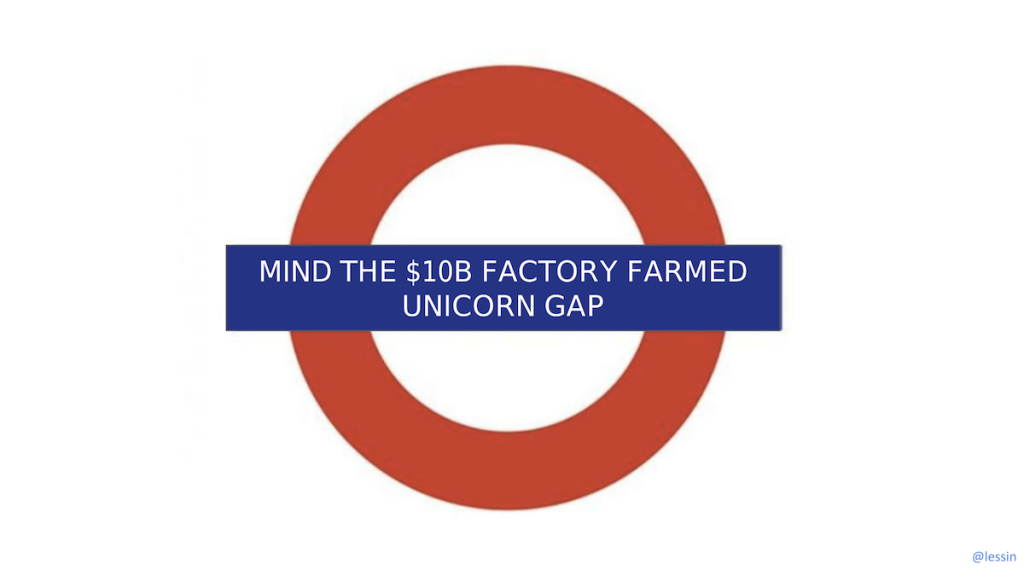
A screenshot from Sam Lessin's WTF VC presentation

I’ve been thinking about Sam Lessin’s latest deck about the future of venture capital and its implications about the future of how technology is funded and built. Sam is General Partner at Slow Ventures and partner to Jessica Lessin, founder of tech industry publication The Information.

It’s certainly worth reading if you’re in the industry (although be aware that it’s a DocSend link that requires that you provide your email address to proceed). I don’t always agree with Sam — in particular, he recently wrote a piece about banning TikTok because of pro-Palestinian content that I vehemently disagree with. But there are some claims in this deck that, if true, will be seismic.

He first sets the stage for how VC has turned into a kind of assembly line over the last twenty years:

With clarity and manufactured consistency of what late-stage VCs had to 'roll off the line' to sell to the public market, it became possible for the whole ecosystem to reverse-engineer and standardize the metrics companies needed to be worth at different stages and 'peg' valuations to those stages for intermediate products.

This trend towards startup standardization, measurement, and 'legibility' at all stages allowed the VC factory run way more efficiently and dramatically scale up. It allowed different funds to specialize in different stages of startup production - doing just one step - and passing the goods along for markups.

This is a clear description of the venture capital funding ladder: from pre-seed to seed, then through early equity funding rounds, then to growth rounds, and out into acquisition and the public markets. As Lessin says, individual funds and ecosystems developed around each of these stages. It was like a factory line in a way, but also a bit like a Ponzi scheme: the way early stage investors made money was by later stage investors putting money in.

At each stage, Limited Partners — high net-worth individuals, pension funds, and so on — put a certain amount of their money into a venture capital fund with the expectation that they would see a return within a pre-determined timeframe (often ten years). VCs typically made a 2% management fee and then took 20% of the profit once the fund reached maturity.

The trouble was, most of the companies constructed this way didn’t succeed in the public markets. The model described above worked fairly well for the inward-facing market of investors, and sometimes created services that people used, but it didn’t actually create the value necessary to justify those valuations. This — together with a reformed market landscape in the wake of the pandemic — means that the formulae investors used to calculate valuations are meaningless. There’s no factory-ready set of calculations to use. Every company is different.

Every company was always different, and valuations could never be paint-by-number, but it’s become harder to maintain the appearance of set standards.

Lessin also points out that the factory model also allowed absolutely unscalable non-tech companies to get the tech treatment: direct to consumer products, electric scooters, networks of doctor’s offices, and so on were all VC-funded using the same metrics designed for software, despite not being software at all. These companies didn’t do well at all and trust was eroded.

There are lots of reasons why this happened, which Lessin doesn’t touch on: once limited partners have put money into a fund, the investor needs to deploy capital from that fund on investments within the timing of the fund. These investments have to come from somewhere, and it becomes harder and harder to find the right kind of software deals the more competition there is. In a 0% interest (“ZIRP”) environment that hosted an explosion of VC funds that were all competing for founders, investors often hustled hard to get any deals at all. There were simply more funds than viable software companies to support.

All this and a renewed government interest in enforcing anti-trust rules means that acquisitions (which were how many funds really made their money) have slowed. And because LPs didn’t get their money back from previous funds, they’re not re-investing in new ones. And potential founders aren’t leaving big tech companies, because layoffs and a more uncertain economic environment means they might not get their jobs back if their startups fail.

What Lessin does say — in, for me, the most interesting part of the deck — is that this dynamic is still going on, and is behind the current AI boom. He characterizes investor interest in AI as a somewhat desperate attempt to maintain the venture investing status quo:

But what of generative Al you say! Well, this is what you call wishful thinking... a clear example of a narrative generated out of desperation in the VC community vs. good sense. The Al startup opportunity is largely a mirage of thirsty investors trying to cling to an old way of doing things after similar spun up stories on Metaverse (and yes in its peak froth moment Crypto) didn't play out, and the last narrative around ‘on demand services' mostly crumbled.

It’s an extending / sustaining innovation, Lessin argues: one that allows incumbents (Microsoft, for example) to make higher profits rather than providing opportunities to new players in the marketplace. There are no moats: no way for startups to maintain a lead because there are no network effects and everything is open source. On top of this, the startups are so overpriced because of the concentration in investor activity that they would need to be phenomenally successful to provide a reasonable return. If any of these turn out to be the case, investors in AI startups will not see the returns they’re hoping for.

Remember, this doesn’t mean AI isn’t necessarily useful in itself: it’s simply an argument that it might not be a good fit for new startups or for venture capital investment. Whether a venture is suitable for VC funding is not a value judgment on it in overall. Nonetheless, it’s an enormous statement.

Instead of pursuing the “factory” model of startups that require lots of rounds of funding, Lessin suggests that small investors should put their money into more capital-efficient businesses: small business platforms, communities, and business-to-business platforms with low expenditures. In other words, communities that are built slowly and can be revenue-driven without having to grow to monopoly size. The world where investors can aggressively fund a tech company until its competitors are dead, regardless of its own profitability, is gone.

I see this as largely positive: this is a world where people are more aligned with the services they use, and where revenue rather than exploitation is central. It remains to be seen how accurate it will be for the market at large, but I consider it notable and exciting that investors like Lessin are coming around to thinking along these lines.


· Posts · Share this post


Open Society and Other Funders Launch New Initiative to Ensure AI Advances the Public Interest

This is the kind of AI declaration I prefer.

“As we know from social media, the failure to regulate technological change can lead to harms that range from children’s safety to the erosion of democracy. With AI, the scale and intensity of potential harm is even greater—from racially based ‘risk scoring’ tools that needlessly keep people in prison to deepfake videos that further erode trust in democracy and future harms like economic upheaval and job loss. But if we act now, we can build accountability, promote opportunity, and deliver greater prosperity for all.”

These are all organizations that already do good work; it's good to see them apply pressure on AI companies in the public interest.

[Link]

· Links · Share this post


The Bletchley Declaration by Countries Attending the AI Safety Summit, 1-2 November 2023

For me, this paragraph was the takeaway:

"We affirm that, whilst safety must be considered across the AI lifecycle, actors developing frontier AI capabilities, in particular those AI systems which are unusually powerful and potentially harmful, have a particularly strong responsibility for ensuring the safety of these AI systems, including through systems for safety testing, through evaluations, and by other appropriate measures. We encourage all relevant actors to provide context-appropriate transparency and accountability on their plans to measure, monitor and mitigate potentially harmful capabilities and the associated effects that may emerge, in particular to prevent misuse and issues of control, and the amplification of other risks."

In other words, the onus will be on AI developers to police themselves. We will see how that works out in practice.

[Link]

· Links · Share this post


Technical Standards Bodies are Regulators

This is an interesting point of view, but I don't think I fully buy it: while these bodies set technical standards, they have no ability to actually enforce.

Consider the situation with Internet Explorer back when it virtually owned the web (and, to a lesser extent, the situation today with Chrome). Standards could be set, directions could be established, but there was no-one to stop Microsoft from going their own way.

[Link]

· Links · Share this post


Return To Office is all about power

A laptop open on a table in a cabin in the woods

Expensify’s experiment to use craft coffees and a free cocktail bar to lure employees back to the office failed spectacularly:

If the best office in the entire planet can't compete with the local coffee shop, the tightly-closed Pandora's box of "work from anywhere" has burst open, and will never be resealed. No amount of begging or coercion is going to work in the long run: the businesses that demand it are fighting a losing war of attrition against an infinite universal energy. You heard it here folks: the office is dead.

This isn’t where every company has ended up on this issue. Most large tech companies in particular are demanding a return to the office, for a few reasons.

The first, although not the main reason, is that a lot of very large companies have real estate portfolios that are now sitting mostly-empty, which will drive down prices when leases come up for renewal, in turn jeopardizing the value of commercial real estate holdings. (Boo hoo.)

The second is a belief — more religious than fact-based — that workers are more productive in the office than if they work from home. (Research tends to show the opposite.)

And the third is ostensibly about company culture:

In a 2022 Korn Ferry survey of 15,000 global executives, two-thirds agreed that corporate culture accounts for more than 30% of their company’s market value. Many leaders, the report notes, believe that a strong culture can only be established and maintained “if everyone is — at least some of the time — occupying the same workplace.”

Culture is important — the core issue on most teams — and I’ll come back to that issue. There’s a subtext here, too, about power. The essential flip is between an employer-controlled environment and a worker-controlled environment. In the former, employees can be observed and their behavior influenced. In the latter, not so much.

This balance of power, at least for knowledge workers, is what has flipped forever. Nobody’s willingly going back to an environment of predominant employer control — at least not without significant concessions.

I wrote a flippant post on Mastodon:

You really want to get people back to the office? Forget free cocktails. Think free daycare, six month parental leave, 25 days vacation + holidays, extensive carer benefits for those who need them, the expectation that you’ll stay home and rest rather than work if you’re sick, flexible hours, further help with the enormous cost of living in the cities you operate in.

Oh, and test and require vaccination proof for everyone.

The response was really strong. Americans overwhelmingly responded with, “Yes! And also retrofit offices to have better ventilation.” Europeans, meanwhile, overwhelmingly responded with, “This would actually be an erosion of my rights; aim higher.” — a good reminder that the working conditions Americans are used to are not the norm virtually anywhere else in the world.

The crux of what I was trying to say is that the balance of power has been in favor of employers; working from home has been much-needed freedom for employees (albeit granted by necessity rather than benevolence). It’s still not truly in balance, and the benefits I discussed should be provided regardless of whether a workforce works from home or from the office — but if a full return to office is on the table, worker benefits, rights, and protections should be too.

And that’s the crux of changes to company culture, too. When employers say “culture” they often mean “norms”: when people show up for work, how they dress, notions of professed work ethic, and so on. These are all cultural elements that benefit the office. But there are also “softer” cultural elements that are a hard requirement for functioning well as a community in any context, that are even more important when workers are not in constant contact with each other.

In a remote environment, communication skills, inclusion, empathy, feeling supported, and connectedness all become vital. It’s easy to feel isolated or unsupported when you’re working from your kitchen table and conversations need to be scheduled video calls. It’s easy to not know what’s happening, understand the team’s goals, or not realize that your colleague is having a hard time this week and isn’t able to be fully present. Many of these things were implicit and unspoken when everyone was in the same room. Not addressing them explicitly was already to the detriment of a company’s culture; it was never optional. But now that everyone is distributed, its importance is amplified.

It turns out that very few employers know how to adapt to that.

It’s worth considering ideas of formal and informal communication in work contexts. Everyone knows that the real benefits at work-related conferences aren’t the sessions, but the hallway track: the conversations people informally have on the side. In my early-career work in higher education, I used to argue that learning was dependent on friendship and study groups that are formed at colleges: the informal spaces where people learn and share knowledge together.

Relationships and ambient information are built in workplaces in the same way. Building a company culture is a lot like building any community. Everyone needs to feel supported, through both hard actions (providing inclusive benefits, tools, processes, policies) and soft gestures (trust, openness, vulnerability, transparency, empathy). There need to be spaces for reflection, and there has to be room for being messily human. Everyone has to feel valued because they are valued, both in word and action. And in turn, it turns out that having increased power, agency, connectedness, support, and trust will make them happier and more productive.

There are tools for this, but they’re different tools. I believe strongly in journaling inside a company, for example: a way of modeling transparent communication, quiet reflection, and vulnerability. The best place I’ve seen this work is Medium, which has a private version of its site (called Hatch) run as an intranet for employees. It’s a beautiful space that runs the gamut from engineering specs to personal introductions and introspection. As Marcin Wishary wrote a few years ago:

It’s so good it feels like a perk. It forces us to be thoughtful about our product and about our company. It makes everyone a better writer/explainer/storyteller. It keeps the relevant ideas and thoughts afloat, as they don’t just die in individual mailboxes.

It’s not a surprise that when the then-CTO of Medium moved on, it was to found Range, a sort of operating system for team communication.

These are hundreds of similar ideas — some of them formal tools, some of them informal practices — that can help with building a strong remote team culture. It’s completely possible, if employers can bring themselves to understand that they have to do the work, and to internalize Expensify’s finding that the previous status quo is never coming back.

No matter which way you cut it or which tools you use, remote work does depend on trust in your employees, more devolved power and distributed equity, high transparency, and great, bi-directional communication. If those are challenging to an organization, there just might be deeper problems that need to be addressed.

· Posts · Share this post


That's beautiful!

· Replies · Share this post


Pushing for a lower dev estimate is like negotiating better weather with a meteorologist

I've lived this, and I'd go so far that it's a sure sign of a dysfunctional team: when non-technical leadership pushes for lower estimates based on their own business hopes and doesn't accept the ones given by their in-house experts.

"Pushing for a lower estimate is like negotiating better weather with the meteorologist" covers it nicely.

[Link]

· Links · Share this post


Senior web development at ProPublica

ProPublica is hiring a senior web developer.

You’re familiar with ProPublica’s reporting even if you’re not sure about the name. They’re the newsroom that reported on Justice Clarence Thomas’s close relationship with GOP megadonor Harlan Crow; on TurboTax’s misleading practices that coerce low income tax filers into paying for its product; on Illinois schools collaborating with local police to issue tickets for minor misbehavior. It’s won major journalism prizes including the Pulitzer, had an outsize impact on American democracy, and shown the way for non-profit news.

The product team is a small group of creative technologists that provide the website, data, and infrastructure platform for this journalism to be published. It’s a remote team (although applicants must be in the United States) with an option to be in-person in New York City. Go apply here and say I sent you.

· Posts · Share this post


What Palestinians Really Think of Hamas

Palestinians in Gaza are, by and large, not fans of Hamas, and are not aligned with eliminating Israel.

"By and large, Gazans do not share Hamas’s goal of eliminating the state of Israel. When presented with three possible solutions to the Israeli-Palestinian conflict (as well as an option to choose “other”), the majority of survey respondents (54 percent) favored the two-state solution outlined in the 1993 Oslo accords."

Of course, they likely also don't favor being bombed to oblivion.

[Link]

· Links · Share this post


The Handcrafted Artisanal Web

"The future is returning to an artisanal web, where you cultivate your niches and small communities, where maybe you don’t become a millionaire and a star, but you do feel a sense of belonging, and maybe make enough to get by. I think that’d be okay, honestly."

I think that's more than okay. I'd say it's optimal. Let's get there quickly, please.

[Link]

· Links · Share this post


‘The Messenger’ Speed Runs The U.S. Journalism Implosion Cycle Thanks To Incompetent Billionaires And ‘Both Sides’ Clickbait Gibberish

"Like so many rich media executives (see: Politico owner and CEO Mathias Döpfner), Finkelstein’s incapable of seeing most of the fatal flaws in modern U.S. journalism, whether it’s the inherent class, race and gender biases in most newsrooms, the steady erosion of trust caused by feckless “both sides” or “view from nowhere” reporting, or the underlying flaws with the ad-engagement models that now prop up — and violently derail — efforts to educate and inform the public."

This is not wrong. And you could see this implosion coming a mile off. It's just impressive to see it happen so quickly.

[Link]

· Links · Share this post


Beyond Checkboxes: Privacy Protections That Work for the Future Generation

I think the conclusions here are the right ones. In particular, ensuring privacy by design is a far better strategy than pushing for informed consent, because the vast majority of people are not informed about the implications of data collection (even without considering Gen-Z's ambient comfort with the idea of being tracked). And DEI in the context of trust and safety is an obvious and hard requirement.

These are not standards the industry will come to voluntarily. Regulation is required in every jurisdiction and eventually as an international agreement. Without international cooperation, it'll be too easy for companies (and governments) to hop jurisdictions and use locales that are convenient for their data collection needs.

[Link]

· Links · Share this post


Journaling in private with my friends

I kind of miss having something like a LiveJournal.

If you missed its heyday about twenty years ago, LiveJournal was a private blogging community that led to much of what we know as social media. You could follow your friends, and they could follow you back if they wanted; your posts could be shared with the whole world, just with your friends, or with a subset. Every post could host thriving, threaded discussions. You could theme your journal extensively, making it your own. And while you could post photos and other media, it was unapologetically optimized for long-form text. The fact that the whole codebase was also open sourced, paving the way for Dreamwidth and other downstream communities, didn’t hurt at all. Brad Fitzpatrick, its founder, went on to build a stunning number of important web building blocks.

There’s no other service I’ve found that allows you to write in long-form in a private space that you share with your friends. Instagram might be the closest in some ways: it’s turned into a more interesting, introspective social network than most. But I’m better with words than with pictures, and I miss that quiet, shared reflection.

Public social networks force us to use a different facet of our identities. In a private space with your friends, nobody really cares about your job, and nobody’s hustling to promote whatever it is they’re working on. Twitter nudged social networking into becoming a space for marketing and brands, which is a ball the new Twitter-a-likes have picked up and carried. Much like the characters from The Breakfast Club, each of the new Twitters has its own stereotypical niche: the nerds, the brands, the rich people, the journalists. But they all feel a little bit like people are trying to sell ideas to you all of the time.

Like many people on social media, I’m constantly sharing links to things I’m worried about, or things I’ve written, or things I’m working on. The underlying numbers are important. Is what I’m writing resonating with people? Are people subscribing? There’s an underlying neurosis to it that isn’t very healthy — and it’s this neurosis that also leads to blogging FOMO, where you feel like you have to keep pushing out content otherwise you’ll lose people. I know that influencers (the modern internet’s far better-looking answer to bloggers) also feel this acutely.

Not everything has to be about building a brand or a following. It can just be about reflecting, or sharing something with your friends. Private spaces allow us to be weird, unvarnished, and vulnerable in a way that’s harder for most people if they think the world could be watching. On the public web, everyone is their own little media publisher. In private, we’re just us. The former creates an enforced distance — almost a mask — between writer and reader. The latter is intimacy.

How can we reclaim some of that humanity from our social spaces? Should that even be a goal? I can’t decide, but I do know I miss it. I think what that really means is that I miss when the web felt like it was about making a genuine, reflective connection with other people — and it most often doesn’t anymore.

· Posts · Share this post


Without a Trace: How to Take Your Phone Off the Grid

A really accessible guide to privately using a cellphone.

One thing I think might be missing here: you probably shouldn't use the phone near your home or regular haunts. While not connecting to your home wi-fi is probably smart, cell tower records will still show your most common locations, which can also be used to identify you.

[Link]

· Links · Share this post


Bandcamp Editorial Director: “Fuuuuuck Bandcamp United”

This is a complete misunderstanding of the nature and value of unions: they're not just for low-income workers. Unionization can help all workers and make healthier workplaces for everyone.

Even with that aside, this kind of public rhetoric pits a manager directly against his workforce in a way that surely can't be healthy for company culture or morale. A case study in what not to do.

TL;DR: unions are good, actually.

[Link]

· Links · Share this post


Leaving Twitter

Interesting to see this comment from Benedict Evans, who is far from an ideological internet participant: his social commentary very often leans conservative, and he was formerly a partner at Andreessen Horowitz.

But enough is enough. Musk's promotion of antisemitic sources and tropes has pushed him off the platform with no plans to return. Others will be watching and will certainly follow.

[Link]

· Links · Share this post


POSSE: a better way to post on social networks

Really fun to see indieweb concepts like POSSE gain attention again.

When I built POSSE into Known, I knew it would be a matter of time before API changes cut off access (and it was). These days, in a world made of open source protocols, these restrictions don't exist: my website is syndicated directly to Mastodon, and soon Threads, and nobody can stop me from doing so.

Syndicating to closed platforms is almost pointless because their owners will close the doors once they feel threatened. But open platforms have no doors. You can share your content there in a hundred different ways.

It's truly a social web.

[Link]

· Links · Share this post


I'm looking for a new adventure

I’m looking for new adventures! These might be:

  • A full-time position
  • A paid board or advisory position
  • A long-term contract

Maybe there’s a me-shaped hole in your organization! Let’s talk.

What do I do?

I’m an experienced technology leader and strategist with an engineering background.

I’ve spent years working in leadership teams, including:

Alongside this, I also:

  • Taught equitable product design to newsrooms as part of Open Matter and the Newmark School’s Product Immersion for Small Newsrooms
  • Served as the Geek in Residence at the Edinburgh Festivals Innovation Lab
  • Was a senior engineer at Medium, a top 100 website, where I also co-founded the openness circle and co-led workshops into responses to the 2016 election
  • Have been an active member of the indieweb community, advocating for a vibrant, diverse, independent web
  • Open sourced a rubric for making technology decisions

You can learn more about my career background on my LinkedIn profile.

What am I looking for?

I want to work with collaborative, empathetic, inclusive teams that are using technology to make the world better — or are advising mission-driven organizations about their use of technology.

We might be a great fit if:

  • You need someone who can create a product vision and execute on it
  • You’re looking for a leader with a technical background who can create a supportive, productive team culture
  • You’re looking for someone to advise on technology or startup strategy
  • You want to stay on top of technology trends and assess emerging opportunities
  • You need someone to help hire a great technology team
  • You’ve enjoyed my writing here and believe these ideas would be useful in your organization

Or all of the above! I would also strongly consider teaching or research positions.

What am I not looking for?

We’re not a great fit if:

  • You work with the military of any nation
  • You’re primarily looking for a software engineer (although I love coding in the context of the work listed above)
  • You’re an all-male or all-White team

I also only take remote-first positions, although I am willing to travel into the office or to customers from time to time. I can work in the United States without need for a visa or sponsorship.

How can I get in touch?

Email me at ben@werd.io to organize a chat. I’m looking forward to meeting you!

· Posts · Share this post


Notes, Links, and Weeknotes (23 October 2023) – Baldur Bjarnason

Baldur Bjarnason talks frankly about the cost of writing critically about AI:

"It’s honestly been brutal and it’ll probably take me a few years to recover financially from having published a moderately successful book on “AI” because it doesn’t have any of the opportunity multipliers that other topics have."

I worry about the same thing. I've noticed that AI-critical pieces lead to unsubscribes on my newsletter, and that most lucrative job vacancies relate to AI in some way.

I'm not sure I regret my criticism, though.

[Link]

· Links · Share this post


The map-reduce is not the territory

Someone holding up an old-fashioned compass in Yosemite

There are two ways to use GPS navigation in a car:

The first is to use the directions as gospel. The system has found the right path for you to take; you need to follow them if you’re going to get to your destination.

The second is as a kind of North Star. The navigation will always point you towards your destination, but you know that you don’t have to follow the directions: if you choose to take one street instead of another, or take a detour, the system will adapt and find another way to go.

In the first scenario, the computer tells you what to do. In the second, it’s there to advise you, but the decisions are yours.

The first may get you there faster, if the systems’s model of the streets and traffic around you matches reality to an adequate degree. We’ve all discovered road closures or one-way streets that weren’t represented on-screen. By now, most people are familiar with the practical implications of Alfred Korzybski’s reminder that the map is not the territory even if they haven’t encountered the work itself. The computer’s knowledge of the street and its traffic is made of city plans, scans from specially equipped cars, road sensors, and data from geolocated phones of people in the area. While this collection of data points is very often adequate, much is left out: the model is not the territory.

But even if the model were accurate, the second method may be the most satisfying. A GPS system doesn’t have whims; it can’t say, “that street looks interesting” and take a detour down it, or choose to take an ocean drive. The first method gets you there most efficiently, but the second allows you to make your own way and take creative risks without worrying about getting completely lost. Sometimes you dowant to get completely lost — or, at least, I do — and then there’s no need to have the GPS switched on at all. You find new places, the second way; you discover new streets; you explore and learn about a neighborhood. You engage your emotions.

One way to think about the current crop of AI tools is as GPS for the mind. They can be used to provide complete instructions, or they can be used as a kind of North Star to glance at for suggestions when you need a helping hand. Their model isn’t always accurate, and therefore their suggestions aren’t always useful.

If you use AI for complete instructions — to tell you what to do, or to create a piece of work or a translation — you likely will get something that works, but it’ll be the blandest route possible. Prose will be prosaic; ideas will not be insightful. The results will be derived from the average of the mainstream. Sometimes you’ll need to adjust the output in the same way you need to drive around a closed road that GPS doesn’t know about. But the output will probably be something you can use and it’ll be more or less fine.

If you use AI as a kind of advisor, you’re still in control: your creativity has the wheel. You have agency and can take risks. What you’ll make as a human won’t be the average of a data corpus, so it’ll be inherently more interesting, and very likely more insightful. But you might find that a software agent can unstick you if you run into trouble, and gently show you a possible direction to go in. It’s a magic feather.

I worry about incentives. For many, they will be used to instruct or replace our decision-making faculties, rather than as a tool we can use while remaining in control. Software can be used to democratize and distribute power, or it can be used by the powerful to entrench their dominance and disenfranchise others. So it is with AI: the tools can aid creativity and augment agency, or they can be used to prescribe and control. I have no doubt that they will often be used for the latter.

There was a story that Google Maps intentionally routed people driving south from San Francisco on US Route 101, an objectively terrible stretch of highway, leaving the parallel and far more pleasant Interstate 280 free for its employees. It’s kind of funny but not actually true, as far as I know; still, because Google Maps navigation is a black box, they could have done it without anyone realizing it was on purpose. Nobody would need to know. All benefit would be to the owners of the system.

GPS isn’t only used by human drivers. Take a stroll around San Francisco or a few other major cities and you’ll notice fleets of driverless taxis, which use a combination of GPS, sensor arrays, and neural networks to make their way around city streets. Here, there’s no room for whim, because there’s no human to havewhims. There’s just an integrated computer system, creating instructions and then following them.

Unlike many people, I’m not particularly worried about AI replacing peoples’ jobs, although employers will certainly try and use it to reduce their headcount. I’m more worried about it transforming jobs into roles without agency or space to be human. Imagine a world where performance reviews are conducted by software; where deviance from the norm is flagged electronically, and where hiring and firing can be performed without input from a human. Imagine models that can predict when unionization is about to occur in a workplace. All of this exists today, but in relatively experimental form. Capital needs predictability and scale; for most jobs, the incentives are not in favor of human diversity and intuition.

I also have some concerns about how this dehumanization may apply life beyond work. I worry about how, as neural network models become more integrated into our lives and power more decisions that are made about us, we might find ourselves needing to conform to their expectations. Police departments and immigration controllers are already trying to use AI to make predictions about a person’s behavior; where these systems are in use, their fate is largely at the hands of a neural network model, which in turn is subject to the biases of its creators and the underlying datasets it operates upon. Colleges may use AI to aid with admissions; schools may use it to grade. Mortgage providers may use AI to make lending decisions and decide who can buy a house. Again, all of this is already happening, at relatively low, experimental levels; it’s practically inevitable that these trends will continue.

I see the potential for this software-owned decision-making to lead a more regimented society, where sitting outside the “norm” is even more of a liability. Consider Amazon’s scrapped automated hiring system for software developers, which automatically downgraded anyone it thought might be a woman.

Leaving aside questions of who sets those norms and what they are, I see the idea of a norm at all as oppressive in itself. A software engine makes choices based on proximity to what it considers to be ideal. Applying this kind of thinking to a human being inherently creates an incentive to become as “normal” as possible. This filtering creates in-groups and out-groups and essentially discards groups the software considers to be unacceptable. If the software was a person or a political movement, we’d have a word for this kind of thinking.

Using AI to instruct and make decisions autonomously does not lead to more impartial decisions. Instead, it pushes accountability for bias down the stack from human decision-making to a software system that can’t and won’t take feedback, and is more likely to be erroneously cast as impartial, even when its heuristics are dangerously dystopian.

I like my GPS. I use it pretty much every time I drive. But it’s not going to make the final decision about which way I go.

I appreciate using AI software agents as a way to check my work or recommend changes. I like it when software tells me I’ve made a spelling mistake or added an errant comma.

I do not, under any circumstances, want them running our lives.

· Posts · Share this post


Patrick Newman's Software Engineering Management Checklist

I have no real arguments here: this is a concise, simple list of things an engineering manager should strive for. There's a world of detail not represented here, of course, but these are the headlines.

[Link]

· Links · Share this post


Leading researcher: Strong encryption protects journalism

"In addition to being important for protecting the information that journalists are provided by all types of sources, encryption is key to making sure that information and communications within news organizations are kept safe as well."

This is my finding too from my time spent leading technology teams in newsrooms: encryption is an absolutely vital tool that keeps journalists and stories safe.

Backdoors might make life slightly easier for law enforcement, but they have so many negative downstream effects that they should not be considered a real solution in the public interest.

Backdoors are an antipattern; let's keep them out of our software.

[Link]

· Links · Share this post


IFTAS Fediverse Trust and Safety Needs Assessment Report Q3 2023

An in-depth assessment of moderation needs on the fediverse. Findings here include that most instances aren't incorporated and don't have liability insurance.

I'd bet that these numbers are actually better than if they'd done the same study for all community spaces on the web: web forums and so on. Considering the open nature of the fediverse - let's please just call it the social web - this is promising.

Which is not to say that folks don't need help, and that there doesn't need to be support for instance operators as they come online and support different communities. I love that this survey was undertaken, and I'm curious to see how this data is used.

[Link]

· Links · Share this post

Email me: ben@werd.io

Signal me: benwerd.01

Werd I/O © Ben Werdmuller. The text (without images) of this site is licensed under CC BY-NC-SA 4.0.