

 

Feels Good Man! Pepe, copyright, and NFTs

"And then NFT craze hits, and Pepe becomes a star in the non-fungible token markets. I’ve spent countless hours in NFT platforms in the last months, every time I open a new page, there’s usually an animated Pepe waiting for me. Many NFT artists are part of the meme generation that grew up on Pepe and other memes, so these tend to feature heavily on their output (probably only beaten by Doge). Instead of fighting the trend, Furie joined the NFT revolution, and started making lots of money off Pepe “originals”, and allowing most other NFTs of Pepes to continue."

[Link]

· Links · Share this post


What do I want you to know about Ma?

I wrote this piece to read at my mother's memorial on Saturday, August 28. I don't want to lose it, so I'm posting it here, to my personal space.

This is terrifying to me, which is why I’ve decided to write something down. I can’t possibly hope to represent Ma well. Even finding a story to tell is incredibly hard because there are so many of them: a lifetime of happy stories from a childhood that always felt like a kind of wheatgerm-fueled adventure where we lived on our own terms in spite of what the world might have wanted from us.

I started calling her Ma as a term of endearment when I was an adult. “Mum” is too British; “Mom” doesn’t sound right coming out of my mouth. “Mom”. So I confess, I absolutely stole Ma from [our cousins] the Neales, who have similar accent difficulties, and who I admire in lots of ways.

But when we were growing up, I called her Debbie. We were a very respectful but non-hierarchical household: we called our parents by their first names, we were encouraged to take things apart and ask how things worked, and we were consulted on all kinds of things that children are not necessarily best-equipped to weigh in on - but we were trusted, and that was wonderful, and a reflection of how both my parents think and thought. It’s a mindset rooted in equality, growth, and learning.


So. What do I want you to know about Ma?

Everything. Or at least, quite a few things. But let’s start here:

I want you to know that she was really freaking smart.

In my line of work, which is working in product and engineering in the tech industry, people often say things like, “explain this like you were explaining it to your mother.” It’s obviously a completely sexist line of thinking, which is kind of a reflection of the tech industry to be honest, and I take great satisfaction in telling them that my mother taught me to program. Not only that, but she learned assembler, which is one of the most intricate ways to program.

She would sit patiently with me for hours on end, and together we’d plug source code into our 8-bit Atari. She taught me BASIC, and then later on, we moved on to more complicated languages together.

When we didn’t have the money to get the latest and greatest PC, she organized a computer club at a local business in Oxford so that I’d have access. Every Thursday night, a bunch of kids from across the city would play games, make art, learn to code, and become computer literate together under her gentle guidance.

She studied the telecommunications industry, and knew that both the internet and the mobile revolution were coming. She understood the implications, and spoke to many of the people who were making things happen. She wrote detailed analyses of the forces that would reshape much of society over the coming decades.

She took me with her to industry shows in Cannes, and as a family we went to technology conferences across Europe, where we’d go sightseeing (and I might sneak into an event or two) and she’d be running panels and conducting interviews.

She was unassuming about it; she wasn’t self-important, but if she’d been someone else, she could have become a billionaire.

Instead, she withdrew from the industry, retrained, became a middle school science teacher in one of the most impoverished towns in California, and never looked back. I don’t remember her as happy at work as when she was teaching those kids. Even when she started to get sick, she went into work every day with an oxygen tank on her back, looking like a Ghostbuster. Even when she couldn’t work anymore, she helped her school get grants and organized an educational program with NASA. She was dedicated and she loved it.

She would engage in debate about anything. It was common to see her and my dad watching a documentary or lecture on any number of obscure topics and discussing it late into the night and sometimes days later. She became fascinated by science and space. She could speak a bunch of languages and would read and analyze academic reports in languages she didn’t even know yet. She was well-read, and read voraciously - often with multiple books on the go at once, which even this year she’d alternate between during dialysis and while she was getting her tube feeds in bed - and was hungry for knowledge.

So, sure, I’ll explain it like I’m explaining it to my mother. I’ll include all the detail, know that she’ll understand the implications better than I will, and be ready for a series of informed, insightful questions - and to be, more than anything else, challenged on the ethics of it.


What do I want you to know about Ma?

I want you to know that she cared. She wasn’t just kind and forgiving, willing to see the best in absolutely everyone and go out of her way to help - although she was definitely all of those things. But more than that, she really cared deeply: about people and the intricacies of their lives, about the world, and particularly about fairness.

Before I was born, both my parents were involved in struggles to support affirmative action and tenants’ rights. She described herself as having been radicalized early on, but it’s not particularly that she was radical: she could just see past the social templates that everyone is expected to adhere to, and which perpetuate systemic injustices, and could see how everything should operate to be fairer.

That was true on every level. She wanted she and Steve and Erica to all be treated equally, and would make it known if she thought the others were getting a raw deal. She tried her best to treat Hannah and I equally. If someone made a sexist or a homophobic remark around her, she would call it out. If someone was xenophobic, or unthinkingly imperialist, she would bring it up. She was outspoken - always with good humor, but always adamant about what really mattered.

Later in life, when she had a little bit more money, she gave to causes she believed in: representation for women, reproductive rights, racial justice, voting rights, and the environment. She was glued to the Presidential debates, appalled by the previous guy, and was completely on top of what was going on in the world.

She was a feminist, as we all should be. She defined her own identity, dressed as she wanted to dress, acted as she wanted to act, spoke how she wanted to speak. It wasn’t that she was irreverent towards more traditional expectations; they were utterly irrelevant. As they should be.


What do I want you to know about Ma?

I want you to know that she was herself - and that self was full of life and energy and humor and movement. And I’m not just talking about her amazing trousers.

The last time I was here at the Cape, which was three years ago, we were all hanging out in the pond behind Little Lane. For some reason, there was an inflatable bull out there with us. None of us could climb on top of it: Hannah, me, Anna, I think Rachel was there, Wiley, Elise.

Ma was weak, and the lung transplant drugs were taking their toll, and she was having trouble eating food. And when she started to climb onto that bull, I’ve got to admit, I was kind of worried.

But by god, climb she did, and she was the only one of us who made it to the top of that bull. And once she’d scrambled to the top of it, she lifted her arms up in victory.

That was Ma.

We realized later that she absolutely was not supposed to be in a closed body of water as an immunosuppressed person, but whatever. There were no ill effects. She climbed the bull.

She spent the last decade scrambling to the top of the biggest metaphorical inflatable bull you’ve ever heard of. And she spent most of that decade balancing precariously on top of it with her arms held high in victory.

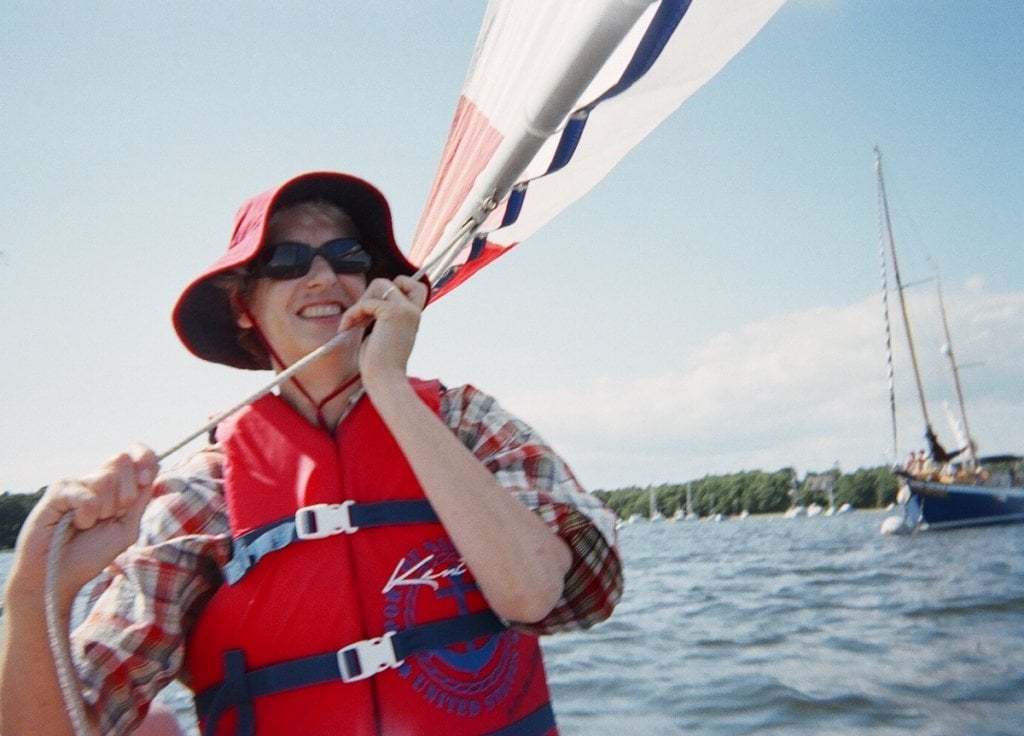
When Pammy gifted us the Sunfish - the same boat that they had both sailed when they were younger - it was like a key to unlocking the bay. We spent days and days tacking around the bay, finding exactly the right breeze, and making our way back to Grandmother’s Beach at high speed in a single tack. She would yell: whooooooosh! And then we’d think about tacking back to Sagelots and doing it all again.

Life was always full of those small moments of joy. Taking Tessie, our little Jack Russell Terrier, out on Port Meadow and watching her bound through the tall grass. Going out to the wildlife sanctuary outside of Turlock and seeing the birds fly through the reeds. Sneaking out and stealing a dinghy late at night from Grandmother’s Beach and oohing at the phosphorescence shimmering around our oars. Getting out the sofabed and all sitting together under the covers to watch Doctor Who or a movie on a Friday night. Sitting around the table with people she loved, picking crabs.

When she got sick, life was still full of those moments of joy. Even just a five minute walk through the park had the same energy. Just a few months ago, she got out and walked the boardwalk at Monterey. “I still have life-force in me,” she told the doctors. She loved to live.


What do I want you to know about Ma?

One last thing for now. I actually have a message to impart. Not so long ago, while she was lying in a bed on the tenth floor at UCSF, surrounded by all the tubes and hospital paraphernalia, she gave me a simple instruction:

“Tell everyone I love them.”

And she did. She loved you so much. She loved all of us so much, in a way that was open, and forgiving, and kind, and all in her own way.

I’m really glad you’re all here. She would be glad too. She was hoping to be with you all one more time.

Thank you.
· Posts · Share this post


A delay

I failed to publish a Fairness Friday post today. In my defense, I've been preparing for my mother's memorial, which is tomorrow.

I'll likely post on Sunday. For now, I hope that you have a lovely weekend, full of good things, and urge you to tell your loved ones how you feel about them.

· Posts · Share this post


My dead dad’s journal: How I finally met a man I knew for my entire life

"It was a window into the mind of a loving father. It was a look into the fraught thought process of a deeply analytical man. A religious man who knew he was sinning. An addict who was self-aware, and still couldn’t pull himself out from the abyss. It was Jekyll talking to Hyde. Bruce Banner talking to the Hulk. And, in honor of my dad I feel I must also include: It’s Data talking to Lore."

[Link]

· Links · Share this post


Chelsea Manning Is Back, And Hacking Again, Only This Time For A Bitcoin-Based Privacy Startup

"Halpin asked Manning to look for security weaknesses in his new privacy project, which eventually became Nym, a Neuchâtel, Switzerland-based crypto startup. Halprin founded Nym in 2018 to send data anonymously around the Internet using the same blockchain technology underlying Bitcoin. To date, Nym has raised some $8.5 million from a group of crypto investors including Binance, Polychain Capital and NGC Ventures. The firm now employs 10 people and is using its latest round of capital to double its team size." I've known Harry for a long time, and was privileged to meet Chelsea when she was an advisor to his previous startup (which we invested in at Matter). I'm excited to see this collaboration.

[Link]

· Links · Share this post


The Secret Bias Hidden in Mortgage-Approval Algorithms

“We found that lenders gave fewer loans to Black applicants than White applicants even when their incomes were high—$100,000 a year or more—and had the same debt ratios. In fact, high-earning Black applicants with less debt were rejected more often than high-earning White applicants who have more debt.” Alternative credit scores are vital - Classic FICO disproportionately harms people of color.

[Link]

· Links · Share this post


Parents Are Not Okay

“School is only just starting and already kids are being quarantined in mind-boggling numbers: 20,000 across the state of Mississippi, 10,000 in a single district in Tampa, Florida. They’re getting sick too, with hospitalizations of kids under 17 across the country up at least 22 percent in the past month, by the CDC’s count, and each new week sets pediatric hospitalization records for the entire pandemic.”

[Link]

· Links · Share this post


What I Learned While Eavesdropping on the Taliban

"When people ask me what I did in Afghanistan, I tell them that I hung out in planes and listened to the Taliban. My job was to provide “threat warning” to allied forces, and so I spent most of my time trying to discern the Taliban’s plans. Before I started, I was cautioned that I would hear terrible things, and I most certainly did. But when you listen to people for hundreds of hours — even people who are trying to kill your friends — you hear ordinary things as well."

[Link]

· Links · Share this post


On TikTok, misogyny and white supremacy slip through ‘enforcement gap’

"News investigations have nevertheless revealed that TikTok is used by Islamic State militants and to promote neo-Nazism. While the platform has started releasing transparency reports with details about the content it has removed for violating its guidelines, it is not yet part of a consortium of tech giants such as Facebook, Twitter and YouTube involved in an industry anti-terrorism effort to collaboratively track and review content from white supremacists and far-right militia groups."

[Link]

· Links · Share this post


Evolution is now accepted by a majority of Americans

“The level of public acceptance of evolution in the United States is now solidly above the halfway mark, according to a new study based on a series of national public opinion surveys conducted over the last 35 years.” That number is 54%, which is absolutely pathetic.

[Link]

· Links · Share this post


‘Bloody’ overtaken as the UK’s most popular swear word, study suggests

I've been self-censoring since I got to the US - people swear much less often here - but I'm being less diligent over time.

[Link]

· Links · Share this post


11 assertions about blockchain

  1. Proof-of-work is a disaster. There’s no way to couch it; arguments about it providing economic incentives for renewable energy are cognitive dissonance at best. Proof-of-work blockchains have the environmental footprint of a small country. Bitcoin could raise global temperatures by two degrees over the next decade all on its own. There is no valid argument for that being acceptable - or necessary.

  2. Not all blockchains are terrible. Algorand could be considered to be carbon-negative if you accept that carbon offsets are effective (I don’t). Still, it’s got a very low footprint. Proof-of-stake chains have a much lower impact; Ethereum is a high profile example of one that’s making the change. But, of course, it should have happened faster.

  3. The financialization of everything sucks. The instinct to put everything on-chain is a horrible idea that undermines social contracts in favor of free markets. In its worst embodiments, it’s a hardcore conservative libertarian’s wet dream. To have value, something doesn’t need to have financial value. Social contracts, representative democracy, social programs, and welfare all have immeasurable social value that should not be replaced with a Decentralized Autonomous Organization or anything else. Not to mention creating art for the sake of art, or community spaces for the sake of community. We don’t have to - and shouldn’t - make everything into a market.

  4. But putting some resources on-chain isn’t bad. A rough rule of thumb for me: if the current gatekeeper for a resource is a wealth silo (giant corporation, wealthy individual) then it’s a prime candidate for replacement by a decentralized mechanism. Once again for the conservative libertarians: our democratically-elected government represents us and our interests, so government-run programs are not candidates for this.

  5. Too many projects use an “if we built it they will come” mentality. I once saw a crypto investor tell an audience that he likes crypto projects to find an audience for their work in year two or three. That’s bonkers. As with every other software project - or every project - you need to validate the need and the users on day one. Otherwise you’re playing a very risky game, probably with other people’s money. It’s fun to pretend that you’re smarter than everyone else and can make something amazing without outside input, but it’s also highly unlikely.

  6. And most of them are near-impossible to use. Using web3 projects is a horrible, archaic user experience. Centralized exchanges like Coinbase are far easier to use than decentralized exchanges for almost everyone, and unless someone comes up with the equivalent of Netscape Navigator (the first truly usable web browser), centralized services will always be the gateway to blockchain tech for most people.

  7. Crypto may threaten to replace reserve currencies. The dollar has been used as a reserve currency for decades, but the ease of cross-border trade with cryptocurrencies may unseat it. Countries like China and El Salvador seem to be betting on this. It’s not obvious to me that a truly-decentralized currency replacing the dollar is a bad thing; but of course, not every cryptocurrency is truly decentralized. Even the likes of Bitcoin aren’t if a single entity controls enough of the miners.

  8. Crypto is transforming global trade on a local level (which is great). I’m personally aware of freelancers in countries like Colombia being paid in crypto rather than USD or local currency. Vietnam, India, and Pakistan lead global adoption. I think this is a really positive change that could have a major impact on traditional global power hierarchies.

  9. Some incumbents won’t go down without a fight. Both the empowerment of individuals in the global south and the upending of reserve currency structures will be major issues over the next decade or so. It’s the kind of change that has the potential to start wars. And at the very least, there are plenty of interests locked up in the traditional financial system that will do what they can to preserve their wealth.

  10. Free markets tend not to protect the vulnerable - and we can’t afford to not. We need mechanisms to mitigate climate change, to empower people who live in poverty, to support social goods like education and public health, and to ensure that everyone has the opportunity to lead a prosperous, good life in health and safety. Those things need to be dealt with intentionally.

  11. We need to be wary of crypto-libertarians. We need to beware of people who want to replace representative democracy with a financialized system, and who want to replace social safety nets with markets. Markets and society can happily live hand in hand; one does not need to replace the other. There are lots of opportunities that come with decentralization; conservative libertarians see opportunities to remove these social protections. We should continue to build for progress, and not tear down important protections that were hard-won over generations.


Photo by NASA on Unsplash

· Posts · Share this post


Feds Deliberately Targeted Black Lives Matter Protesters, A Report Says

"Movement leaders and experts said the prosecution of protesters over the past year continues a century-long practice by the federal government, rooted in structural racism, to suppress Black social movements via the use of surveillance tactics and other mechanisms."

[Link]

· Links · Share this post


Rain falls at Greenland ice summit for first time on record

“That meltwater is streaming into the ocean, causing sea levels to rise. Already, melting from Greenland's ice sheet --the world's second-largest after Antarctica's -- has caused around 25% of global sea level rise seen over the last few decades, scientists estimate. That share is expected to grow, as global temperatures increase.” We’re increasingly screwed.

[Link]

· Links · Share this post


Court rules California gig worker initiative is unconstitutional, a setback to Uber and Lyft

“A California judge on Friday ruled that a 2020 ballot measure exempting rideshare and food delivery drivers from a state labor law is unconstitutional because it infringes on the Legislature’s power to set workplace standards.” Great news!

[Link]

· Links · Share this post


Fairness Friday: California Immigrant Youth Justice Alliance

I’m posting Fairness Fridays: a new community social justice organization each week. I donate to each featured organization. If you feel so inclined, please join me.

This week, I’m donating to the California Immigrant Youth Justice Alliance. CIYJA is an organization run and developed by undocumented youth organizers. It describes its work as follows:

CIYJA is a statewide immigrant youth-led alliance that focuses on placing immigrant youth in advocacy and policy delegations in order to ensure pro-immigrant policies go beyond legalization, and shed light on how the criminalization of immigrants varies based on identity.

Its work includes pressure to divest from private prisons and to prevent deportations and family separations.

I donated. If you have the means, I encourage you to do the same.


Photo by Peg Hunter.

· Posts · Share this post


Op-Ed: As a doctor in a COVID unit, I’m running out of compassion for the unvaccinated. Get the shot

“I can pretty much guarantee we would have never met had you gotten vaccinated because you would have never been hospitalized. All of our COVID units are full and every single patient in them is unvaccinated. Numbers don’t lie. The vaccines work.”

[Link]

· Links · Share this post


The three-dimensional engineer

I’m hiring for a few engineers right now: five Ruby on Rails positions (most of them senior), two JS positions, and a quality engineer. More than a few people I’ve spoken to for these roles have apologized to me for coming from different backgrounds and not having been the product of a conventional CS track.

There’s no need to apologize for this. At all. In fact, I really like working with people who come from non-traditional backgrounds and/or small startups. Conversely, I’m not at all swayed by whether people went to top CS schools (or did CS at all) or are an an alumnus of a Fortune 500 tech company. Perhaps it’s worth exploring why; it seems obvious to me, but maybe isn’t to everyone.

The short answer is: it’s about priorities and values. Big companies and well-established CS tracks tend to (but don’t always!) lead to a certain kind of templated thinking that doesn’t necessarily translate to a smaller startup environment. People from more creative backgrounds or who have worked on smaller startups tend to be focused on making an outsized impact on a real, human problem using a broader set of skills, rather than developing a niche skill and working their way up the corporate ladder.

The skills required to climb the corporate ladder are intrinsically different to the ones required to solve problems quickly. One of the reasons I’ve avoided big tech companies for most of my career is that I’m allergic to office politics and the confrontation that inevitably arises: if a major concern for someone is building and maintaining power within an organization, becoming a gatekeeper to information, or not being willing to help build a supportive team culture, they’re going to be an obstacle to the team’s success.

If, on the other hand, a person’s focus is on solving the problems in front of the team and building the best product possible (including the best culture that leads to building the product), everyone is going to have a better time working together, and the product is exponentially more likely to be fit for purpose. All teams are communities of people pulling together to achieve a common goal. For any community to work well, the focus must be on the whole community’s success, while also ensuring that every member of the community is treated well and benefits from the group’s work.

In a smaller startup or organization, this is crucial. In these contexts, the focus needs to be on building. You have to go broad, because there just aren’t enough people to go around; you have to have a “no job too big / no job too small” mindset. Everyone needs to be a doer, not a manager. The CEO is doing everything from setting business strategy to unplugging the toilets. Engineers will sometimes need to make product decisions, think about design, or gather insights from customers. They need to find scrappy ways to get answers to questions themselves, sometimes by any means necessary. It’s not about hustling - hustle culture is not productive - but it is about pulling together to build the right product in the right way, using the full weight of your skills and insights.

I’ve been really impressed by engineers who have made their way to the discipline through meandering paths. Some of the best engineers I’ve ever worked with don’t have degrees; some studied music or art or literature. Perhaps this group has self-selected to be particularly passionate about solving the right sorts of problems; perhaps the wider breadth of disciplines helps to build stronger problem-solving skills; perhaps it’s something else entirely.

It’s not that you can’t have these skills if you’ve come from a traditional CS path. I studied computer science (with AI) in Edinburgh, and have met plenty of really strong team players with this background too. But they tend to be people who have been drawn to smaller, scrappier startups in the past. They’ve often built their own thing (although not everybody has the resources and freedom to do so, so perhaps they’ve been drawn to other people’s startups). They have a bias towards working on interesting projects rather than simply building up their own wealth and career.

It’s unfortunately also true that people from more “traditional” paths tend to be from a narrower demographic: CS degrees and Fortune 500 tech companies infamously have an inclusion problem. If you’re serious about solving problems for a breadth of people, you’d better have a team who represents those people. And, honestly, as well as being the right thing to do, it’s just more fun to work on a more diverse team.

Everyone on a team should be compensated well, should enjoy good work-life integration, and should be able to work in an emotionally supportive (not just emotionally safe) environment. Ideally, everyone should bring a different perspective, their unique creativity, and a set of skills and personality traits that allows them to contribute uniquely to the community as a whole. They should have a bias towards action and be able to Sherlock Holmes their way through problems in collaboration with their colleagues. That requires a sort of scrappiness that isn’t taught in CS degrees, and isn’t required in resource-rich Fortune 500 companies.

There’s no need to apologize for being different. I’m grateful for it, and I’m excited to build a community of unique, talented, creative people who build software that matters together.


This is a personal post, but I'm hiring Ruby on Rails, Front End JS, and Lead Quality engineers. If this is you, I'd love to meet you!

Photo by Lagos Techie on Unsplash

· Posts · Share this post


Global organizations urge Apple to drop child safety features

"More than 90 civil liberties organizations around the world sent a letter to Apple's Tim Cook Thursday, urging the CEO to walk back its plans to use machine learning to automatically detect child sexual abuse material on users' devices." Although everybody wants to protect children, the implications are unfortunately enormous.

[Link]

· Links · Share this post


Afghanistan's all-girls robotics team frantically trying to flee Taliban

"Members of the team, who range in age from 12 to 18, have overcome war and other hardships to pursue their love of engineering and robotics and strike a blow for national pride. They've made global headlines as a symbol of a more progressive Afghanistan."

[Link]

· Links · Share this post


If your question is "how can we keep all these people out of our country" and not "how can we help all these people in need", I'm not sure what to even say to you.

· Statuses · Share this post


‘It’s not hard work for me’: At 101 years old, this Maine lobsterwoman still works the water

"Virginia Oliver is the oldest licensed lobsterer in Maine and possibly on the planet. But in her eyes, it’s simply what she does. Her world has changed in once-unimaginable ways since 1920, but in other ways it’s hardly changed at all." Come for the story, stay for the amazing photo.

[Link]

· Links · Share this post


Afghanistan Meant Nothing. A Veteran Reflects on 20 Wasted Years

“And so I sit here, reading these sad fucking articles and these horrified social media posts about the suffering in Afghanistan and the horror of the encroaching Taliban and how awful it is that this is happening but I can’t stop feeling this grim happiness, like, finally, you fuckers, finally you have to face the thing Afghanistan has always been. You can’t keep lying to yourself about what you sent us into.”

[Link]

· Links · Share this post


Disability Advocates Fight Ruling Allowing Electric Shock Treatment Back In Mass. Residential School

“students wear backpacks equipped with electrical stimulation devices around the clock. Workers at the residential school employ the shocks using a remote control device when the students display a range of unwanted behaviors.” WTF?

[Link]

· Links · Share this post


2020 Census data: The United States is more diverse and more multiracial than ever

“While the under-18 population decreased during the last decade, it is rapidly diversifying. Non-White US residents younger than 18 now make up 53% of the population among minors, up from 47% in 2010.” (NB: I don’t like the “non-white” framing; white is not the default.)

[Link]

· Links · Share this post

Email me: ben@werd.io

Signal me: benwerd.01

Werd I/O © Ben Werdmuller. The text (without images) of this site is licensed under CC BY-NC-SA 4.0.